In the cloud-wrapped ecotones where Costa Rica’s lowland tropical dry forest gives way to intermediate elevation rain forest, a small parasitoid wasp has quietly overturned more than two centuries of biogeographical assumption. A new study published in the Deutsche Entomologische Zeitschrift describes Rogas shimborii, a previously unknown species of braconid wasp that represents the first confirmed member of its genus ever found in the Americas. Until now, Rogas was considered a strictly Old World lineage, known from Europe, Asia and Africa, with every supposed New World record dismissed as a historical misidentification. The discovery, made not through traditional field observation alone but through the power of DNA barcoding, is a vivid reminder of how much biodiversity still hides in plain sight, sometimes inside museum trays and barcode databases labeled with the wrong name.
The story begins with a taxonomic mess that stretches back to the early nineteenth century. Rogas was established by the German entomologist Nees in 1819, but for much of the twentieth century the genus functioned as what taxonomists candidly call a dumping ground. Because the group was poorly defined, hundreds of species of rogadine braconids from around the globe were shuffled into it, including many from North and South America. Later work gradually cleaned house: nearly all of those New World species were transferred to other genera, chiefly Aleiodes and Triraphis, leaving Rogas as a small, tidy, entirely Old World genus. Crucially, modern molecular phylogenetics has shown that Aleiodes and Rogas are not even close relatives, belonging to different, well-separated tribes within the subfamily Rogadinae, so the old lumping was misleading at a deep evolutionary level as well as a superficial one.
The confusion did not stop there. At one point the genus Triraphis was even treated as a junior synonym of Rogas, before being resurrected in 1991 by the Dutch taxonomist van Achterberg, who redescibed Rogas in detail and provided a key separating the two lineages. Triraphis, in that revised sense, included a western Palaearctic type species and two North American species, and subsequent intensive work in Costa Rica, including thirteen new species described by Valerio and Shaw in 2015 and thirty more by Sharkey and colleagues in 2021, revealed that the Neotropical Triraphis fauna is far richer than anyone had suspected. Morphologically, the two genera differ in subtle but consistent details, including the shape of the basal lobe of the tarsal claw and the ventral course of the occipital carina, a ridge on the back of the head. Yet even careful morphologists could be forgiven for confusing them, because the superficial resemblance is striking.
The breakthrough came, as so many modern discoveries do, from a barcode. While preparing a new key to the New World genera of Rogadinae, the researchers found that two Costa Rican specimens originally identified as Triraphis did something unexpected in a neighbor-joining tree built from their COI DNA barcodes: they sat far away from every other member of the genus. That genetic outlier status prompted a full morphological re-examination, and the specimens turned out to possess the diagnostic hallmarks of genuine Rogas. The lesson is one that the DNA barcoding revolution has taught repeatedly, but it never loses its force: a specimen’s outward appearance can anchor it firmly in the wrong branch of the tree of life, and molecular data can yank it free.
To confirm the finding rigorously, the team assembled a phylogenetic dataset combining the standard barcoding region of the mitochondrial cytochrome c oxidase subunit 1 gene, COI, with the D2–D3 expansion region of the nuclear 28S rDNA gene. They included the most complete sequences available for every species of the tribe Rogadini that had a barcode index number in the BOLD system. Aligning COI was straightforward because the protein-coding sequence contained no insertions or deletions, but the length-variable 28S sequences demanded more care: they were aligned according to a secondary structure model of the RNA molecule, and only confidently alignable positions were retained. The concatenated matrix was partitioned by the three COI codon positions and by pairing versus non-pairing bases of the RNA gene, then analyzed under maximum likelihood using the program RAxML-NG with a GTR+G model selected for every partition. It is a minimalist but well-constructed pipeline, exactly the kind of analysis that can settle questions of generic placement with confidence.
The result was unambiguous on the key point. The new Costa Rican species was recovered nested squarely within the Old World Rogas representatives, as the sister group to Rogas roxana from the Russian Far East, albeit with low statistical support for that specific sister relationship, and far removed from Triraphis. In other words, the DNA says what the morphology confirms: a true Rogas is living in the New World. Interestingly, the analysis also delivered a side finding that complicates life for Neotropical wasp taxonomists. Triraphis itself was not recovered as monophyletic; its two clades were well separated, with the larger clade composed entirely of Meso- and South American species, while the smaller clade contained mostly Old World species but also included the North American Triraphis discoideus and one Costa Rican species, Triraphis robertomirandai. The genus, in short, may itself be hiding evolutionary depth that future studies will need to untangle.
So what does Rogas shimborii actually look like? The genus is diagnosed by a suite of distinctive features, some of them almost charmingly specific. The antenna carries more than fifty flagellomeres. The third segment of the maxillary palpus, a sensory appendage near the mouthparts, is strongly enlarged and flattened from the side in both sexes, and the second segment of the labial palpus is inflated. The propodeum, a segment of the fused thorax, bears a short mid-longitudinal carina that divides into a pair of nearly parallel submedial ridges. In the hind wing, veins 1rs-m and M join at an acute angle much less than seventy-five degrees, and the hind tibia carries a comb of modified setae. The tarsal claws bear a large, dark, rather square basal lobe, in sharp contrast to the small, acute, pale lobe of Triraphis, and the occipital carina is complete ventrally and joins the hypostomal carina, another point of difference. These are exactly the kinds of minute structural characters that separate look-alike genera across the whole of the Ichneumonoidea.
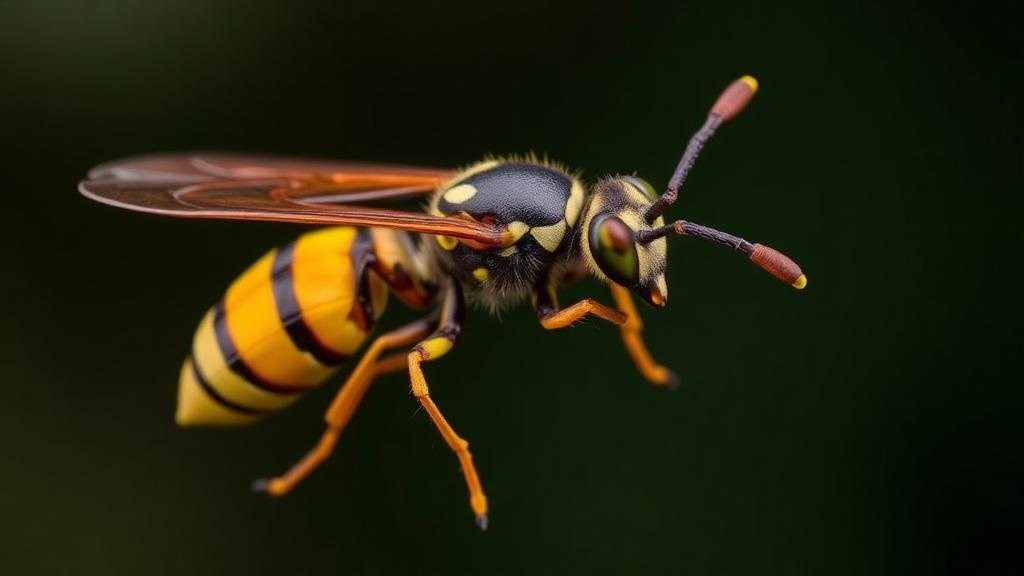
The new species itself can be told apart from all of its Old World relatives by coloration. Its metasoma, the rear part of the body, is bicolorous, black and ivory-white, whereas the corresponding region is reddish-yellow, ochreous-yellow or brown in species such as R. luteus, R. oyeyamensis, R. roxana, R. nigrovenosus, R. nigristigma and R. flavus, and largely uniformly black in R. nigricans and R. nigridorsum. A darkened transverse band across the middle of the forewing is also unique to the new species. The holotype, a female, was collected in August 2018 in the Area de Conservación Guanacaste at Pailas Dos, at around 809 meters elevation, in the ecotone between lowland tropical dry forest and intermediate elevation rain forest, using a Malaise trap operated by the long-running inventory program of Daniel Janzen and Winnie Hallwachs. A paratype female came from a nearby trap at 853 meters in June 2020. Both specimens are deposited in the Canadian National Collection of Insects, Arachnids and Nematodes in Ottawa, and the species belongs to barcode index number BOLD:AEF7075. The species is named in honor of Eduardo Mitio Shimbori in recognition of his contributions to Neotropical Rogadinae systematics, and the paper provides a minimalist COI barcode diagnosis alongside the morphological and color characters, illustrated with detailed photographs of the type material.
Ecologically, the finding fits a known pattern with a new twist. All reliable host records for Rogas point to caterpillars of the moth family Limacodidae, the slug caterpillars, which the wasps parasitize in the manner typical of rogadines: the larva develops inside the host, which ultimately dies in a characteristic mummified state. Published records from Zygaenidae caterpillars, the authors note, resulted from failures to recognize Triraphis as a distinct genus, and records from other host families likely stem from misidentifications of Aleiodes species. Whether R. shimborii attacks Costa Rican limacodids remains to be documented, but the Area de Conservación Guanacaste, with its decades of rearing records linking caterpillars to their parasitoids through barcodes, is precisely the place where such host associations will eventually be pinned down. There is also a historical footnote here: researchers had previously observed that New World species then called Rogas possess a unique venom apparatus and speculated that they might not be closely related to their Old World namesakes, a suspicion that the modern taxonomic cleanup vindicated, even as the present discovery shows that at least one genuine Rogas did reach the Americas after all.
The broader message of the study resonates far beyond a single wasp genus. It shows how DNA barcodes, morphological redescription and phylogenetic analysis can work in concert to correct centuries of accumulated error, and it warns that biogeographical narratives built on old labels may crumble the moment someone runs a specimen through a sequencer. A genus assumed to be confined to one hemisphere turns out to have a foothold in another, discovered not in some remote unexplored wilderness but in one of the most intensively sampled tropical sites on Earth. For the researchers, the practical takeaway is a caution: superficially, R. shimborii closely resembles New World Triraphis species, which frequently show darkened veins and wing membrane in the middle of the forewing, so future studies of Triraphis must proceed carefully with the new knowledge that both genera occur in the Americas. For everyone else, it is a compelling piece of evidence that the age of discovery is not over; it has simply moved into the barcode lab, where a few centimeters of Costa Rican rainforest can still rewrite the map of life.
Subject of Research: Discovery of the first New World species of the braconid wasp genus Rogas through DNA barcoding and morphological analysis
Article Title: Discovery of the Old World genus Rogas Nees ( Hymenoptera , Braconidae , Rogadinae ) in the New World by DNA barcoding
Article References: Quicke, D. L. J., Sharkey, M. J., Janzen, D. H., Hallwachs, W., & Butcher, B. A. (2025). Discovery of the Old World genus Rogas Nees (Hymenoptera, Braconidae, Rogadinae) in the New World by DNA barcoding. Deutsche Entomologische Zeitschrift, 72(1), 1-7. https://doi.org/10.3897/dez.72.142960
Image Credits: AI Generated
Keywords: Rogas, Braconidae, DNA barcoding, parasitoid wasps, Costa Rica, taxonomy, COI barcode, Rogadinae, Triraphis, phylogenetics, new species, biogeography
News Source: Gavin Prescott. (October 18, 2026). DNA Barcodes Reveal a Wasp Genus Long Thought Exclusively Old World Living in Costa Rica. Scienmag.