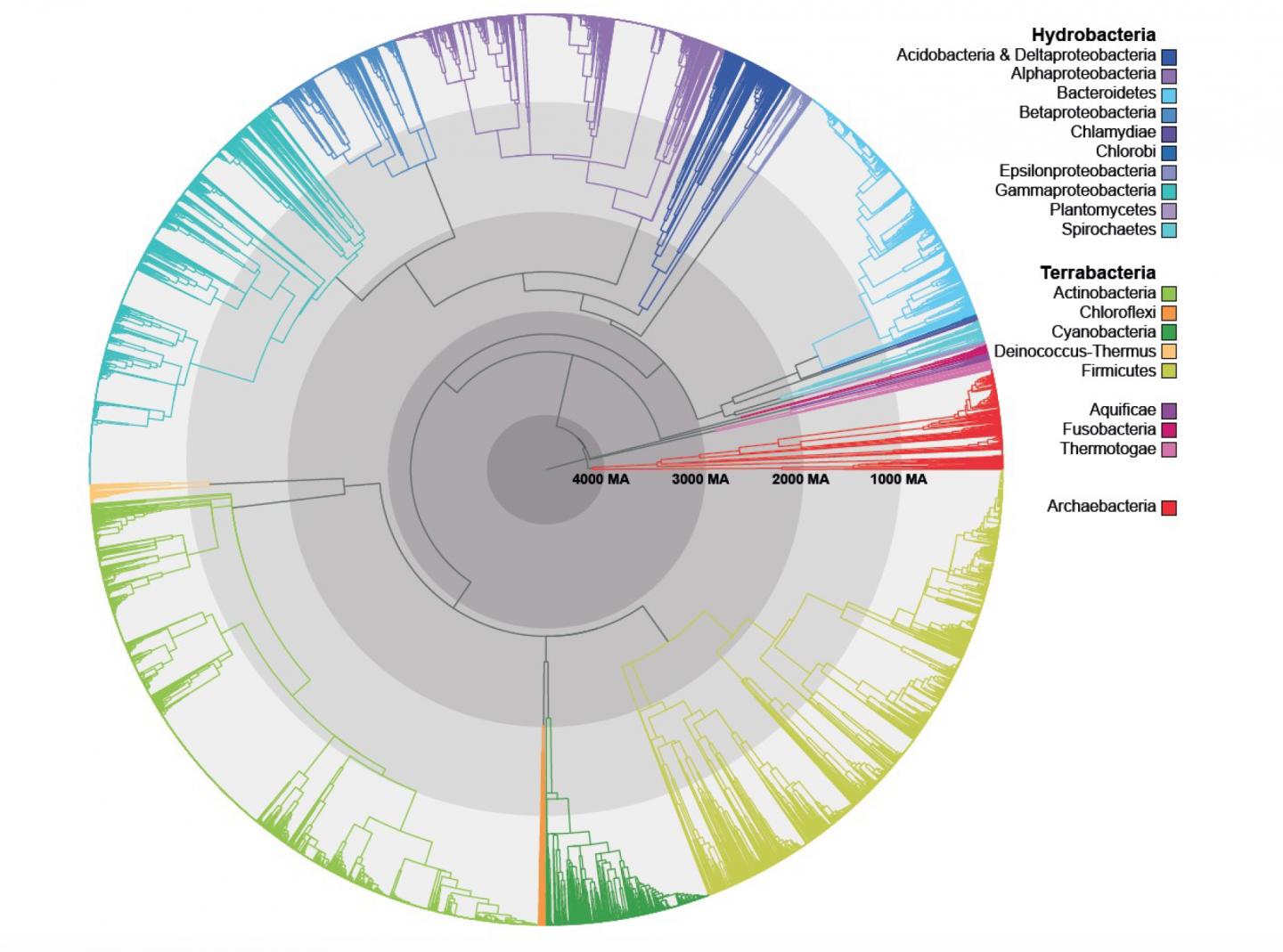
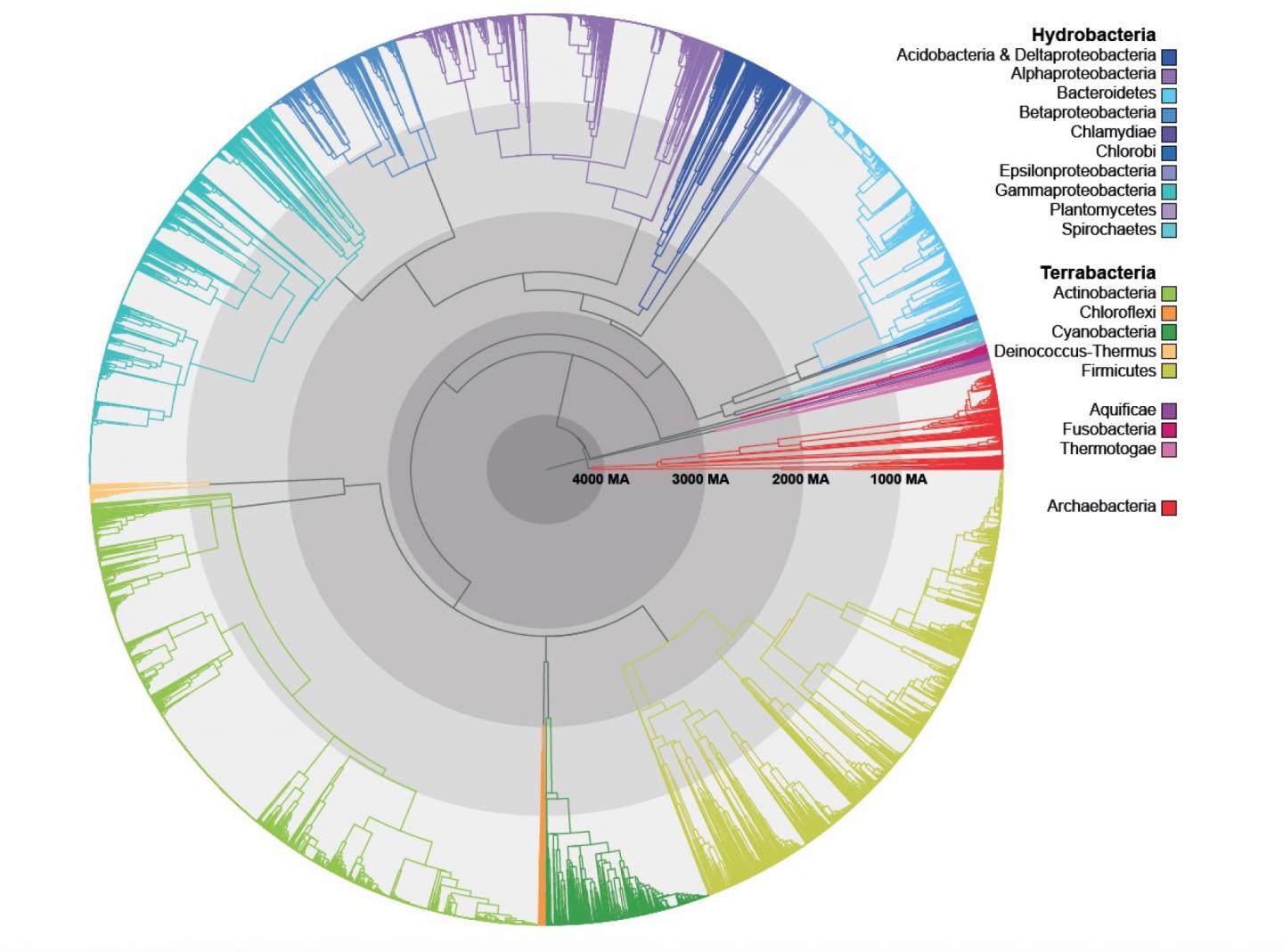
Credit: Temple University
Bacteria were the original masters of their domain, having the Earth to themselves for the majority of their existence, filling every environmental niche, nook and cranny, from mountain peaks to the thermal vents at the ocean's floor.
Now, researchers at Temple and Oakland universities have completed a new tree of prokaryotic life calibrated to time, assembled from 11,784 species of bacteria. The new tree explores grand patterns of evolutionary change that, surprisingly, has revealed remarkable similarities with that of eukaryotes, including animals, plants, and fungi.
With widespread rapid and low-cost sequencing available, the branches in the tree of life have grown ever more detailed and scientists can more readily uncover macroevolutionary forces at work. Relying on data from the small subunit ribosomal RNA of bacteria, researchers at Temple University's Center for Biodiversity, including Laura H. Carnell Professor and director S. Blair Hedges and Postdoctoral Fellow Julie Marin, together with colleagues from Oakland University, Assistant Professor Fabia Battistuzzi and graduate student Anais Brown, produced a new timetree of prokaryotic life.
"We have produced a timetree of most described prokaryote species that has revealed a constant diversification rate, remarkably similar in that respect to eukaryotes and probably resulting from the same mechanism, the random nature of lineage survival over millions of years," said Hedges.
The findings, which appear in the advanced online edition of Molecular Biology and Evolution, build on a 2015 eukaryotic timetree study led by Hedges, which revealed that eukaryotic life has been expanding at a constant rate — not slowing down. "Our results were contrary to the popular alternative model that predicts a slowing down of diversification as niches fill up with species," Hedges said.
Instead, the constant rate of diversification found in that 2015 study indicated that eukaryotic ecological niches are not being filled up and saturated. Those previous findings also underscored the importance of random genetic events and geographic isolation in speciation — the biological process by which new species arise. The researchers in that study found that it took about 2 million years on average for a new eukaryotic species to emerge onto the scene.
Yet, in the new prokaryotic study, the rate of diversification was found to be 2.1 times slower than in eukaryotes. "This is probably the result of the periodic selection, which provides genetic cohesion of lineages, slowing their genetic divergence," said Marin. "The overall similarity in these important aspects of the evolution of prokaryotes and eukaryotes supports the idea that species of prokaryotes are real evolutionary units much like eukaryotic species."
The evolutionary implications of both studies are profound, indicating that the diversification of life on Earth as a whole is unbound by constraints. Rather, diversity results from the random splitting of lineages and is neither limited by existing diversity (filled niches) nor responsive, in any major way, to environmental changes.
###
The new prokaryotic data will be added the Timetree of Life (TTOL) initiative, which includes internet tools for researchers and the general public to explore the tree of life and its relationship with historical patterns in other fields such as geology, climatology, and astronomy.
Media Contact
Joseph Caspermeyer
[email protected]
480-258-8972
@OfficialSMBE
http://mbe.oxfordjournals.org/
############
Story Source: Materials provided by Scienmag