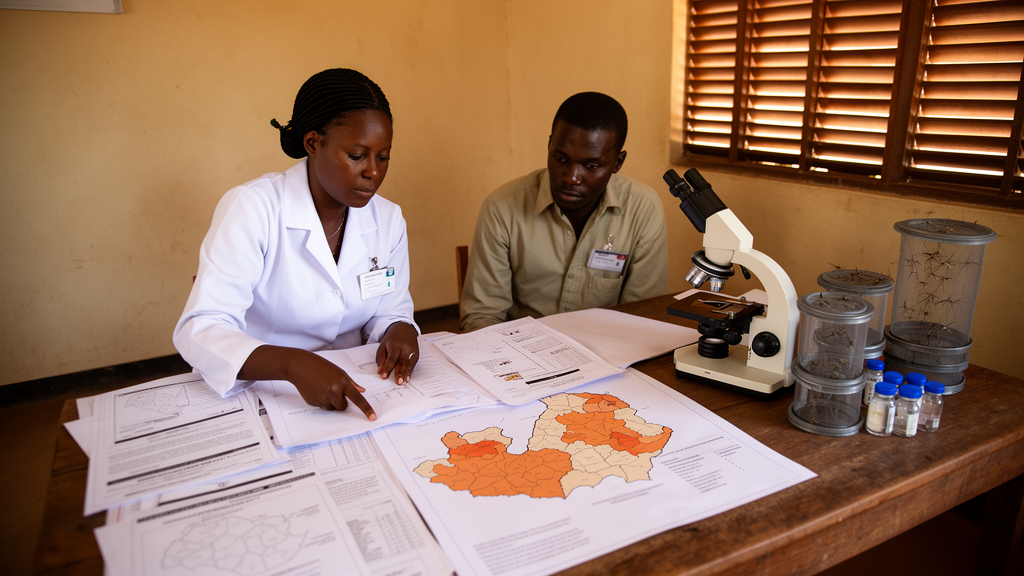
An implementation case study in mainland Tanzania has brought together fragmented malaria data into a single district-level profile, linking malaria case incidence with the coverage of vector control interventions across the country’s councils. The analysis, drawing on monthly council-level records from 2018 to 2022, aims to give programme managers actionable evidence for allocating resources where they matter most.
The researchers extracted monthly malaria incidence data for each council from DHIS2, Tanzania’s health information system. To estimate access to insecticide-treated nets (ITNs), they applied a stock-and-flow model that tracked net distribution against population, assuming a Tanzania-specific median net lifespan of 2.15 years. Indoor residual spraying (IRS) implementation records and entomological monitoring reports from 2011 to 2022 were also reviewed, and rainfall data were summarized as overlapping monthly time series to contextualize transmission patterns.
According to the annual vector control reports for 2021 and 2022, mean modeled council-level population access to ITNs was 63.9 percent in 2021 and 65.2 percent in 2022. These figures suggest that, on average, roughly two-thirds of the population had access to a treated net, though the national average concealed wide variation between councils.
Across the 184 councils analyzed, 17.4 percent had low ITN access, defined as below 50 percent, while 59.2 percent fell into the moderate category of 51 to 80 percent. Only 23.4 percent of councils achieved sufficient access above 80 percent, the threshold associated with the strongest protection.
The relationship between access and burden was consistent: councils with ITN access above 80 percent reported lower malaria incidence rates, whereas councils below 50 percent access were generally associated with higher malaria burden. This association underscores the importance of accurate quantification of net needs and timely distribution, the authors note.
The study also highlights the limits of bed nets alone. In areas where Anopheles arabiensis predominates, complementary outdoor vector control interventions may be needed to address residual transmission that indoor-based tools cannot reach.
A central problem the case study documents is data fragmentation across malaria burden figures, intervention coverage estimates, and entomological monitoring results, making it difficult for district managers to see the full picture. By integrating these sources into a unified, granular profile, the analysis complements existing stratification approaches used in national malaria strategy.
The authors argue that district-level vector control profiling can enhance programme effectiveness by supporting evidence-based resource allocation and adaptive intervention strategies at the council level. As Tanzania pursues malaria elimination, such granular profiles could help target nets, spraying campaigns, and other interventions to the councils where the burden remains highest.
As an implementation case study, the analysis is descriptive and observational, and the observed association between net access and incidence does not by itself establish causal effects. Nevertheless, it demonstrates a practical pathway for turning routine health data into decisions that could accelerate elimination efforts in mainland Tanzania.
Subject of Research: Integration of district-level malaria burden and vector control data in mainland Tanzania
Article Title: Strategies and approaches to vector control effectiveness toward the elimination of malaria in mainland Tanzania: An implementation case study analysis
Article References: Gitanya, M. P., Worges, M., Koenker, H., Kiware, S., Lazaro, S., Kitau, J., Kisinza, W., Serbantez, N., Kamala, B., Dismas, C., & Matowo, J. (2026). Strategies and approaches to vector control effectiveness toward the elimination of malaria in mainland Tanzania: An implementation case study analysis. PLOS Global Public Health, 6(10), e0005574. https://doi.org/10.1371/journal.pgph.0005574
Image Credits: AI Generated
DOI: 10.1371/journal.pgph.0005574
Keywords: malaria, vector control, Tanzania, insecticide-treated nets, DHIS2, indoor residual spraying, Anopheles arabiensis, malaria incidence, data integration, malaria elimination, district health data, Strategies
News Source: Courtney Benton. (October 24, 2026). District-Level Data Unite Malaria Burden and Vector Control in Tanzania. Scienmag.