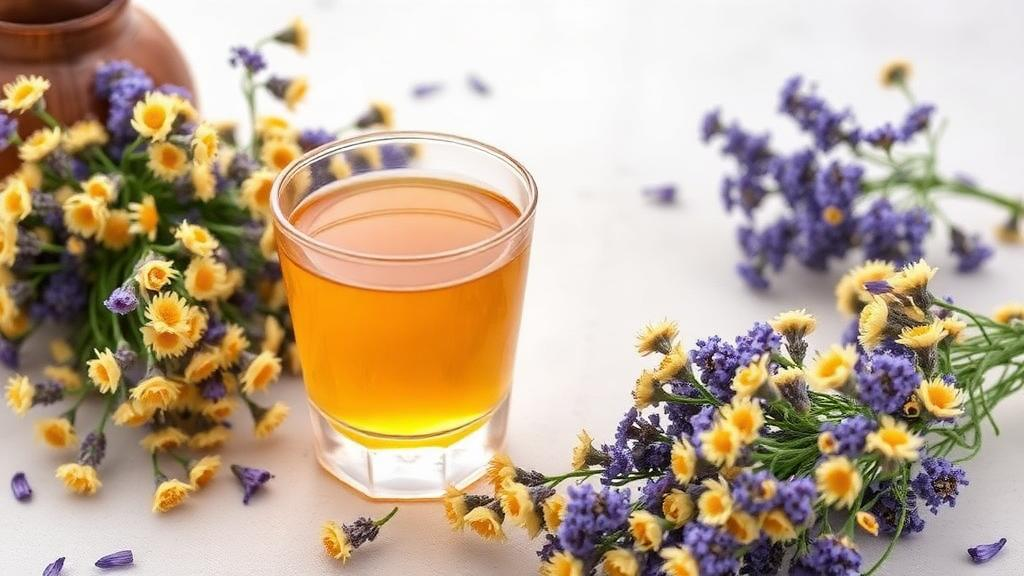
Every year, producers of essential oil strip tons of fragrant plant matter through steam distillation and then throw away what is left. That leftover biomass has long been treated as little more than a disposal problem, a soggy heap of spent herb with no obvious commercial future. A new study published in Food Chemistry: X challenges that assumption for one of the Mediterranean’s most aromatic crops, showing that the solid residue left behind after distilling Helichrysum italicum — the golden-flowered herb known as immortelle — still harbors a rich cargo of water-extractable phenolic compounds that can be brewed into a drinkable, tolerable functional beverage.
The research team, led by scientists at the University of Primorska in Slovenia together with collaborators at the Institute for Medicinal Plants Research Dr Josif Pančić in Serbia, set out with a simple but commercially significant question: does the plant material that survives essential oil extraction still contain anything worth extracting? Immortelle is cultivated across Italy, Spain, Portugal, Corsica, and the coastal stretches of Slovenia and Croatia primarily for its essential oil, which accumulates in glandular trichomes on the flowering shoots. The oil yield is remarkably low, typically between 0.5 and 0.8 percent of the processed biomass, which means that for every kilogram of precious oil, producers generate well over a hundred kilograms of dry leftover plant matter.
Chemically, this outcome makes sense. Steam distillation is designed to pull out volatile, hydrophobic molecules such as alpha-pinene, geranyl acetate, and the ester 2-phenylethyl tiglate, which give immortelle oil its characteristic scent and its documented skin-related bioactivities. Those compounds dissolve poorly in water, so they should largely remain locked in the plant matrix or escape with the oil itself. But the non-volatile phenolic fraction — hydroxybenzoic acids, hydroxycinnamic acids, and flavonoid derivatives — follows different solubility rules, and because the plant material is not finely ground before distillation, a substantial share of these intracellular compounds can survive the steam treatment intact.
To test that hypothesis, the researchers prepared hot-water infusions from immortelle biomass both before and after distillation, steeping one gram of dried material in 200 milliliters of boiling water for ten minutes, exactly the way a consumer would brew a tea bag. They then quantified fifteen phenolic compounds by high-performance liquid chromatography with diode-array detection and measured total phenolic content with the Folin-Ciocalteu assay. The results were striking: infusions from distilled biomass contained the major phenolic constituents at concentrations statistically indistinguishable from those extracted from undistilled material. Total phenolic content actually came out slightly higher in the distilled sample, at 28.89 milligrams of gallic acid equivalents per gram versus 26.99 for the undistilled herb, and the radical-scavenging capacity measured by the DPPH assay followed the same pattern.
The dominant compounds in both infusions were a rosmarinic acid derivative at roughly 50 micrograms per gram, vanillic acid at about 27 micrograms per gram, and chlorogenic acid at around 15 micrograms per gram. These are molecules with meaningful nutritional pedigrees. Rosmarinic acid has shown a favorable safety profile in human trials at oral doses of 500 milligrams, with reported benefits for cognitive performance and sleep quality. Chlorogenic acid has been implicated in fat oxidation and body-composition regulation in cell models and clinical studies of enriched coffee, while caffeic and p-coumaric acids have been linked to improved vascular endothelial function in adlay tea research.
Knowing that a residue is chemically rich is one thing; proving that people will happily drink it is another. Phenolic compounds are notorious for imparting bitterness, and earlier work by the same group found that plain immortelle infusions scored only 3.14 out of 6 for taste acceptability. To address this, the team blended the distilled biomass with Vitalplant, a commercially available botanical mixture containing buckthorn bark, peppermint leaves, caraway fruit, and parsley fruit, a formulation chosen both for its aromatic masking potential and for prior preclinical evidence of metabolic benefits. The blends were analyzed alongside the individual components, and the mixtures containing immortelle roughly doubled the phenolic content and antioxidant activity compared with Vitalplant alone, confirming the residue as the dominant contributor of bioactivity.
Interestingly, distillation left a subtle fingerprint on the detailed phenolic profile of the blends. The mixture with undistilled immortelle contained more chlorogenic acid, caffeic acid, and one luteolin derivative, while the mixture with distilled biomass delivered more rosmarinic acid, its derivative, and a second luteolin derivative. The authors caution that these shifts may reflect changes in solvent accessibility within the plant matrix after oil removal, or interactions among the blended herbs, rather than simple loss during distillation. Either way, the total phenolic payload was essentially preserved, which is the number that matters most for a functional ingredient.
The team then took the concept into a human trial. Thirty-two adults aged 40 to 60, all carrying at least two traits of metabolic syndrome, drank 200 milliliters of one of three beverages every morning for one week in a randomized, partially crossover design: Vitalplant plus distilled immortelle, Vitalplant plus undistilled immortelle, or Vitalplant alone. Sensory scoring revealed a genuine advantage for the distilled material. The blend with distilled immortelle earned an overall impression score of 4.15 and a taste-liking score of 3.70, both better than the undistilled blend’s 3.27 and 2.95, and its overall impression was not significantly different from Vitalplant alone, which scored around 5. The researchers speculate that removing volatile constituents during distillation may strip out compounds that amplify bitterness perception, though they note this explanation remains tentative because the volatiles were not directly measured.
Physiologically, the one-week intervention was deliberately short, and most measures stayed flat. No significant between-beverage differences emerged for body composition, blood lipids, glucose, or inflammatory markers, and none of the within-group changes in gastrointestinal symptoms or appetite survived correction for multiple comparisons. One notable exception was blood pressure: the group drinking the distilled-immortelle blend showed a significant reduction in both systolic pressure, down 4.05 millimeters of mercury, and diastolic pressure, down 3.38 millimeters of mercury, changes that remained significant after adjustment. Because there was no significant difference between the beverages on this endpoint, the authors urge caution, noting that regression to the mean and measurement variability cannot be excluded. Crucially, no adverse effects appeared in any group, supporting the short-term safety of beverages made from post-distillation biomass.
The broader implications reach well beyond immortelle. From an ecological standpoint, a preliminary study has suggested that dumping distillation residues on soil can depress plant-available nitrogen, possibly because residual phenolics inhibit nitrification and alter microbial communities, so extracting those compounds before land application could ease that agronomic risk while capturing commercial value. The authors also argue that the same valorization logic should apply to other dual-purpose aromatic crops such as sage, fennel, rosemary, and lavender, plants that are distilled for oil yet also have traditions as foods and herbal remedies. Longer intervention periods, comprehensive chemical profiling including mass-spectrometric identification of the unidentified peaks, and formal sensory optimization of bitterness and astringency remain the next steps. But the core proof of concept now stands: the fragrant waste pile outside the distillery is not waste at all, and with a simple pot of boiling water it can be converted into a phenolic-rich infusion that people can actually drink.
Subject of Research: Valorization of post-distillation Helichrysum italicum biomass as a phenolic-rich functional beverage ingredient
Article Title: Valorization of post-distillation Helichrysum italicum biomass for functional beverage infusions
Article References: Kenig, S., Arbeiter, A. B., Stupar, A., Mišan, A., Zugic, A., Nešić, I., Tadić, V., Bandelj, D., Pražnikar, Z. J., & Petelin, A. (2026). Valorization of post-distillation Helichrysum italicum biomass for functional beverage infusions. Food Chemistry: X, Article 104604. https://doi.org/10.1016/j.fochx.2026.104604
Image Credits: AI Generated
DOI: 10.1016/j.fochx.2026.104604
Keywords: Helichrysum italicum, immortelle, essential oil distillation residue, phenolic compounds, functional beverage, food waste valorization, circular bioeconomy, antioxidant activity, rosmarinic acid, chlorogenic acid, sensory evaluation, clinical trial
News Source: Bethany Barker. (October 11, 2026). Distillation Waste From Immortelle Plants Could Become Antioxidant-Rich Functional Teas. Scienmag.