• HOME
  • NEWS
  • EXPLORE
    • CAREER
      • Companies
      • Jobs
    • EVENTS
    • iGEM
      • News
      • Team
    • PHOTOS
    • VIDEO
    • WIKI
  • BLOG
  • COMMUNITY
    • FACEBOOK
    • INSTAGRAM
    • TWITTER
Monday, May 11, 2026
BIOENGINEER.ORG
No Result
View All Result
  • Login
  • HOME
  • NEWS
  • EXPLORE
    • CAREER
      • Companies
      • Jobs
        • Lecturer
        • PhD Studentship
        • Postdoc
        • Research Assistant
    • EVENTS
    • iGEM
      • News
      • Team
    • PHOTOS
    • VIDEO
    • WIKI
  • BLOG
  • COMMUNITY
    • FACEBOOK
    • INSTAGRAM
    • TWITTER
  • HOME
  • NEWS
  • EXPLORE
    • CAREER
      • Companies
      • Jobs
        • Lecturer
        • PhD Studentship
        • Postdoc
        • Research Assistant
    • EVENTS
    • iGEM
      • News
      • Team
    • PHOTOS
    • VIDEO
    • WIKI
  • BLOG
  • COMMUNITY
    • FACEBOOK
    • INSTAGRAM
    • TWITTER
No Result
View All Result
Bioengineer.org
No Result
View All Result
Home NEWS Science News Chemistry

Discovery will allow more sophisticated work at nanoscale

Bioengineer by Bioengineer
July 28, 2020
in Chemistry
Reading Time: 2 mins read
0
IMAGE
Share on FacebookShare on TwitterShare on LinkedinShare on RedditShare on Telegram

New method of fluid gating has implications for drug delivery, power generation and other uses
IMAGE

Credit: ACS Applied Nano Materials

The movement of fluids through small capillaries and channels is crucial for processes ranging from blood flow through the brain to power generation and electronic cooling systems, but that movement often stops when the channel is smaller than 10 nanometers.

Researchers led by a University of Houston engineer have reported a new understanding of the process and why some fluids stagnate in these tiny channels, as well as a new way to stimulate the fluid flow by using a small increase in temperature or voltage to promote mass and ion transport.

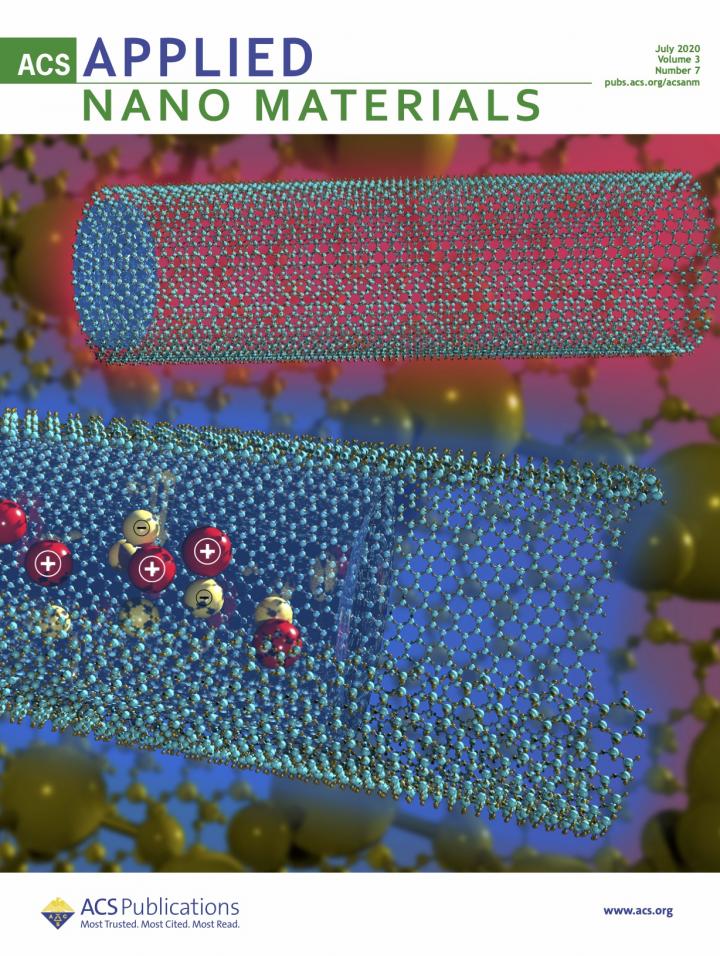
The work, published in ACS Applied Nano Materials, explores the movement of fluids with lower surface tension, which allows the bonds between molecules to break apart when forced into narrow channels, stopping the process of fluid transport, known as capillary wicking. The research was also featured on the journal’s cover.

Hadi Ghasemi, Cullen Associate Professor of Mechanical Engineering at UH and corresponding author for the paper, said this capillary force drives liquid flow in small channels and is the critical mechanism for mass transport in nature and technology – that is, in situations ranging from blood flow in the human brain to the movement of water and nutrients from soil to plant roots and leaves, as well as in industrial processes.

But differences in the surface tension of some fluids causes the wicking process – and therefore, the movement of the fluid – to stop when those channels are smaller than 10 nanometers, he said. The researchers reported that it is possible to prompt continued flow by manipulating the surface tension through small stimuli, such as raising the temperature or using a small amount of voltage.

Ghasemi said raising the temperature even slightly can activate movement by changing surface tension, which they dubbed “nanogates.” Depending on the liquid, raising the temperature between 2 degrees Centigrade and 3 degrees C is enough to mobilize the fluid.

“The surface tension can be changed through different variables,” he said. “The simplest one is temperature. If you change temperature of the fluid, you can activate this fluid flow again.” The process can be fine-tuned to move the fluid, or just specific ions within it, offering promise for more sophisticated work at nanoscale.

“The surface tension nanogates promise platforms to govern nanoscale functionality of a wide spectrum of systems, and applications can be foreseen in drug delivery, energy conversion, power generation, seawater desalination, and ionic separation,” the researchers wrote.

###

In addition to Ghasemi and first author Masoumeh Nazari, researchers involved with the project include Sina Nazifi, Zixu Huang, Tian Tong and Jiming Bao, all with the University of Houston, and Kausik Das and Habilou Ouro-Koura, both with the University of Maryland Eastern Shore.

Funding for the project came from the Air Force Office of Scientific Research, the National Science Foundation and the U.S. Department of Education.

Media Contact
Jeannie Kever
[email protected]

Original Source

https://uh.edu/news-events/stories/july-2020/07282020ghasemi-ion-transport.php

Tags: Chemistry/Physics/Materials SciencesMaterialsMechanical EngineeringNanotechnology/Micromachines
Share12Tweet8Share2ShareShareShare2

Related Posts

Enhancing Surgical Safety with Laser-Induced Acoustic Imaging #ASA190 — Chemistry

Enhancing Surgical Safety with Laser-Induced Acoustic Imaging #ASA190

May 11, 2026
Miniature Sensor Uses Light to Detect Touch — Chemistry

Miniature Sensor Uses Light to Detect Touch

May 8, 2026

Iron Minerals Determine Whether Dissolved Organic Matter Fuels Microbes or Becomes Long-Term Carbon Storage

May 8, 2026

Kate Evans Appointed Associate Lab Director for Biological and Environmental Systems Science at ORNL

May 8, 2026
Please login to join discussion

POPULAR NEWS

  • Research Indicates Potential Connection Between Prenatal Medication Exposure and Elevated Autism Risk

    841 shares
    Share 336 Tweet 210
  • New Study Reveals Plants Can Detect the Sound of Rain

    728 shares
    Share 290 Tweet 182
  • Salmonella Haem Blocks Macrophages, Boosts Infection

    62 shares
    Share 25 Tweet 16
  • Breastmilk Balances E. coli and Beneficial Bacteria in Infant Gut Microbiomes

    57 shares
    Share 23 Tweet 14

About

We bring you the latest biotechnology news from best research centers and universities around the world. Check our website.

Follow us

Recent News

Author Correction: New Astrocyte-Specific Brain Therapies Sought

NYU Quantum Institute and IBM Launch Postdoctoral Research Program in Quantum Computing

Decarbonizing Desert Greenhouses with Direct Air Capture

Subscribe to Blog via Email

Enter your email address to subscribe to this blog and receive notifications of new posts by email.

Join 82 other subscribers
  • Contact Us

Bioengineer.org © Copyright 2023 All Rights Reserved.

Welcome Back!

Login to your account below

Forgotten Password?

Retrieve your password

Please enter your username or email address to reset your password.

Log In
No Result
View All Result
  • Homepages
    • Home Page 1
    • Home Page 2
  • News
  • National
  • Business
  • Health
  • Lifestyle
  • Science

Bioengineer.org © Copyright 2023 All Rights Reserved.