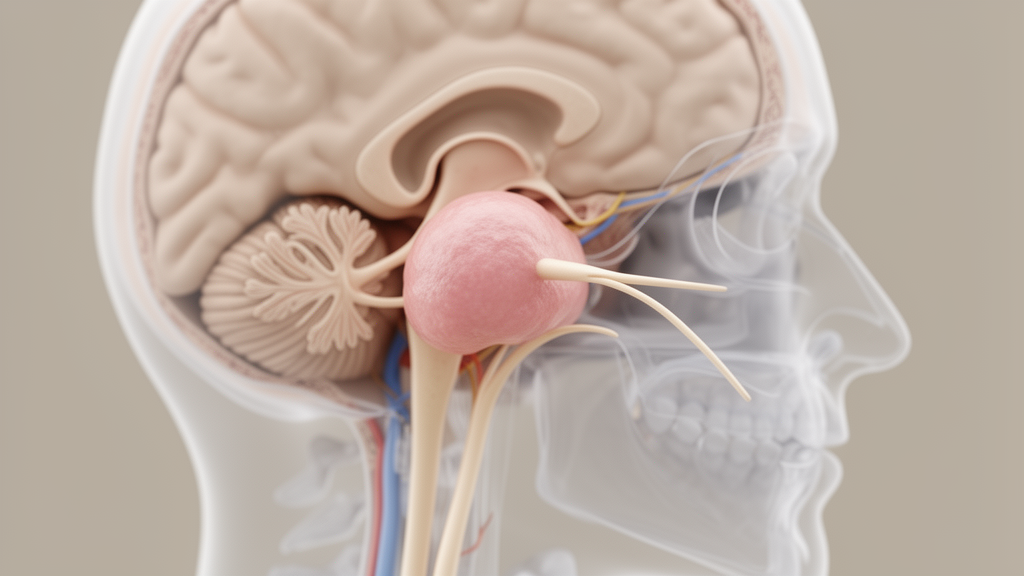
Surgeons removing vestibular schwannomas—benign tumors on the balance nerve that can compress the facial nerve—have long relied on tumor size to predict how the nerve will fare after operations. The research, published in Acta Neurochirurgica, examined anteromedial extension, a simple magnetic resonance imaging-derived measure of the direction in which tumor burden is distributed, and tracked its relationship with early facial nerve outcomes in 129 adults who underwent retrosigmoid resection of unilateral vestibular schwannomas between 2019 and 2023.
The rationale behind the measure is straightforward. Tumor size is known to be associated with early facial nerve status after vestibular schwannoma surgery, but the standard descriptors—maximal diameter, three-dimensional volume, and Koos grade—provide limited information about the direction in which the tumor burden is distributed. Anteromedial extension was proposed as a simple directional description that is not represented by Koos stage alone. The authors measured it preoperatively alongside diameter, volume, and Koos grade, and then compared these morphometric measures against two outcomes: anatomical facial nerve transection during surgery, and postoperative House-Brackmann facial function grades at discharge and at one year. Functional analyses were restricted to the 120 patients in whom nerve continuity was preserved.
The headline numbers underline how frequently early facial palsy follows these operations even in a contemporary series. Nine patients, or 7.0 percent of the cohort, sustained anatomical transection of the facial nerve. These early outcomes are the study’s focus; the paper also captured status at one year, though the strongest reported associations concern the immediate postoperative period.
Statistically, anteromedial extension turned out to share substantial information with conventional size. It correlated strongly with maximal diameter and with three-dimensional volume, with Spearman coefficients of 0.810 and 0.827 respectively. That overlap showed in the modeling. In parsimonious two-predictor models, anteromedial extension remained associated with early postoperative House-Brackmann status when it was paired with Koos grade, but the association disappeared when it was paired with continuous diameter or volume. In other words, once the full metric of tumor size was accounted for, the directional measure added little independent signal—a finding the authors present candidly rather than overselling.
Where the directional measure did show promise was within a specific subgroup: patients with Koos grade IV tumors, the largest category, whose nerve continuity was preserved. This exploratory analysis included 48 patients, of whom 14 had House-Brackmann grade IV or worse at discharge. Within this group, greater anteromedial extension was associated with severe early postoperative facial nerve dysfunction, with an odds ratio of 1.22 per millimeter and a 95 percent confidence interval of 1.05 to 1.42. The authors derived a cut point of 8 millimeters using the Youden criterion calculated in the same cohort. That threshold separated observed rates of grade IV or worse dysfunction of 5 out of 33 patients, or 15.2 percent, below the cut point, versus 9 out of 15 patients, or 60.0 percent, above it. Sensitivity was 50.0 percent and specificity 94.0 percent—meaning the threshold missed half of the severe outcomes even in the data used to define it.
Discrimination analysis added a further note of caution. For predicting House-Brackmann grade IV or worse, three-dimensional volume achieved a higher area under the curve than anteromedial extension, 0.824 versus 0.768. The authors conclude that anteromedial extension may provide a simple directional description not captured by Koos stage alone, and that in Koos IV tumors greater extension was associated with severe early dysfunction, but they are explicit that the internally derived 8-millimeter cut point is hypothesis-generating and requires independent validation before any clinical use. The threshold was treated as exploratory precisely because it was derived and tested in the same 129-patient cohort, a design that guarantees optimistic performance.
For readers weighing the practical significance, the study’s scope and limitations deserve emphasis. No claim is made that measuring anteromedial extension improves surgery or changes outcomes; the finding is associative, describing how a directional imaging feature tracks with early nerve function in this particular population.
What the study does offer is a candidate concept for refinement. The Koos IV subgroup analysis, with its 1.22-per-millimeter odds ratio, is the seed of that idea. But with a threshold that misses half of severe outcomes and a discrimination advantage held by simple volume, the authors’ own framing is the right one: an internally derived, hypothesis-generating observation that now needs independent cohorts to confirm or refute it before it earns a place in surgical planning conversations.
Subject of Research: The relationship between anteromedial tumor extension on MRI and early facial nerve outcomes after retrosigmoid vestibular schwannoma resection
Article Title: Anteromedial extension and early facial nerve outcome after retrosigmoid vestibular schwannoma resection: a retrospective cohort study
Article References: Bubeníková, A., Fík, Z., Novák, V., Betka, J., Bradáč, O., & Vlasák, A. (2026). Anteromedial extension and early facial nerve outcome after retrosigmoid vestibular schwannoma resection: a retrospective cohort study. Acta Neurochirurgica. https://doi.org/10.1007/s00701-026-07052-6
Image Credits: AI Generated
DOI: 10.1007/s00701-026-07052-6
Keywords: vestibular schwannoma, facial nerve, retrosigmoid approach, anteromedial extension, Koos grade, House-Brackmann grade, retrospective cohort, MRI, tumor volume, facial nerve transection, neurosurgery, outcome prediction
News Source: Ophelia Keating. (October 28, 2026). Direction of Tumor Growth May Signal Facial Nerve Risk After Vestibular Schwannoma Surgery. Scienmag.