


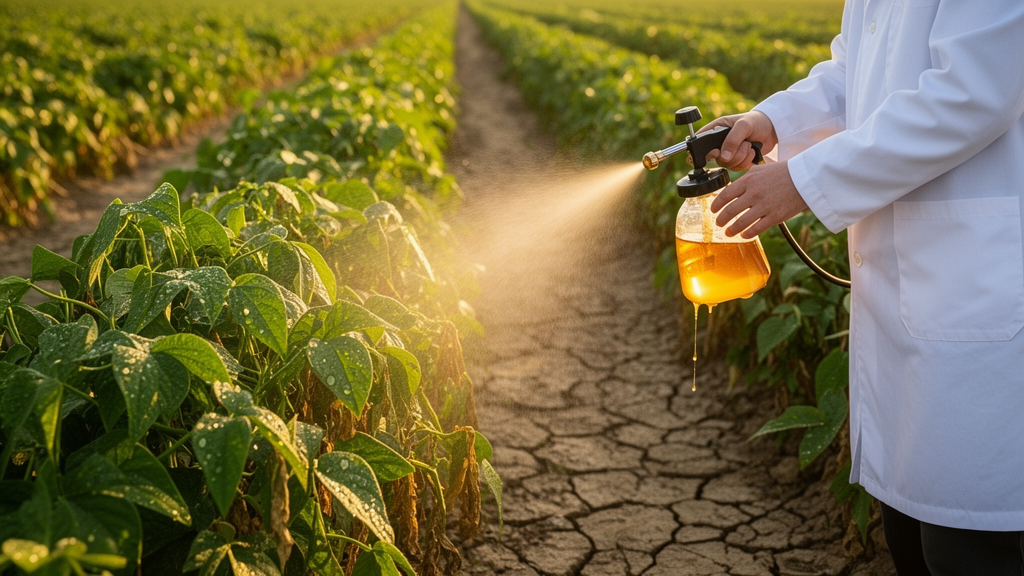
Diluted bee honey, sprayed onto the leaves of common bean plants, emerged as the most effective of several natural biostimulants tested against drought stress in a two-season field study in Egypt. In the trial, a 4 percent dilution of clover honey raised green pod yield by 54 percent under deficit irrigation compared with untreated stressed plants, while also lifting photosynthetic efficiency, leaf water status, antioxidant defenses and nutrient uptake. The findings, published in Botanical Studies, position a food-derived spray as a candidate option for common bean growers facing water-limited conditions.
Common bean, Phaseolus vulgaris, is a staple legume in many developing countries, valued for its protein, dietary fiber, starch and vitamins. Like most crops, it suffers sharply when water runs short. The research team, whose authors include Hussein E. E. Belal, Amr Elkelish, Mohamed M. Zaid and Mostafa M. Rady, set out to test whether two food-derived sprays, diluted lemon fruit juice and diluted bee honey, could buffer the crop against drought. Both materials are rich in bioactive compounds: lemon juice supplies organic acids, vitamin C, phenolics and flavonoids, while honey carries organic acids, polysaccharides, soluble sugars, flavonoids, minerals, proteins, vitamins, fatty acids, amino acids and enzymes, including catalase and glucose oxidase.
The experiment ran over two early summer seasons, 2023 and 2024, on clayey soil at a private farm in the Al-Wasta District of Beni Suef. Seeds of the cultivar Sabaris were sown in late February each year, and the plots were arranged in a split-plot design. The main factor was irrigation: full watering at 100 percent of crop evapotranspiration, or deficit irrigation at 60 percent, delivered as 6,600 or 3,960 cubic meters per hectare respectively. Within each irrigation strip, five spray treatments were randomized across six plots each: distilled water as a control, lemon juice at 3 and 6 percent, and honey at 4 and 8 percent. Sprays were applied in the early morning at three, four and five weeks after sowing, mixed with a small amount of Tween-20 surfactant to help penetration into leaf tissue.
Drought stress significantly reduced the crop's performance. Under deficit irrigation, total chlorophylls, carotenoids, SPAD readings, the chlorophyll fluorescence ratio Fv/Fm and the photosystem II performance index PIABS all fell by 35.2 to 38.5 percent relative to fully watered plants. Leaf relative water content dropped 21.5 percent and membrane stability index 25.5 percent, while electrolyte leakage, malondialdehyde, hydrogen peroxide and superoxide anion more than doubled. Growth and yield traits, including leaf number, leaf area, shoot biomass, pod count and total yield, declined by 28 to 41 percent. Nutrient accumulation also fell, with reductions ranging from 16.7 percent for selenium to 48.3 percent for phosphorus.
Against that backdrop, both biostimulants improved nearly every measured parameter under both irrigation regimes, but the honey sprays consistently outperformed the lemon sprays. The 4 percent honey treatment proved the standout and the most economical choice, since it showed no statistically significant difference from the 8 percent concentration. Under drought, it raised total chlorophylls by 58.7 percent, carotenoids by 62.5 percent, SPAD values by 41.5 percent, Fv/Fm by 25.5 percent and PIABS by 60.4 percent compared with untreated stressed plants. Leaf integrity recovered as well: relative water content climbed 30.8 percent and membrane stability index 40.7 percent.
The spray also reduced the oxidative stress markers that drought elevates in leaf tissue. Behind these shifts lay a strengthened antioxidant system. The 4 percent honey spray increased ascorbate by 37.2 percent, reduced glutathione by 35.4 percent, alpha-tocopherol by 28.4 percent, total phenols by 22.4 percent, total flavonoids by 32.7 percent and total antioxidant activity by 31.3 percent. Enzymes followed suit: superoxide dismutase rose 18.6 percent, catalase 41.5 percent, ascorbate peroxidase 21.1 percent and glutathione reductase 19.5 percent, while total protein content increased 50.8 percent.
Osmoprotectants, the small molecules plants accumulate to keep cells turgid under water stress, also responded. Under drought, the best treatment lifted total soluble sugars by 27.6 percent, glycine betaine by 23.0 percent and proline by 36.0 percent. Nutrient status improved in parallel, with phosphorus up 93.5 percent, zinc 86.3 percent, potassium 49.8 percent, calcium 48.2 percent and iron 35.3 percent under deficit irrigation. The authors attribute these gains to the bioactive constituents of the biostimulants penetrating leaf cells after foliar application, helping rebalance osmotic pressure, scavenge reactive oxygen species and support the enzymatic machinery that detoxifies them.
The yield and quality story was equally striking. Under drought, the 4 percent honey spray increased leaf area by 54.9 percent, shoot fresh weight by 73.6 percent and green pod yield by 54.0 percent, while pod protein content rose 41.8 percent. At the same time, fiber content fell 27.5 percent and nitrate content 53.5 percent, shifts the researchers interpret as improved pod nutritional quality. Drought alone had pushed fiber up 37.3 percent, vitamin C up 41.9 percent and nitrate up 96.0 percent in untreated plants, and the biostimulant reduced fiber and nitrate contents relative to those stressed plants.
The authors frame the work as filling a gap in biostimulant research, noting that most prior studies have focused on plant-based extracts or synthetic compounds rather than food-derived materials. They compare their results with earlier findings that moringa leaf extract improved drought resilience in common bean and that seaweed-derived biostimulants enhanced nutrient uptake in legumes, noting that honey and lemon juice provide a broader spectrum of osmoprotectants and antioxidants. They also acknowledge limitations: the composition of natural raw materials varies with location, season, plant organ and growth stage, and the response of the target crop may differ across environments. Consistent product performance, they suggest, would require sourcing raw materials under regulated conditions, and omics-based approaches could help clarify how the bioactive compounds act.
The researchers recommend the 4 percent honey dilution as a cost-effective option for sustaining common bean production and quality under 60 percent crop evapotranspiration, and they call for further work on soil microbial communities, nutrient cycling under repeated field use, and the economic feasibility of scaling the approach.
Subject of Research: Foliar sprays of diluted bee honey and lemon juice mitigating drought stress in common bean plants
Article Title: Novel biostimulants-mediate tolerance to drought stress in Phaseolus vulgaris plants by optimizing osmoprotectants and antioxidant defense systems
Article References: Belal, H. E. E., Elkelish, A., Zaid, M. M., Alhudhaibi, A., El-Roby, M. S. A., Abd Elmohsen, Y. H., Abeed, A. H. A., Ukozehasi, C., Rady, M. M., & Sayed, A. A. S. (2025). Novel biostimulants-mediate tolerance to drought stress in Phaseolus vulgaris plants by optimizing osmoprotectants and antioxidant defense systems. Botanical Studies, 66(1), Article 36. https://doi.org/10.1186/s40529-025-00483-x
Image Credits: AI Generated
DOI: 10.1186/s40529-025-00483-x
Keywords: Phaseolus vulgaris, drought stress, biostimulants, bee honey, lemon juice, foliar spray, antioxidant enzymes, osmoprotectants, green pod yield, deficit irrigation, oxidative stress, common bean
News Source: Alan Morgan. (October 30, 2026). Diluted Bee Honey Spray Boosts Drought-Stressed Bean Yields in Field Trial. Scienmag.



