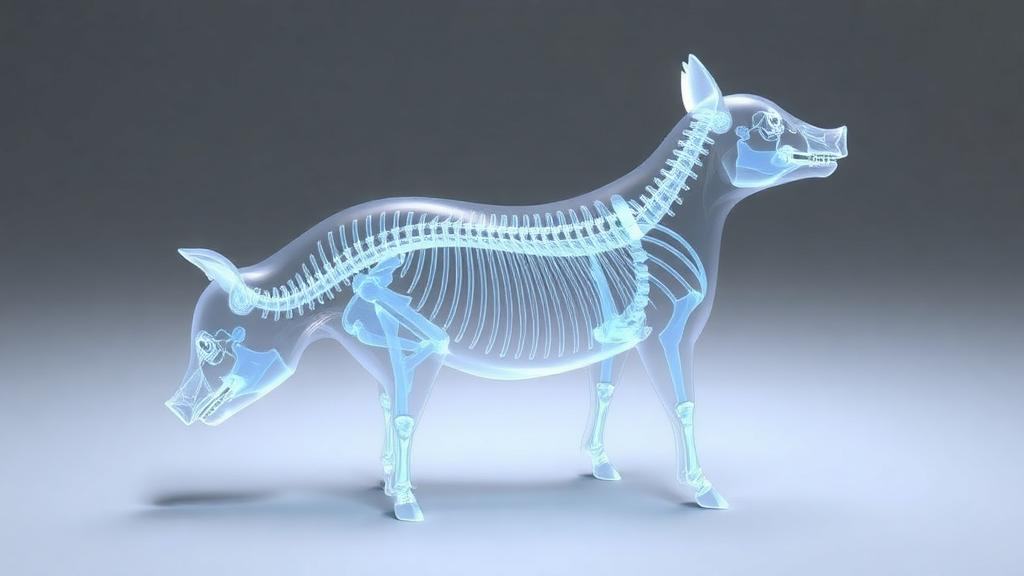
Scoliosis has long been one of pediatric orthopedics’ most stubborn puzzles, but a team of biomedical engineers and surgeons has now built something remarkable: a computer model of a growing pig spine that can predict, week by week, how a surgically implanted tether will bend a living backbone out of shape. The work, published in the Annals of Biomedical Engineering, represents the first image-based finite element model of the juvenile porcine thoracic and lumbar spine to incorporate calibrated stress-growth relationships, and it could reshape how researchers test new implants for children with early onset spinal deformity.
The stakes are considerable. Scoliosis affects roughly two to three percent of the pre-adult population, but a particularly vulnerable subset of children develop spinal deformity before the age of ten, before most of their skeletal growth has occurred. These cases, driven by congenital, neuromuscular, or acquired conditions, do far more than impair posture and height. Early onset spine deformity contributes to genuine morbidity and mortality, in part because a distorted spine and rib cage restrict the space available for the lungs to develop, sometimes culminating in a life-threatening condition known as thoracic insufficiency syndrome.
Modern surgical philosophy has shifted away from fusing a child’s spine with metal rods, an approach that corrects the curve but stunts thoracic growth and compromises pulmonary function. Instead, surgeons increasingly favor growth-preserving devices that exploit a century-old biological principle known as the Hueter-Volkmann law: compression across a growth plate inhibits bone elongation, while tension stimulates it. By applying asymmetric forces to a still-growing spine, implants such as posterior tethers can theoretically slow growth on one side of the vertebral column while the other side continues to lengthen, gradually straightening the deformity from within the child’s own biology.
The problem is that no instrument can measure the tissue-level stresses inside a living vertebra. That is where finite element models come in. These computational structures divide a spine into thousands of small elements and calculate how forces distribute through bone, discs, and ligaments. Yet most existing models of the porcine spine either used generic parametric geometry, which sacrifices anatomical detail, or modeled only single motion segments without any growth at all. The new study, led by Christian R. D’Andrea and Sriram Balasubramanian of Drexel University together with collaborators at the University of Pennsylvania, Thomas Jefferson University, the University of Delaware, and Boston Children’s Hospital, closes that gap.
The experimental foundation came from three skeletally immature female Yorkshire pigs, aged eight to twelve weeks, in which surgeons implanted a spring-loaded posterolateral cable tether spanning the lower thoracic and lower lumbar spine. The 1.7-millimeter cobalt-chromium cable attached to pedicle screws via lateral offset connectors, and tensioning it to approximately 30 newtons produced a left lateral bending moment across the intercalated segments. Over the following sixteen weeks, each pig developed a clinically significant convex right kyphoscoliosis, with Cobb angles reaching between 49 and 61 degrees. Serial CT scans captured the deformity’s progression from before surgery through the full growth period.
Building the digital counterpart required considerable ingenuity. Rather than meshing each spine from scratch, the team adapted a published dual-kriging morphing technique to warp a validated human spine mesh onto porcine anatomy defined by fifteen landmark points per vertebra. The resulting hexahedral mesh matched the CT-derived surface geometry with a mean symmetric error of just 1.48 millimeters, and roughly 94 percent of elements met recommended quality criteria. The researchers then recreated the implant hardware in software, modeled costovertebral joints as spherical articulations, represented ligaments and intercostal membranes with tension-only springs, and simulated vertebral growth using a thermal expansion trick that allowed each of four quadrants per vertebral body to elongate independently.
The heart of the model is a linear growth-modulation equation in which each vertebral quadrant’s growth rate depends on a baseline growth rate, a stress sensitivity coefficient, and the difference between the local intervertebral disc stress and the average stress under normal loading. Because the exact values of these parameters were unknown, the team calibrated them against the real pigs’ CT-derived curve progression, using a 64-sample Gaussian sampling strategy and an objective function that weighted Cobb angle errors and three-dimensional landmark displacements equally. Calibration slashed the objective function value by 83 to 93 percent compared with literature-based parameters, with baseline growth rates landing between 0.33 and 0.35 millimeters per week and stress sensitivities between 0.61 and 0.80 per megapascal.
The calibrated simulations reproduced the dominant frontal-plane deformity with a mean absolute Cobb angle error of 4.6 to 8.5 degrees across the three pigs, and landmark correspondence errors of only 2.1 to 2.9 millimeters, well within the five-millimeter precision target. For one pig, agreement matched or exceeded a previously reported parametric model, with errors of 2.5 plus or minus 1.6 degrees versus roughly 2.0 plus or minus 2.4 degrees. Just as importantly, the models captured the mechanism: disc compression rose nearly fourfold over sixteen weeks, from about 0.5 to 1.9 megapascals on average, with apical discs showing a stark gradient from 3.8 megapascals on the concavity to 1.4 on the convexity. That gradient suppressed growth on the compressed concave side, and vertebral body wedging accounted for roughly 83 percent of the final simulated deformity, mirroring the biological sequence in which disc wedging appears first and bony wedging follows.
The model was less convincing in the sagittal and transverse planes, where kyphosis angle errors ranged from 10.6 to 22.6 degrees and apical axial rotation errors hovered around 11 degrees. The authors attribute this partly to variability in how pigs were positioned during CT imaging, and partly to deliberate simplifications: rigid, non-growing ribs, no modeled growth of posterior vertebral elements, a homogeneous disc without a distinct nucleus pulposus, and a lumped follower load standing in for muscles and gravity. Notably, the pre-tether disc stresses of about 0.43 to 0.46 megapascals closely match the 0.48 megapascal growth-plate stress previously reported for standing pigs under low muscle activation, lending credibility to the loading assumptions.
The team is candid that this is a proof of principle. Three animals, one of which yielded only eight weeks of data due to tether failure, cannot establish a generalizable porcine stress-growth law, and because the same pigs served for both calibration and assessment, the reported agreement reflects in-sample fit rather than true validation on unseen cases. Still, the framework scales: larger cohorts, standardized imaging, posture-specific loading, and validation on animals excluded from calibration could turn these models into virtual testing grounds where implant designs and surgical configurations are screened computationally before any animal or child is involved. In an era when digital twins are transforming cardiovascular devices and orthopedic implants alike, a spine that grows inside a computer may soon be the first patient every new scoliosis treatment meets.
Subject of Research: Finite element modeling of stress-modulated vertebral growth in a porcine model of mechanically induced scoliosis
Article Title: Scoliosis Induction in the Porcine Spine Using a Growth-Modulating Posterior Tether: Finite Element Model Development and Calibration
Article References: D’Andrea, C. R., Orbach, M. R., Fusco, A., Vresilovic, E. J., Snyder, B. D., Schaer, T. P., Cahill, P. J., & Balasubramanian, S. (2026). Scoliosis Induction in the Porcine Spine Using a Growth-Modulating Posterior Tether: Finite Element Model Development and Calibration. Annals of Biomedical Engineering. https://doi.org/10.1007/s10439-026-04403-3
Image Credits: AI Generated
DOI: 10.1007/s10439-026-04403-3
Keywords: scoliosis, finite element model, porcine spine, growth modulation, posterior tether, Hueter-Volkmann law, early onset scoliosis, spine biomechanics, intervertebral disc stress, vertebral growth, implant design, computational biomechanics
News Source: Ophelia Keating. (October 6, 2026). Digital Twin Pigs: Computer Models Recreate Scoliosis to Guide Growth-Modulating Spine Implants. Scienmag.