• HOME
  • NEWS
  • EXPLORE
    • CAREER
      • Companies
      • Jobs
    • EVENTS
    • iGEM
      • News
      • Team
    • PHOTOS
    • VIDEO
    • WIKI
  • BLOG
  • COMMUNITY
    • FACEBOOK
    • INSTAGRAM
    • TWITTER
Friday, June 5, 2026
BIOENGINEER.ORG
No Result
View All Result
  • Login
  • HOME
  • NEWS
  • EXPLORE
    • CAREER
      • Companies
      • Jobs
        • Lecturer
        • PhD Studentship
        • Postdoc
        • Research Assistant
    • EVENTS
    • iGEM
      • News
      • Team
    • PHOTOS
    • VIDEO
    • WIKI
  • BLOG
  • COMMUNITY
    • FACEBOOK
    • INSTAGRAM
    • TWITTER
  • HOME
  • NEWS
  • EXPLORE
    • CAREER
      • Companies
      • Jobs
        • Lecturer
        • PhD Studentship
        • Postdoc
        • Research Assistant
    • EVENTS
    • iGEM
      • News
      • Team
    • PHOTOS
    • VIDEO
    • WIKI
  • BLOG
  • COMMUNITY
    • FACEBOOK
    • INSTAGRAM
    • TWITTER
No Result
View All Result
Bioengineer.org
No Result
View All Result
Home NEWS Science News Biology

Did the first cells evolve in soda lakes?

Bioengineer by Bioengineer
March 19, 2024
in Biology
Reading Time: 2 mins read
0
Last Chance Lake
Share on FacebookShare on TwitterShare on LinkedinShare on RedditShare on Telegram

Soda lakes, which are dominated by dissolved sodium and carbonate species, could have provided the right conditions for the first cells, according to a study. Early cells may have been composed of RNA inside lipid membranes. But RNA function requires divalent cations such as Mg2+, which disrupt primitive membranes made of fatty acids. The question arises whether the relatively low concentrations of Mg2+ found in soda lakes may have allowed both RNA and membranes to function together. To explore this possibility, Zachary Cohen and colleagues collected water from Last Chance Lake and Goodenough Lake in Canada after seasonal evaporation. These soda lakes each contained ~1 M Na+ and ~1 mM Mg2+ at pH 10. The authors found that spontaneous extension of short RNA primers occurred in lake water at a rate comparable to the rates in standard laboratory conditions. The authors added fatty acids, which could have been available on the early Earth, to the lake water to see if the molecules would assemble into membranes.  The membranes formed in dilute water that simulates a rainfall event, and the membranes persisted even when surrounded by concentrated lake water from the dry season. According to the authors, soda lakes on the early Earth could have supported key features of protocell development, with RNA copying and ribozyme activity taking place in the dry season and vesicle formation occurring during the wet season.
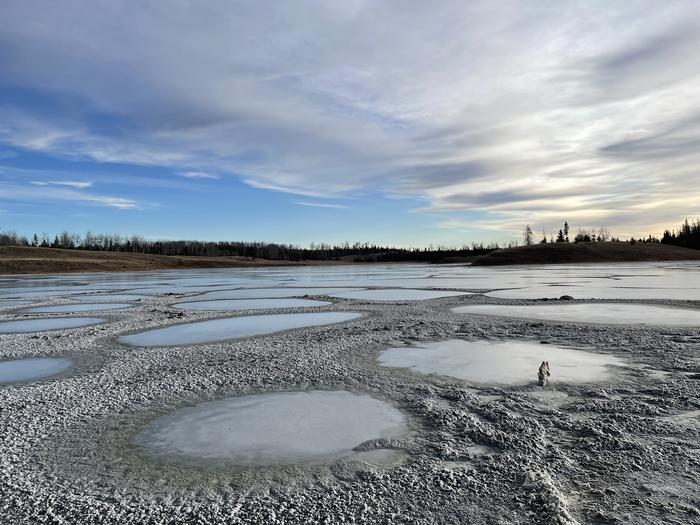
Last Chance Lake

Credit: Zachary R. Cohen

Soda lakes, which are dominated by dissolved sodium and carbonate species, could have provided the right conditions for the first cells, according to a study. Early cells may have been composed of RNA inside lipid membranes. But RNA function requires divalent cations such as Mg2+, which disrupt primitive membranes made of fatty acids. The question arises whether the relatively low concentrations of Mg2+ found in soda lakes may have allowed both RNA and membranes to function together. To explore this possibility, Zachary Cohen and colleagues collected water from Last Chance Lake and Goodenough Lake in Canada after seasonal evaporation. These soda lakes each contained ~1 M Na+ and ~1 mM Mg2+ at pH 10. The authors found that spontaneous extension of short RNA primers occurred in lake water at a rate comparable to the rates in standard laboratory conditions. The authors added fatty acids, which could have been available on the early Earth, to the lake water to see if the molecules would assemble into membranes.  The membranes formed in dilute water that simulates a rainfall event, and the membranes persisted even when surrounded by concentrated lake water from the dry season. According to the authors, soda lakes on the early Earth could have supported key features of protocell development, with RNA copying and ribozyme activity taking place in the dry season and vesicle formation occurring during the wet season.


Journal

PNAS Nexus

Article Title

Natural soda lakes provide compatible conditions for RNA and membrane function that could have enabled the origin of life

Article Publication Date

19-Mar-2024

Share12Tweet8Share2ShareShareShare2

Related Posts

Secure Firearm Storage Could Lower Lead Exposure Risk in Children Living with Guns — Biology

Secure Firearm Storage Could Lower Lead Exposure Risk in Children Living with Guns

June 4, 2026
AI-Driven CardioNVT Revolutionizes High-Throughput In Situ Cardiomyocyte Ploidy Analysis Without Immunostaining — Biology

AI-Driven CardioNVT Revolutionizes High-Throughput In Situ Cardiomyocyte Ploidy Analysis Without Immunostaining

June 4, 2026

How Cells Combat Infections from Within

June 4, 2026

Newly Discovered Velociraptor Relative Likely Glided on Four Wings and Preyed on Early Birds

June 4, 2026

POPULAR NEWS

  • ESMO 2025: mRNA COVID Vaccines Enhance Efficacy of Cancer Immunotherapy

    321 shares
    Share 128 Tweet 80
  • Multi-Hospital Study Reveals Long Covid Burden Is Twice as High as Current Estimates

    88 shares
    Share 35 Tweet 22
  • Saying Goodbye to PGY-6: Pediatric Fellowship Realities

    75 shares
    Share 30 Tweet 19
  • Common Food Preservatives Associated with Elevated Blood Pressure and Increased Heart Disease Risk

    57 shares
    Share 23 Tweet 14

About

We bring you the latest biotechnology news from best research centers and universities around the world. Check our website.

Follow us

Recent News

Major Trial Finds Finerenone Slows Kidney Decline and Lowers Cardiovascular Risk in Non-Diabetic Chronic Kidney Disease

New Study Links Common Blood Pressure Medication to Worsened Kidney Outcomes in Type 2 Diabetes

Breakthrough ‘Universal Vaccine’ Technology Promises Protection Against Future Virus Outbreaks

Subscribe to Blog via Email

Enter your email address to subscribe to this blog and receive notifications of new posts by email.

Join 82 other subscribers
  • Contact Us

Bioengineer.org © Copyright 2023 All Rights Reserved.

Welcome Back!

Login to your account below

Forgotten Password?

Retrieve your password

Please enter your username or email address to reset your password.

Log In
No Result
View All Result
  • Homepages
    • Home Page 1
    • Home Page 2
  • News
  • National
  • Business
  • Health
  • Lifestyle
  • Science

Bioengineer.org © Copyright 2023 All Rights Reserved.