• HOME
  • NEWS
  • EXPLORE
    • CAREER
      • Companies
      • Jobs
    • EVENTS
    • iGEM
      • News
      • Team
    • PHOTOS
    • VIDEO
    • WIKI
  • BLOG
  • COMMUNITY
    • FACEBOOK
    • INSTAGRAM
    • TWITTER
Friday, June 12, 2026
BIOENGINEER.ORG
No Result
View All Result
  • Login
  • HOME
  • NEWS
  • EXPLORE
    • CAREER
      • Companies
      • Jobs
        • Lecturer
        • PhD Studentship
        • Postdoc
        • Research Assistant
    • EVENTS
    • iGEM
      • News
      • Team
    • PHOTOS
    • VIDEO
    • WIKI
  • BLOG
  • COMMUNITY
    • FACEBOOK
    • INSTAGRAM
    • TWITTER
  • HOME
  • NEWS
  • EXPLORE
    • CAREER
      • Companies
      • Jobs
        • Lecturer
        • PhD Studentship
        • Postdoc
        • Research Assistant
    • EVENTS
    • iGEM
      • News
      • Team
    • PHOTOS
    • VIDEO
    • WIKI
  • BLOG
  • COMMUNITY
    • FACEBOOK
    • INSTAGRAM
    • TWITTER
No Result
View All Result
Bioengineer.org
No Result
View All Result
Home NEWS Science News Chemistry

DGIST achieves the highest efficiency of flexible CZTSSe thin-film solar cell

Bioengineer by Bioengineer
September 19, 2019
in Chemistry
Reading Time: 3 mins read
0
IMAGE
Share on FacebookShare on TwitterShare on LinkedinShare on RedditShare on Telegram

IMAGE

Credit: DGIST

DGIST announced on Tuesday, September 10 that Dr. Jin-Kyu Kang’s research team in Division of Energy Technology achieved 11.4% for the photoelectric conversion1 efficiency of flexible CZTSSe thin-film solar cell, the highest in the world. This research is expected to contribute to the development of future solar power technology and the thin-film solar cell industry of next generation.

Flexible thin-film solar cell can be applied in various fields such as wearable, building, and automobiles based on the flexible substrate technology. Since CZTSSe thin-film solar cell uses low-cost, ecofriendly materials, it is drawing limelight and is being researched as the next generation solar power technology throughout the world. However, Flexible CZTSSe`s photoelectric conversion efficiency had not exceeded 10% due to technological issue such as the spread of impurities inside the flexible substrate and delamination.

In response, the DGIST research team conducted research and achieved the highest efficiency of 11.4%, which was officially recognized. This achievement is drawing more attention because its mass production is much easier with the use of low-cost, ecofriendly materials such as copper(Cu), zinc(Zn), tin(Sn) than the existing thin-film solar cell (CIGS, CdTe, perovskite2), which uses high-cost heavy metal materials such as indium, lead, and cadmium.

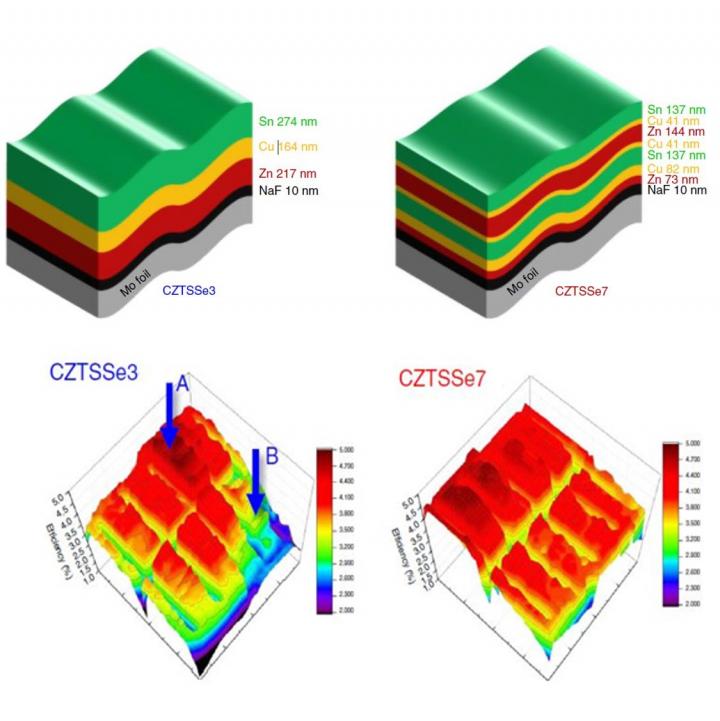
One of the biggest achievements of this research is increased efficiency by changing the existing 3-stack structure of CZTSSe thin-film solar cell precursor into a multi-layered structure and by improving the voltage characteristics and uniformity. Moreover, it has the problem with uniformity degradation when a large-area process is applied to thin-film solar cell, but applied process technology in this research improved not only efficiency but also uniformity.

Dr. Kee-Jeong Yang who led the development of process technology said “Our research achievement has presented ways to secure the uniformity of large-area process, which can cause issues in commercialization. We will be able to advance the commercialization of next generation solar cell which is applicable in various fields such as building outer walls.” Moreover, Senior Researcher Jin-Kyu Kang, the research project manager, said “As there is growing interest towards environment and resources are used unlimitedly these days, it is a very meaningful achievement that we have developed a thin-film solar cell using widely available, ecofriendly materials. We plan to lead the future solar cell technology using widely available materials and contribute to the development of thin-film solar cell industry.

###

This research was carried out as a project “Development of earth abundant, non-toxic chalcogenide absorber based flexible inorganic thin film solar cell” with support by Korea Energy Technology Evaluation and Planning (KETEP), which is affiliated under the Ministry of Trade, Industry, and Energy. DGIST plans to open the Research Center for Thin Film Solar Cell based on this achievement. Its precursor design technology was published on international journal Nature Communications on July 4.

1 Photoelectric conversion: Conversion of light energy into electric energy.

2 Perovskite: A crystal structure with excellent electrical conductivity, created by mixing methyl ammonium, formamidium, and inorganic and organic matters. Forms electrons when receives light and produces electricity like regular solar cell.

Media Contact
Jin-Kyu Kang
[email protected]

Original Source

https://www.dgist.ac.kr/bbs/?mode=V&site_dvs_cd=en&menu_dvs_cd=060202&code=060104&no=abd23de9f410c73fdf0ccc515f257241&GotoPage=1

Related Journal Article

http://dx.doi.org/10.1038/s41467-019-10890-x

Tags: Biomedical/Environmental/Chemical EngineeringChemistry/Physics/Materials SciencesElectrical Engineering/ElectronicsElectromagneticsEnergy/Fuel (non-petroleum)
Share12Tweet8Share2ShareShareShare2

Related Posts

Unveiling Optical Activity in Achiral Crystals: A Breakthrough Discovery — Chemistry

Unveiling Optical Activity in Achiral Crystals: A Breakthrough Discovery

June 11, 2026
Aromatic Ring Flips Reshape Protein Dynamics in Crystals — Chemistry

Aromatic Ring Flips Reshape Protein Dynamics in Crystals

June 11, 2026

Newly Synthesized Fullerene Material Retains Metallic Properties at Low Temperatures

June 11, 2026

Magnet Bundle Milestone Heralds a New Era in Fusion Research

June 11, 2026
Please login to join discussion

POPULAR NEWS

  • ESMO 2025: mRNA COVID Vaccines Enhance Efficacy of Cancer Immunotherapy

    324 shares
    Share 130 Tweet 81
  • Saying Goodbye to PGY-6: Pediatric Fellowship Realities

    96 shares
    Share 38 Tweet 24
  • Multi-Hospital Study Reveals Long Covid Burden Is Twice as High as Current Estimates

    90 shares
    Share 36 Tweet 22
  • Common Food Preservatives Associated with Elevated Blood Pressure and Increased Heart Disease Risk

    58 shares
    Share 23 Tweet 15

About

We bring you the latest biotechnology news from best research centers and universities around the world. Check our website.

Follow us

Recent News

Real-Time 3D Scanning Detects Geometric Errors Instantly

Denoised MDS-UPDRS Reveals New Parkinson’s Progression Patterns

Resolvin D2: Marker for Cognitive Decline in Elderly?

Subscribe to Blog via Email

Enter your email address to subscribe to this blog and receive notifications of new posts by email.

Join 82 other subscribers
  • Contact Us

Bioengineer.org © Copyright 2023 All Rights Reserved.

Welcome Back!

Login to your account below

Forgotten Password?

Retrieve your password

Please enter your username or email address to reset your password.

Log In
No Result
View All Result
  • Homepages
    • Home Page 1
    • Home Page 2
  • News
  • National
  • Business
  • Health
  • Lifestyle
  • Science

Bioengineer.org © Copyright 2023 All Rights Reserved.