• HOME
  • NEWS
  • EXPLORE
    • CAREER
      • Companies
      • Jobs
    • EVENTS
    • iGEM
      • News
      • Team
    • PHOTOS
    • VIDEO
    • WIKI
  • BLOG
  • COMMUNITY
    • FACEBOOK
    • INSTAGRAM
    • TWITTER
Tuesday, June 30, 2026
BIOENGINEER.ORG
No Result
View All Result
  • Login
  • HOME
  • NEWS
  • EXPLORE
    • CAREER
      • Companies
      • Jobs
        • Lecturer
        • PhD Studentship
        • Postdoc
        • Research Assistant
    • EVENTS
    • iGEM
      • News
      • Team
    • PHOTOS
    • VIDEO
    • WIKI
  • BLOG
  • COMMUNITY
    • FACEBOOK
    • INSTAGRAM
    • TWITTER
  • HOME
  • NEWS
  • EXPLORE
    • CAREER
      • Companies
      • Jobs
        • Lecturer
        • PhD Studentship
        • Postdoc
        • Research Assistant
    • EVENTS
    • iGEM
      • News
      • Team
    • PHOTOS
    • VIDEO
    • WIKI
  • BLOG
  • COMMUNITY
    • FACEBOOK
    • INSTAGRAM
    • TWITTER
No Result
View All Result
Bioengineer.org
No Result
View All Result
Home NEWS Science News Chemistry

Developing new smart soft materials

Bioengineer by Bioengineer
August 4, 2020
in Chemistry
Reading Time: 2 mins read
0
IMAGE
Share on FacebookShare on TwitterShare on LinkedinShare on RedditShare on Telegram

synthesis of a pH-responsive dendronized poly(substituted methylene)s
IMAGE

Credit: Ehime University

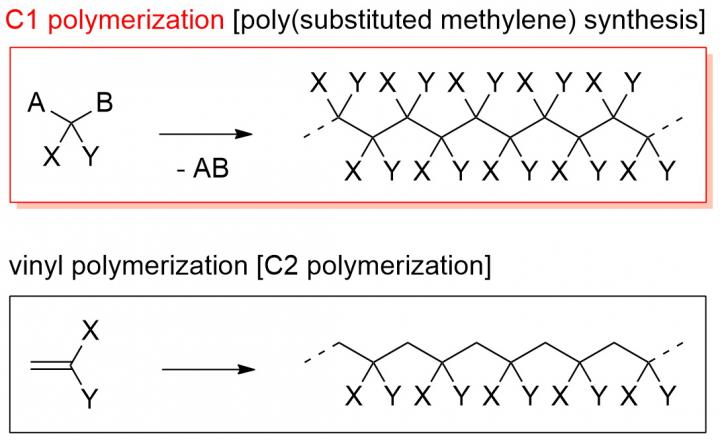
C1 polymerization is a useful technique for preparing polymers with a carbon-carbon main chain. This technique constructs a polymer backbone from “one carbon unit”, in contrast to conventional vinyl polymerization, which produces polymers from a “two carbon unit” derived from vinyl groups. The representative characteristic of C1 polymerization is that it can yield carbon-carbon main polymers having a substituent on each main chain carbon atom [poly(substituted methylene)s]. For the C1 polymerization system, diazoacetates are suitable monomers, yielding polymers with an alkoxycarbonyl group (ester) on each main chain carbon atom.

Stimuli-responsive polymers or smart polymers are macromolecules that undergo a change in properties in response to external stimuli, such as temperature, pH, light, and additives. Their stimuli-responsive behavior strongly depends on the primary structure of the polymer, and thus precise synthesis is necessary to develop smart materials with superior properties. Precise C1 polymerization for diazoacetates is still a challenge, whereas various controlled/living polymerization techniques of vinyl monomers have been achieved to give well-defined stimuli-responsive vinyl polymers. In this context, with the results reported in this report, we have demonstrated that diazoacetates with a sterically bulky substituent can be polymerized in a controlled manner with the π-allylPdCl/borate systems to yield polymers with narrow molecular weight distribution. In addition, we have successfully synthesized carboxy-functionalized dendronized polymers and demonstrated the characteristic pH-responsive behavior derived from the dense accumulation of the side chains in comparison to the corresponding vinyl polymers bearing the same side chains. The introduction of functional groups, other than a carboxy group, in the peripheral phenyl groups should result in a high density of the functional groups around the rigid main chain. These structural characteristics will lead to development of a variety of new functional poly(substituted methylene)s in the near future.

###

Media Contact
Public Relations Division
[email protected]

Related Journal Article

http://dx.doi.org/10.1021/acs.macromol.0c01029

Tags: Chemistry/Physics/Materials SciencesMaterialsPolymer Chemistry
Share12Tweet8Share2ShareShareShare2

Related Posts

AI and Physics Collaborate to Design Advanced Hydrogen Storage Materials

June 25, 2026

International Team Including Dresden Scientists Develops Novel Designer Proteins for Advanced Study of Living Tissue

June 25, 2026

New Study Uncovers Key Factors Driving Water Chemistry in Nanoscale Environments

June 25, 2026

Plasma Technology Extends Catalyst Lifespan in Hydrogen Production

June 24, 2026
Please login to join discussion

POPULAR NEWS

  • Saying Goodbye to PGY-6: Pediatric Fellowship Realities

    103 shares
    Share 41 Tweet 26
  • Multi-Hospital Study Reveals Long Covid Burden Is Twice as High as Current Estimates

    92 shares
    Share 36 Tweet 23
  • Detection of EDCs in Breast Milk and Infant Urine Up to Six Months Highlights Early Exposure Risks

    77 shares
    Share 31 Tweet 19
  • New Drug Candidate Developed at McMaster Shows Potential for Treating Brain Cancer

    58 shares
    Share 23 Tweet 15

About

We bring you the latest biotechnology news from best research centers and universities around the world. Check our website.

Follow us

Recent News

Tracking Lanthanide-Labeled Microplastics in Plants

POSTECH Researchers Slash Cost of Reconstituted Cell-Free Systems by 95%

AI and Physics Collaborate to Design Advanced Hydrogen Storage Materials

Subscribe to Blog via Email

Success! An email was just sent to confirm your subscription. Please find the email now and click 'Confirm' to start subscribing.

Join 82 other subscribers
  • Contact Us

Bioengineer.org © Copyright 2023 All Rights Reserved.

Welcome Back!

Login to your account below

Forgotten Password?

Retrieve your password

Please enter your username or email address to reset your password.

Log In
No Result
View All Result
  • Homepages
    • Home Page 1
    • Home Page 2
  • News
  • National
  • Business
  • Health
  • Lifestyle
  • Science

Bioengineer.org © Copyright 2023 All Rights Reserved.