• HOME
  • NEWS
  • EXPLORE
    • CAREER
      • Companies
      • Jobs
    • EVENTS
    • iGEM
      • News
      • Team
    • PHOTOS
    • VIDEO
    • WIKI
  • BLOG
  • COMMUNITY
    • FACEBOOK
    • INSTAGRAM
    • TWITTER
Tuesday, May 19, 2026
BIOENGINEER.ORG
No Result
View All Result
  • Login
  • HOME
  • NEWS
  • EXPLORE
    • CAREER
      • Companies
      • Jobs
        • Lecturer
        • PhD Studentship
        • Postdoc
        • Research Assistant
    • EVENTS
    • iGEM
      • News
      • Team
    • PHOTOS
    • VIDEO
    • WIKI
  • BLOG
  • COMMUNITY
    • FACEBOOK
    • INSTAGRAM
    • TWITTER
  • HOME
  • NEWS
  • EXPLORE
    • CAREER
      • Companies
      • Jobs
        • Lecturer
        • PhD Studentship
        • Postdoc
        • Research Assistant
    • EVENTS
    • iGEM
      • News
      • Team
    • PHOTOS
    • VIDEO
    • WIKI
  • BLOG
  • COMMUNITY
    • FACEBOOK
    • INSTAGRAM
    • TWITTER
No Result
View All Result
Bioengineer.org
No Result
View All Result
Home NEWS Science News Chemistry

Developing a new type of refrigeration via force-driven liquid gas transition

Bioengineer by Bioengineer
June 19, 2019
in Chemistry
Reading Time: 2 mins read
0
IMAGE
Share on FacebookShare on TwitterShare on LinkedinShare on RedditShare on Telegram

IMAGE

Credit: Hirotomo Nishihara

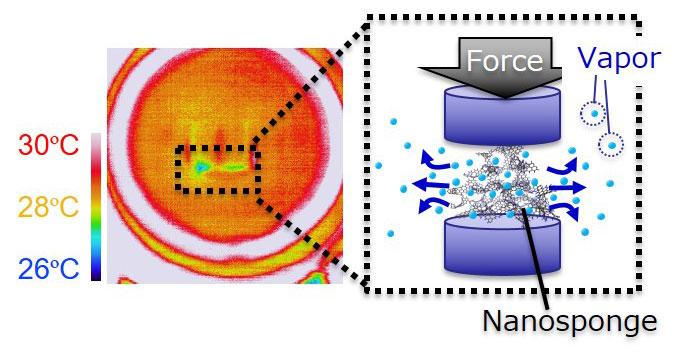
A research team of Tohoku University, Nissan Motor Co., Shinshu University, and Okayama University made a groundbreaking discovery in the quest to replace hydrofluorocarbons in refrigeration systems with natural refrigerants such as water and alcohol. Their study involved carrying-out a liquid-to-gas phase transition via a nanosponge, a soft, elastic material equipped with small nanopores less than 10 nanometers. Their findings could lead to more efficient refrigerants with a smaller carbon footprint.

Refrigeration systems are widely used in air conditioners and refrigerators. Conventional systems use hydrofluorocarbons as a refrigerant. However, hydrofluorocarbons are super pollutants. Their Global Warming Potential is about 1300 times higher than that of CO2.

The team of researchers successfully carried out a force-driven liquid-to-gas phase transition using a nanosponge. When a normal, wet sponge is squeezed, naturally, water is expected to come out. However, when using a nanosponge with a pore size of under 10 nanometers, a different phenomenon occurs. Even under low pressure, the sponge retains its liquid.

When applying force, however, the expelled liquid immediately evaporates into gas. Furthermore, as the sponge returns to its natural shape, it adsorbs the gas as a liquid into the nanopores again.

Until now, researchers have not carried out the squeezing process of nanoporous materials because conventional materials are too hard to be deformed. Nevertheless, the team circumvented this by creating their own soft, elastic, nanoporous materials, consisting of a single-layer of graphene walls. They measured their results using a home-made equipment designed to monitor liquid-gas phase transition when mechanical force is applied.

The team thought about the squeezing method after developing soft nanoporous materials. But even they could not anticipate their prediction becoming reality at the first attempt.

To date, there have been only two methods of converting trapped liquid into gas: i. heating or ii. decreasing the gas-phase pressure. The squeezing method provides a third way, generating a new theme in the field of physical chemistry and paving the path for more environmentally friendly refrigeration systems. Cool stuff!

###

Media Contact
Hirotomo Nishihara
[email protected]

Original Source

https://www.tohoku.ac.jp/en/press/forcedriven_liquid_gas_transition.html

Related Journal Article

http://dx.doi.org/10.1038/s41467-019-10511-7

Tags: Biomedical/Environmental/Chemical EngineeringNanotechnology/MicromachinesTechnology/Engineering/Computer Science
Share12Tweet8Share2ShareShareShare2

Related Posts

TransEuroOGS Project to Connect Optical Ground Stations Across Europe — Chemistry

TransEuroOGS Project to Connect Optical Ground Stations Across Europe

May 19, 2026
Decarbonizing the Grid: The Essential First Step to Capturing Carbon from the Environment — Chemistry

Decarbonizing the Grid: The Essential First Step to Capturing Carbon from the Environment

May 19, 2026

Overcoming Mid-Infrared Interconnection Challenges: Durable Bonding Technique for High-Power Optics Using Liquid-Like Chalcogenide Glass

May 19, 2026

Solar Energy Breakthrough Enables Production of ‘Clean’ Chemicals, Plastics, and Food

May 19, 2026
Please login to join discussion

POPULAR NEWS

  • Research Indicates Potential Connection Between Prenatal Medication Exposure and Elevated Autism Risk

    845 shares
    Share 338 Tweet 211
  • New Study Reveals Plants Can Detect the Sound of Rain

    731 shares
    Share 292 Tweet 182
  • Salmonella Haem Blocks Macrophages, Boosts Infection

    62 shares
    Share 25 Tweet 16
  • Breastmilk Balances E. coli and Beneficial Bacteria in Infant Gut Microbiomes

    58 shares
    Share 23 Tweet 15

About

We bring you the latest biotechnology news from best research centers and universities around the world. Check our website.

Follow us

Recent News

Genetic Drivers of Staph Adhesion Influence Virulence

Boosting Science Breakthroughs with Co-Scientist

Compounding Hazards Amplify Europe’s Flood Costs

Subscribe to Blog via Email

Enter your email address to subscribe to this blog and receive notifications of new posts by email.

Join 82 other subscribers
  • Contact Us

Bioengineer.org © Copyright 2023 All Rights Reserved.

Welcome Back!

Login to your account below

Forgotten Password?

Retrieve your password

Please enter your username or email address to reset your password.

Log In
No Result
View All Result
  • Homepages
    • Home Page 1
    • Home Page 2
  • News
  • National
  • Business
  • Health
  • Lifestyle
  • Science

Bioengineer.org © Copyright 2023 All Rights Reserved.