It is well known that microplastics are a problem: They are tiny, barely visible plastic particles that can harm the environment, for example, if they are eaten by animals. However, it has been difficult to assess the effect of even smaller particles, which can hardly be detected using conventional methods: Plastic particles with a diameter of less than one micrometer commonly referred to as “nanoplastics”. Such tiny particles can even be absorbed into living cells.
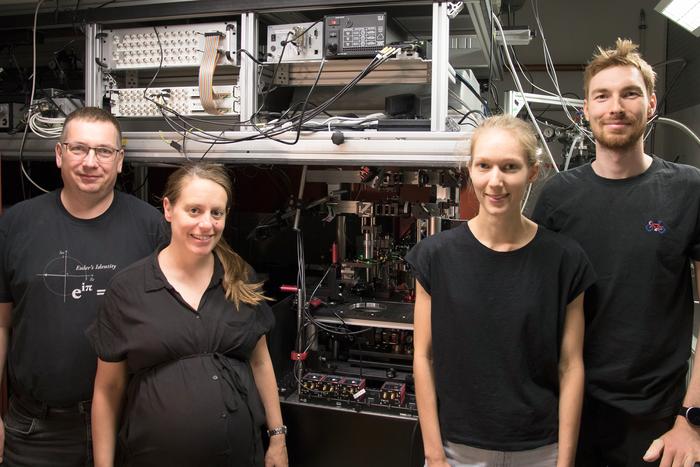
Credit: TU Wien
It is well known that microplastics are a problem: They are tiny, barely visible plastic particles that can harm the environment, for example, if they are eaten by animals. However, it has been difficult to assess the effect of even smaller particles, which can hardly be detected using conventional methods: Plastic particles with a diameter of less than one micrometer commonly referred to as “nanoplastics”. Such tiny particles can even be absorbed into living cells.
TU Wien (Vienna) has now succeeded in developing a measurement method which can even detect individual nanoplastic particles – orders of magnitude faster than previous techniques. These results have now been published in the journal Scientific Reports. The new method now has the potential to become the basis for new measurement devices for environmental analysis.
Detecting molecules by wavelength
“We use a physical principle that has also often been used in chemical analysis, namely Raman scattering,” explains Sarah Skoff, group leader of the “Solid State Quantum Optics and Nanophotonics” research group at TU Wien. In this process, molecules are illuminated with a laser beam, causing them to vibrate. Part of the energy of the laser light is thus converted into vibrational energy, while the rest of the energy is re-emitted in the form of light.
By measuring this light and comparing its energy with the laser light that was originally emitted, the vibrational energy of the molecule is determined – and because different molecules vibrate in different ways, it is possible to find out which molecule it is.
“Ordinary Raman spectroscopy, however, would not be suitable for detecting the smallest nanoplastics,” says Sarah Skoff. “It would be far too insensitive and take far too long.” The research team therefore had to search for physical effects that could significantly improve this technique.
The trick with the gold grid
To do this, they adapted a method that has already been used in a similar form to detect biomolecules. The sample is thereby put onto an extremely fine grid made of gold. The individual gold wires are only 40 nanometers thick and about 60 nanometers apart. “This metal grid acts like an antenna,” says Sarah Skoff. “The laser light is amplified at certain points – so there is a much more intense interaction with the molecules there. There is also an interaction between the molecule and the electrons in the metal lattice, which ensures that the light signal from the molecules is additionally amplified.”
In ordinary Raman spectroscopy, the light that is then emitted by the molecules is normally broken down into all its wavelengths to identify which molecule it is. However, the TU Wien team was able to show that the technique can also be simplified: “We know what the characteristic wavelengths of the nanoplastic particles are, and so we look very specifically for signals at precisely these wavelengths,” Skoff explains. “We were able to show that this can improve the measurement speed by several orders of magnitude. Previously, you had to measure for ten seconds to get a single pixel of the image you were looking for – with us, it takes just a few milliseconds.” Experiments with polystyrene (Styrofoam) showed that even at this very high speed, the nanoplastic particles can be reliably detected – even at extremely low concentrations. Unlike other methods, this technique even allows the detection of individual particles.
The basis for new measurement devices
The research team now wants to investigate the potential applications of the new technique in more detail – for example, how it can be used to detect nanoplastics in environmentally relevant and biological samples, such as blood. “In any case, we have now been able to show that the basic physical principle works,” says Sarah Skoff. “In principle, this lays the foundation for the development of new measurement devices that could be used to examine samples directly in nature outside the laboratory in the future.”
This research work was supported by the Austrian Research Promotion Agency (FFG, PhoQus2D) and the Austrian Science Fund (FWF, Quantoom).
Journal
Scientific Reports
DOI
10.1038/s41598-023-37290-y
Article Title
Imaging and identification of single nanoplastic particles and agglomerates
Article Publication Date
24-Jun-2023