• HOME
  • NEWS
  • EXPLORE
    • CAREER
      • Companies
      • Jobs
    • EVENTS
    • iGEM
      • News
      • Team
    • PHOTOS
    • VIDEO
    • WIKI
  • BLOG
  • COMMUNITY
    • FACEBOOK
    • INSTAGRAM
    • TWITTER
Sunday, May 3, 2026
BIOENGINEER.ORG
No Result
View All Result
  • Login
  • HOME
  • NEWS
  • EXPLORE
    • CAREER
      • Companies
      • Jobs
        • Lecturer
        • PhD Studentship
        • Postdoc
        • Research Assistant
    • EVENTS
    • iGEM
      • News
      • Team
    • PHOTOS
    • VIDEO
    • WIKI
  • BLOG
  • COMMUNITY
    • FACEBOOK
    • INSTAGRAM
    • TWITTER
  • HOME
  • NEWS
  • EXPLORE
    • CAREER
      • Companies
      • Jobs
        • Lecturer
        • PhD Studentship
        • Postdoc
        • Research Assistant
    • EVENTS
    • iGEM
      • News
      • Team
    • PHOTOS
    • VIDEO
    • WIKI
  • BLOG
  • COMMUNITY
    • FACEBOOK
    • INSTAGRAM
    • TWITTER
No Result
View All Result
Bioengineer.org
No Result
View All Result
Home NEWS Science News Biology

Detailed molecular map of skin layer creates pathways for treatments

Bioengineer by Bioengineer
March 14, 2022
in Biology
Reading Time: 3 mins read
0
Skin chemistry images
Share on FacebookShare on TwitterShare on LinkedinShare on RedditShare on Telegram

Scientists have accurately analysed the tough barrier layer of the skin giving the most detailed molecular map of its structure that will help in the development of new skin products and treatments.
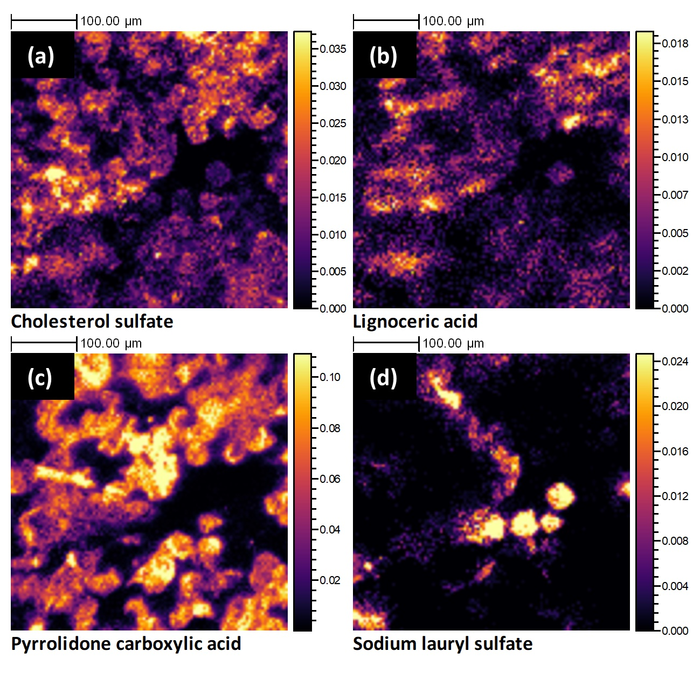
Skin chemistry images

Credit: University of Nottingham

Scientists have accurately analysed the tough barrier layer of the skin giving the most detailed molecular map of its structure that will help in the development of new skin products and treatments.

Researchers from the University of Nottingham used the latest three-dimensional mass spectrometry imaging technique to analyse human skin tissue from the stratum corneum to reveal its molecular chemistry in unprecedented detail. These new findings provide increased fundamental understanding in skin biology and enable the development of new skin products and treatments. These research findings have been published today in PNAS.

The University of Nottingham was the first University in the world to own and operate the 3D OrbiSIMS instrument used in this research. The technology facilitates an unprecedented level of molecular analysis for a range of materials including biological tissues, such as human skin. Importantly, its high mass resolving power, chemical specificity and high sensitivity allow it to be used to analyse in situ human skin samples to accurately map the molecular structure of the skin.

Researchers used ex vivo full-thickness human skin tissue samples and a single gas cluster ion beam to both sputter through the skin and generate secondary ions, which were analysed using the OrbitrapTM to generate a depth profile. This process showed the range of chemistries and 3D distributions within the stratum corneum and indicate how these relate to fundamental biological processes such as the cholesterol sulphate cycle.

David Scurr, Principal Research Fellow in the School of Pharmacy, led the research and said: “This research gives the chemical structure detail of the stratum corneum never seen before. The information we were able to gather on the complex chemistry of this tough barrier layer has the potential to benefit research into fundamental biological processes, such as those associated with ageing and disease in addition to improving the efficacy of topical delivery.”

This research is part of a collaboration with No7 Beauty Company and the analysis done as part of this study has also shown the penetration profile of the stratum corneum. The team were able to accurately track the penetration of No7’s peptide blend Super Matrixyl 3000 Plus™ (a trademark of Sederma) following topical application to the skin surface and detected the peptides responsible for targeting invisible photo-damage that occurs early in the ageing process. 

Mike Bell, Head of Science Research at No7 Beauty Company said: “Commercially this research is very significant as this technique can offer an improved understanding of topical delivery and therefore lead to the development of more effective peptide based anti-ageing products.”


Journal

Proceedings of the National Academy of Sciences

DOI

10.1073/pnas.2114380119

Method of Research

Experimental study

Subject of Research

Human tissue samples

Article Title

Elucidating the molecular landscape of the stratum corneum

Article Publication Date

14-Mar-2022

Share12Tweet8Share2ShareShareShare2

Related Posts

Successful Birth Following Uterus Transplant Marks Medical Breakthrough — Biology

Successful Birth Following Uterus Transplant Marks Medical Breakthrough

May 1, 2026
Cockatoos Mimic Peers to Sharpen Adaptation Skills, Study Finds — Biology

Cockatoos Mimic Peers to Sharpen Adaptation Skills, Study Finds

May 1, 2026

Gut Microbe’s Sulfated Bile Acid Eases Pediatric Sepsis

May 1, 2026

AI Breakthrough Solves One of Science’s Most Challenging Math Problems

May 1, 2026

POPULAR NEWS

  • Research Indicates Potential Connection Between Prenatal Medication Exposure and Elevated Autism Risk

    833 shares
    Share 333 Tweet 208
  • New Study Reveals Plants Can Detect the Sound of Rain

    716 shares
    Share 286 Tweet 179
  • Scientists Investigate Possible Connection Between COVID-19 and Increased Lung Cancer Risk

    67 shares
    Share 27 Tweet 17
  • Salmonella Haem Blocks Macrophages, Boosts Infection

    61 shares
    Share 24 Tweet 15

About

We bring you the latest biotechnology news from best research centers and universities around the world. Check our website.

Follow us

Recent News

Brain Complexity Enhances Premature Newborns’ Maturity Evaluation

Axon Pathways Connect Small Gestational Age to Lung Restrictions

Purslane and Metformin Improve Diabetes-Linked Cognitive Decline

Subscribe to Blog via Email

Success! An email was just sent to confirm your subscription. Please find the email now and click 'Confirm' to start subscribing.

Join 82 other subscribers
  • Contact Us

Bioengineer.org © Copyright 2023 All Rights Reserved.

Welcome Back!

Login to your account below

Forgotten Password?

Retrieve your password

Please enter your username or email address to reset your password.

Log In
No Result
View All Result
  • Homepages
    • Home Page 1
    • Home Page 2
  • News
  • National
  • Business
  • Health
  • Lifestyle
  • Science

Bioengineer.org © Copyright 2023 All Rights Reserved.