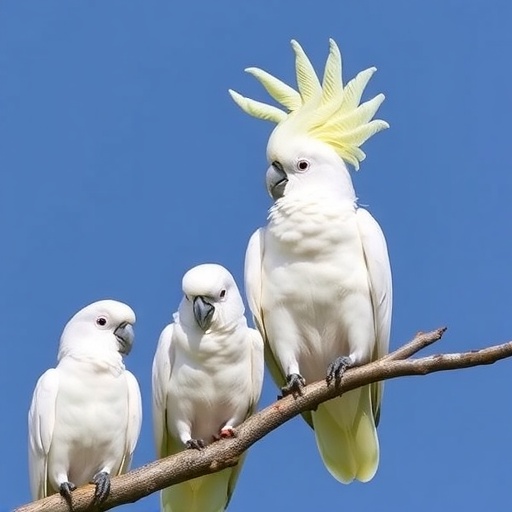
In a groundbreaking study led by researchers at The Australian National University (ANU), new light has been shed on how wild sulphur-crested cockatoos navigate the challenges of urban environments by socially learning which foods are safe to consume. This research unravels the sophisticated mechanisms by which these intelligent birds rely on observation and social connections rather than solitary trial-and-error approaches to adopt novel dietary items, underscoring an exceptional example of animal culture and adaptability in rapidly changing urban landscapes.
The investigation centered around a large-scale, real-world field experiment conducted across Sydney, involving over 700 wild sulphur-crested cockatoos interacting within their natural roosting sites. Uniquely, the study involved training a mere four individual birds to consume dyed almonds placed at designated feeding stations, effectively seeding the spread of this unfamiliar food source. Within a remarkably brief period of just ten days, hundreds of other individual cockatoos began incorporating these novel food items into their diets, but this behavioral shift was strictly localized — occurring only at sites where trained individuals had initially been present, indicating the crucial role of social transmission.
By employing rigorous statistical analyses, the research demonstrated that the dissemination of the newly acquired feeding behavior could be almost entirely attributed to the social networks within the cockatoo populations. This finding decisively refutes the possibility that individual birds independently discovered the novel food source; rather, their behavior was intricately influenced by who they observe and choose to emulate. It is an elegant confirmation of social learning theory in a natural urban setting, revealing how animal groups adapt collectively through communication and observation.
Crucially, the study revealed that social learning among sulphur-crested cockatoos is not a random process but instead shows clear patterns of selectivity. Male cockatoos predominantly followed the actions of other males, and birds were more influenced by their closest social partners than by peripheral associates. This selective emulation highlights the sophisticated social structures that govern knowledge transmission in these birds, bearing significant implications for understanding cultural evolution in non-human species.
Furthermore, a nuanced pattern of age-dependent conformity was observed in the cockatoos’ learning behaviors. Juvenile birds displayed a higher tendency to conform to the majority’s choices in adopting novel foods, demonstrating cautious conservatism analogous to behaviors noted in human children. In contrast, adult cockatoos exhibited more individualistic tendencies and were less inclined to follow the group’s actions strictly. This stratification suggests that developmental and social maturity influence behavioral plasticity and cultural transmission strategies within animal populations.
Notably, beyond merely adopting new foods, the cockatoos were seen to develop and propagate distinct techniques for processing the almonds, such as different methods of opening the nuts. These learned foraging techniques spread through social groups, representing a tangible example of emergent cultural variation akin to traditions. This phenomenon of localized behavioral variants persisting over time confirms the existence of culture in the wild, a notion historically challenging to demonstrate conclusively in non-human animals.
The insights gained from this research build upon earlier findings from the ANU’s Clever Cockie Project, which established sulphur-crested cockatoos as highly social, intelligent urban adapters capable of sophisticated behaviors such as opening bins and adjusting foraging strategies to human activity patterns. Together, these studies illustrate how animal cognition and social networks interplay to facilitate rapid adaptation within human-altered ecosystems, enabling wildlife to thrive amid urban pressures.
Dr. Julia Penndorf, the lead author of the study, emphasized the profound implications of these findings, stating that the reliance of cockatoos on social learning to determine safe foods underscores the instrumental role of social relationships in shaping animal behavior. She highlighted how initial hesitation to consume unfamiliar food was overcome through social cues, enabling the rapid propagation of knowledge and thereby reducing individual risk.
This research propels our understanding of animal culture forward by demonstrating how knowledge can be transmitted almost exclusively via social connections rather than through solitary experimentation. It challenges the conventional view that innovation spread is driven by individual discovery, showcasing instead that social conformity and selective following govern how new behaviors permeate populations.
Moreover, the detailed analysis underscores that the sociobiological architecture of cockatoo groups — who interacts with whom, and the strength of those bonds — is pivotal in determining the trajectory of behavioral innovations. It highlights the complexity of animal societies and the dynamic processes through which culture evolves in nature without human intervention.
The implications of these findings extend beyond avian studies, offering a compelling parallel to human social learning and cultural transmission. The parallels drawn between juvenile cockatoos’ conservative conformity and similar tendencies in human children hint at fundamental evolutionary continuities in how social animals navigate novel challenges through communal learning.
Published in the prestigious journal PLOS Biology, this study not only contributes to our growing understanding of animal intelligence but also offers practical insights for wildlife management and conservation strategies in increasingly urbanized habitats. By appreciating the social dimensions of learning, conservationists can better predict how animal populations may adapt — or fail to adapt — to environmental changes.
As urbanization continues to alter landscapes worldwide, uncovering the adaptive mechanisms that enable wild species like the sulphur-crested cockatoos to thrive is imperative. This research reveals that social learning and culture are vital tools these birds employ to navigate a human-dominated world, ensuring their survival and prosperity in diverse and rapidly evolving environments.
Subject of Research:
Animals
Article Title:
Wild parrots exhibit age-dependent conformity when learning about novel food
News Publication Date:
30-Apr-2026
Web References:
http://dx.doi.org/10.1371/journal.pbio.3003741
References:
Penndorf, J., Aplin, L., et al. “Wild parrots exhibit age-dependent conformity when learning about novel food.” PLOS Biology, 30-Apr-2026. DOI: 10.1371/journal.pbio.3003741
Image Credits:
Julia Penndorf
Keywords:
sulphur-crested cockatoos, social learning, urban adaptation, animal culture, behavioral transmission, conformity, juvenile behavior, innovation spread, bird foraging techniques, animal social networks
Tags: animal culture in urban environmentsavian adaptation to urbanizationdietary innovation in wildlifeecological impact of urbanization on birdsobservational learning in parrotspeer mimicry in cockatoossocial learning in birdssocial transmission of feeding behaviorSydney wildlife field experimentsurban bird adaptation strategieswild bird behavioral studieswild sulphur-crested cockatoos