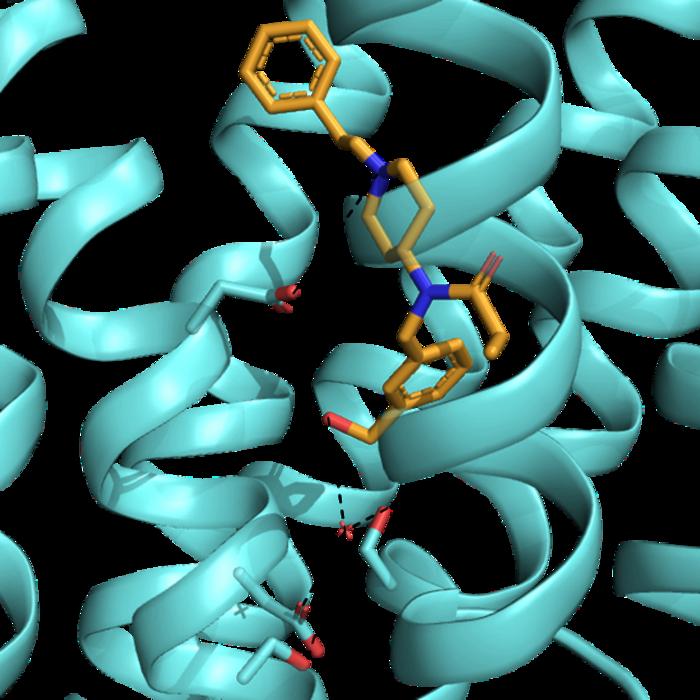
Opioid medications offer people relief from debilitating pain, but these drugs come with dangers: the risk for addiction, miserable withdrawal symptoms and the potential for fatal overdose. In a study in ACS Central Science, researchers have identified a strategy to design safer opioids. They showed that an experimental opioid, which binds to an unconventional spot in the receptor, suppresses pain in animal models with fewer side effects — most notably those linked to fatal overdoses.
Credit: Haoqing Wang
Opioid medications offer people relief from debilitating pain, but these drugs come with dangers: the risk for addiction, miserable withdrawal symptoms and the potential for fatal overdose. In a study in ACS Central Science, researchers have identified a strategy to design safer opioids. They showed that an experimental opioid, which binds to an unconventional spot in the receptor, suppresses pain in animal models with fewer side effects — most notably those linked to fatal overdoses.
Opioid medications tap into the body’s natural system for mitigating pain by activating pain-suppressing opioid receptors on nerve cells in the brain. Although the drugs are intended to help people, sometimes these medications lead to harm. People who take opioids can become physically dependent on them, where sudden stopping can produce withdrawal symptoms, such as muscle pain, nausea and vomiting. In addition, opioids make breathing slow and shallow, a side effect that can become fatal.
Attempts to design safer opioids have largely focused on identifying molecules that bind to the same spot on the receptor, known as the active site, where the body’s own pain-relieving signals attach. In an earlier study, researchers found a molecule called C6 guano, which can activate the opioid receptor when it binds outside the active site. C6 guano interacts with a location inside the opioid receptor that typically responds to sodium ions. Despite its promising effects, C6 guano has a significant drawback: It cannot pass through the blood-brain barrier that protects the organ. So, a team led by Susruta Majumdar, Jay McLaughlin, Haoqing Wang and Ruth Huttenhain set out to improve upon this discovery by identifying a similar molecule with the potential to travel from the blood stream to opioid receptors in the brain.
To find an alternative that also binds to the opioid receptor, the researchers synthesized and evaluated 10 compounds with chemistry that might enable passage through the blood-brain barrier. During their initial testing in cells, they identified the most promising candidate derived from fentanyl, called RO76. By capturing molecules in proximity of the activated receptor, the team showed that RO76 produces a signal within cells that differs from those initiated by classic opioids, such as morphine.
They then evaluated the compound’s efficacy in mice. In these experiments, RO76 appeared to suppress pain as effectively as morphine. But when comparing the opioids’ effects on the animals breathing rates, they found that RO76 slowed breathing far less, suggesting it may not be as deadly as morphine. Likewise, when they gave the mice an opioid-blocking medication, the mice chronically taking RO76 experienced fewer withdrawal symptoms than those taking morphine. What’s more, the team found that, when given by mouth, the new fentanyl derivative had similar, if slightly lower, pain-suppressing effects than when injected under the skin of the animals. The researchers say these results suggest RO76 has the potential for development as an oral medication for humans.
The authors acknowledge funding from the National Institutes of Health and the Pharmaceutical Research and Manufacturers of America Postdoctoral Fellowships. Two of the authors also acknowledge financial interests with biopharmaceutical companies.
The paper’s abstract will be available on July 17 at 8 a.m. Eastern time here: http://pubs.acs.org/doi/abs/10.1021/acscentsci.4c00525
For more of the latest research news, register for our upcoming meeting, ACS Fall 2024. Journalists and public information officers are encouraged to apply for complimentary press registration by completing this form.
###
The American Chemical Society (ACS) is a nonprofit organization chartered by the U.S. Congress. ACS’ mission is to advance the broader chemistry enterprise and its practitioners for the benefit of Earth and all its people. The Society is a global leader in promoting excellence in science education and providing access to chemistry-related information and research through its multiple research solutions, peer-reviewed journals, scientific conferences, eBooks and weekly news periodical Chemical & Engineering News. ACS journals are among the most cited, most trusted and most read within the scientific literature; however, ACS itself does not conduct chemical research. As a leader in scientific information solutions, its CAS division partners with global innovators to accelerate breakthroughs by curating, connecting and analyzing the world’s scientific knowledge. ACS’ main offices are in Washington, D.C., and Columbus, Ohio.
To automatically receive news releases from the American Chemical Society, contact [email protected].
Note: ACS does not conduct research, but publishes and publicizes peer-reviewed scientific studies.
Follow us: X, formerly Twitter | Facebook | LinkedIn | Instagram
Journal
ACS Central Science
DOI
10.1021/acscentsci.4c00525
Article Title
Signaling Modulation Mediated by Ligand Water Interactions with the Sodium Site at μOR
Article Publication Date
17-Jul-2024