Credit: Tokyo Tech
In living organisms, DNA is the storage unit of all genetic information. It is with this information that proteins are encoded, which then enable biological systems to function as needed for the organism to survive. DNA’s functioning is enabled by its structure: a double-stranded helix formed via the joining of specific pairs of molecules called ‘nucleotides’ in specific orders, called ‘sequences’. In recent decades, scientists in the fields of DNA nanotechnology have been able to design DNA sequences to construct desired nanostructures and microstructures, which can be used to investigate biomolecular functions or create artificial cell systems.
The customization of the designs of sequences in DNA nanotechnology also enables the interactions among DNA molecules to be controlled and programmed. The inter-molecular interactions in cells cause various phenomena. A phenomenon called “liquid-liquid phase separation (LLPS)”–the separation of a liquid into a denser phase of droplets within a more dilute phase–plays an important role in many biological processes. LLPS artificially induced via DNA nanotechnology can help deepen our understanding of the applicability of LLPS and provide a methodology for controlling bio-macromolecular droplets.
Therefore, a team of scientists from Tokyo Tech, led by Professor Masahiro Takinoue, designed specific DNA-nanostructures to understand the influence of DNA sequences and demonstrate controllability on LLPS–into DNA-rich and DNA-poor phases–in artificially designed DNA nanostructures.
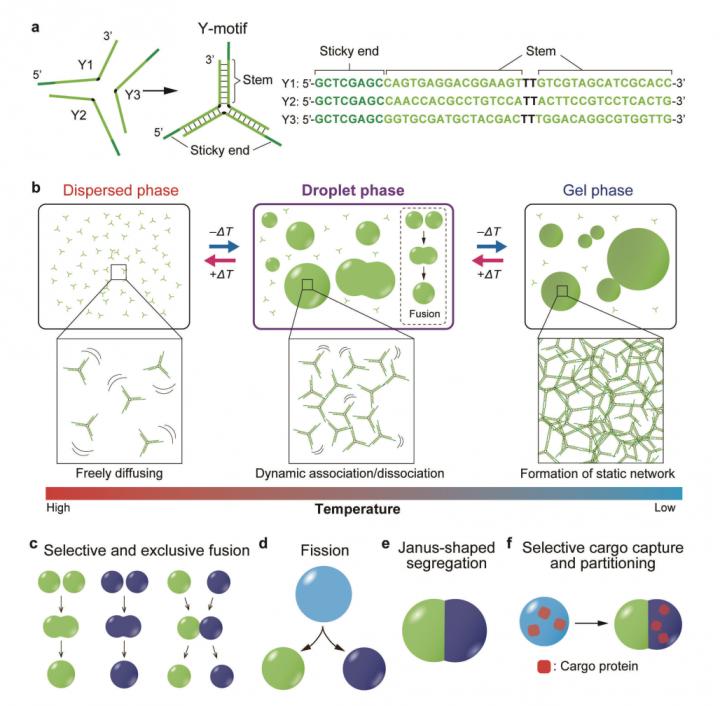
Their study, published in Science Advances, involved the construction of Y-shaped DNA nanostructures called “Y-motifs”. Each side of a Y-motif comprises a short sticky end that interacts with other ‘compatible’ sticky ends (Fig. 1a). Upon progressively decreasing the temperature, the scientists found that the Y-motifs reversibly agglomerate to form droplets and then gels (Figs. 1b and 2a).
When they added another set of constructed Y-motifs with sticky ends that are incompatible with the previous set, two sets of droplets were formed for each type of Y-motif. This demonstrated that DNA sequences can be tailored to fuse exclusively with similar ones (Figs. 1c and 2b).
Prof Takinuoe and team then created a special DNA structure that can bridge together the incompatible Y-motifs. Upon adding this to the mixture of Y-motifs, droplets composed of both motifs were formed. Further construction of a cleavable variant of the special bridge DNA structure and subsequent addition of a certain cleaving enzyme caused the fission of droplets (Figs. 1d and 2c) and the mixed droplets to separate into Janus-shaped droplets with unmixable halves containing the two types of Y-motif (Figs. 1e and 2d). By conjugating cargo molecules with DNA strands compatible with either one type of Y-motif, the scientists were able to localize the cargo molecules exclusively on one half of the droplet (Figs. 1f and 2e).
Thus, the scientists were able to ‘program’ DNA and ‘control’ their behavior, opening doors to a new technique for creating artificial reaction environments to study biological systems and drug delivery. Prof Takinoue explains: “Living systems are well-organized dynamic structures whose behavior is regulated by the information encoded in biopolymers (such as DNA). Our DNA-based liquid-liquid phase separation system could provide a new basis for the development of artificial cell engineering.”
Because precise DNA sequences can be readily produced using available bioengineering techniques, the potential applications of manipulating material behaviors through DNA sequences are far-reaching. Prof Takinoue concludes: “The phase behavior shown in this study could be expanded to other materials that can be modified with DNA, which may enable us to design phases and create droplets for various materials. Moreover, we envision that the observed autonomous behavior of macromolecular structures could one day serve for the development of robotic molecular systems comparable to those of living cells.”
###
Media Contact
Kazuhide Hasegawa
[email protected]
Original Source
https:/
Related Journal Article
http://dx.