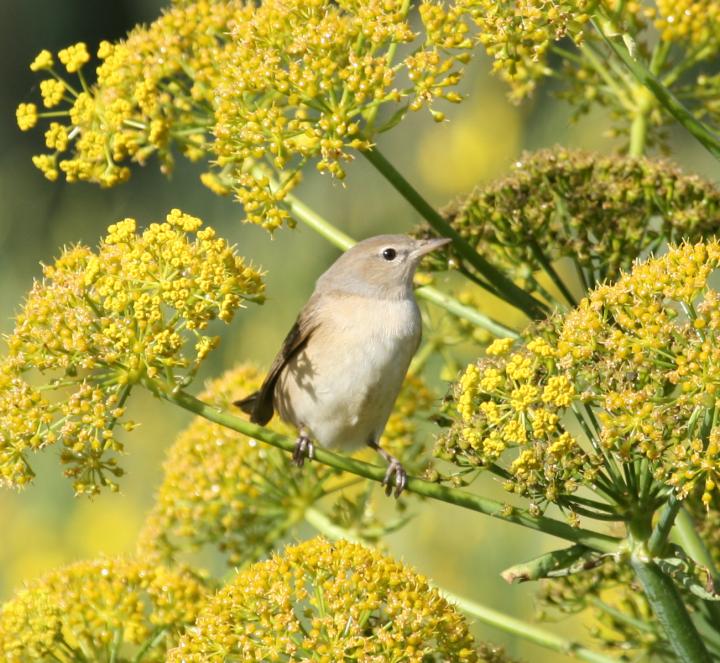
Credit: Wolfgang Goymann
Every year, billions of migratory birds make their way back to Europe from their wintering quarters. Since their energy reserves are not enough for a non-stop flight, they put in stopovers along the way to rest and replenish their fat stores. That migratory birds must stop on their long journey is clear. But how long they rest and what signals tell the birds to continue on their way has so far been unclear.
A research team led by Leonida Fusani of the Konrad Lorenz Institute of Ethology at Vetmeduni Vienna and the Department of Cognitive Biology at the University of Vienna, together with Wolfgang Goymann of the Max Plank Institute for Ornithology in Seewiesen, could now demonstrate, for the first time, that the hormone ghrelin controls migratory behaviour. They were also able to show that a form of grehlin that had been considered to be an inactive form of the hormone is in fact much more influential than had previously been assumed.
Appetite-regulating hormone identified as departure signal
A network of hormones regulates the appetite in mammals. The hormones signal how much food we eat and when we have had enough. Besides leptin and cortisol, ghrelin has been identified as an especially important factor in appetite regulation. "The hormone was recently identified in birds as well. We therefore investigated whether it might also play a role in the behaviour of migratory birds," explains Fusani. Through two experimental studies with the garden warbler Sylvia borin, the researchers found evidence that ghrelin functions as an indicator and a signal for the birds to continue their migratory journey.
On their stopover in the island of Ponza, Italy, the researchers first measured the fat stores and the ghrelin concentrations in the birds. The analysis revealed that concentrations of ghrelin circulating in the bloodstream of "fat" garden warblers were higher than in thinner birds. "The concentration of the hormone correlated very well with the birds' body mass index," says Goymann. The birds' circulating hormone concentrations thus reflected their physical condition. Additionally, garden warblers in good physiological condition and with high ghrelin levels also were in a state of migratory restlessness. Even captive birds exhibit this urge to migrate at the appropriate time.
Inactive form of ghrelin also an active influential factor
Migratory restlessness also indicated the influence of ghrelin in the second experiment conducted by the research team. This behaviour, however, was triggered in the warblers by a form of ghrelin that had previously been considered to be inactive. "Two forms of ghrelin exist in the bloodstream: an acylated and an unacylated form. The latter had previously been considered to be the inactive form of the hormone," says Fusani. The acylated form, which was considered to be the active form of the hormone, differs from the unacylated form in that it has an additional acyl group.
In a second experiment, the researchers injected the birds with different concentrations of the hormone. The acylated form of ghrelin had little effects on the animals; the unacylated form did, however, especially among animals who had not yet sufficiently replenished their energy reserves. Injections of "inactive" ghrelin decreased the appetite in the garden warblers but increased their activity, i.e. it triggered migratory restlessness.
Hormonal control of bird migration as food for thought for mammal research
The research results clearly demonstrated a hormonal trigger behind the decision of migratory birds to continue their journey. "We have thus identified an important factor behind migratory behaviour in addition to natural influences such as the weather and food availability," says Goymann. But the results of the study could also contribute to a better understanding of the hormone's function among mammals.
The evidence that the "inactive" form of ghrelin influences the behaviour of migratory birds indicates that the hormone may have alternative mechanisms. Even unacylated ghrelin can pass the blood-brain barrier. The unacylated form could possibly become activated and trigger a reaction in the central nervous system. "This could contribute to research, from a new perspective, into the regulation of food intake, metabolic disorders or obesity in people," says Fusani.
###
Service: The article "Ghrelin affects stopover decisions and food intake in a long-distance migrant" by Wolfgang Goymann, Sara Lupib, Hiroyuki Kaiya, Massimiliano Cardinale und Leonida Fusani was published in PNAS (Proceedings of the National Academy of Sciences of the United States of America). http://www.pnas.org/content/early/2017/02/03/1619565114.short?rss=1 DOI: 10.1073/pnas.1619565114
About the University of Veterinary Medicine, Vienna
The University of Veterinary Medicine, Vienna in Austria is one of the leading academic and research institutions in the field of Veterinary Sciences in Europe. About 1,300 employees and 2,300 students work on the campus in the north of Vienna which also houses five university clinics and various research sites. Outside of Vienna the university operates Teaching and Research Farms. http://www.vetmeduni.ac.at
Scientific Contact:
Leonida Fusani
Konrad-Lorenz Institute of Ethology
University of Veterinary Medicine Vienna (Vetmeduni Vienna)
Department of Cognitive Research
University Vienna
T +43 1 25077-7320
[email protected]
and
Wolfgang Goymann
Max-Planck-Institute for Ornithology, Seewiesen Germany
T +49 8157 932-301
[email protected]
Released by:
Georg Mair
Science Communication / Corporate Communications
University of Veterinary Medicine Vienna (Vetmeduni Vienna)
T +43 1 25077-1165
[email protected]
Media Contact
Leonida Fusani
[email protected]
43-125-077-7320
http://www.vetmeduni.ac.at