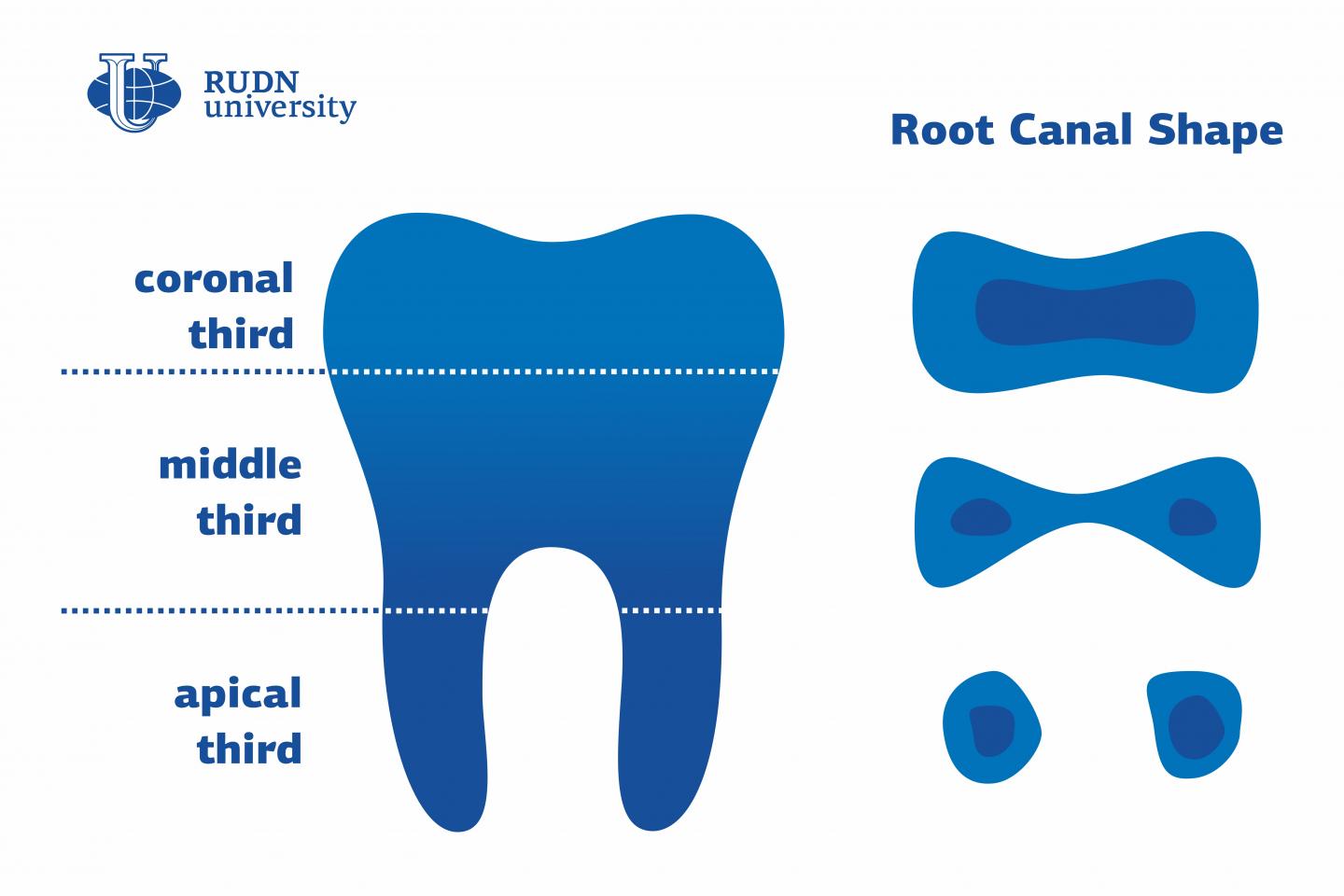
Credit: RUDN University
Individual characteristics of the shape and cross-section of the root canal are one of the main issues for dentists. When treating a root canal, a doctor needs to properly clean it, fill it, and carry out a rebuilding procedure so that a canal is sealed. The first stage of endodontic treatment requires detailed knowledge of root canal anatomy. A team of dentists from RUDN University studied and classified various changes in root canal shapes. The new classification will help doctors avoid diagnostic errors, better select their tools, and treat patients more efficiently. The results of the work were published in the Applied Sciences journal.
A root canal is a hollow space in a dental root with blood vessels and nerves going through it. Root canals have different shapes and width which makes treating them extremely complicated. Turns and shape changes can occur both in the coronal (visible) part of a tooth and in other parts that are invisible to the eye. Previous studies were focused on the curvatures of root canals in either the upper (coronal) or the lower (apical) part of a tooth. But a team of dentists from RUDN University carried out large scale research and presented the first-ever classification of root canal shape changes along its whole length.
“Earlier researchers tended to study about one-third of the root canal: either its coronal or its apical part. However, its shape changes along its full length, and this is an important factor for therapy. That is why we decided to take a look at the variations of root canal cross-sections in all three thirds and in different age groups of adult patients. Our goal was to develop a new classification of root canal shape changes,” said Svetlana Razumova, MD, a Head of the Department of Propaedeutics of Dental Diseases at RUDN University.
The team conducted an experiment that involved 300 patients from 20 to 70 years of age. The medics took CT scans of their healthy teeth in axial projection, i.e. the X-ray from the CT scanner moved along the roll axis of the teeth. This way the images showed the cross-sections of root canals. The team took 4,805 images in total and used them to study the changes in the shape of root canals depending on the part of a tooth. The images were processed using statistical methods.
The most widely spread changes in all age groups affected premolars (the teeth situated between canines and molars). In over 50% of cases, the shape of the root canal in premolars changed from round in the apical third into oval in the coronal third. Another place with frequent changes in root canal shapes was mandibular molars.
Based on the obtained data the team developed a classification of root canal shape changes. The medics suggested dividing all possible changes into four groups: 1 – no changes in the shape, 2 – changes in the middle part of the root canal, 3 – changes in the middle and apical parts of the root canal, and 4 – changes in the apical part only. This classification will help dentists better understand the structure of each particular root canal and select proper tools to work with it.
“Our studies show that the shapes of root canal cross-sections can vary depending on the part of the canal and the age of a patient. All these variations were included in our classification and should be taken into consideration when choosing a method for canal cleaning. The choice of tools and preparation methods determines the efficiency of treatment at this stage and therefore affects the whole prognosis,” added Svetlana Razumova.
###
Media Contact
Valeriya Antonova
[email protected]
Related Journal Article
http://dx.