


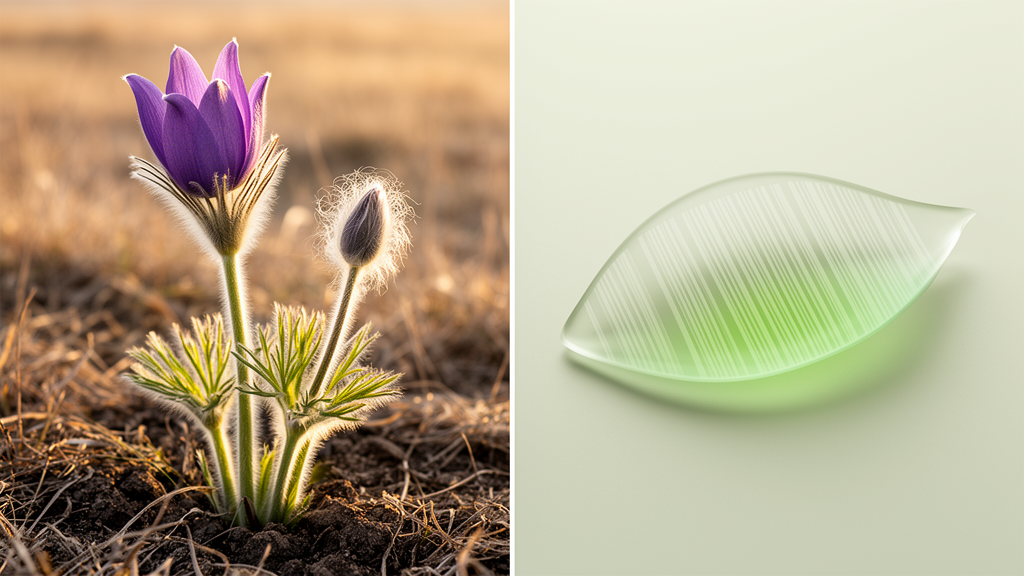
Complete chloroplast genomes have been promoted as a way to settle stubborn taxonomic puzzles in plants, but a new study of the pasqueflower Pulsatilla patens shows that the more thoroughly researchers look, the less useful the chloroplast becomes as a species identifier. The finding, published in BMC Plant Biology, turns a common assumption of DNA barcoding on its head.
Monika Szczecińska and colleagues sequenced 33 plastomes of P. patens within a genus-level dataset of 49 complete chloroplast genomes, and deliberately varied how many individuals they sampled per taxon. Their goal was to quantify, rather than assume, how diagnostic power depends on sampling depth in a lineage prone to reticulate evolution, the tribe Anemoneae.
On raw variation, P. patens looked exceptionally promising. The species carried 2,127 mutations, comprising 1,360 indels and 767 SNPs, concentrated in hotspots within the genes ycf1, rpoC2 and ndhF. Yet this richness failed to translate into diagnostic resolution.
Instead of forming a clean cluster, P. patens was not recovered as monophyletic. P. vernalis sat nested within its variation, and one morphologically typical P. patens individual from Slovakia carried a plastome approximately 99 percent identical to P. vernalis, a signature the authors interpret as a chloroplast capture event. After that individual was reassigned and the divergent Asian subspecies treated separately, only a single fixed diagnostic nucleotide remained for P. patens sensu stricto, located within ycf1.
The subsampling experiment delivered the study’s most striking result. When the same alignment was reduced to two individuals per taxon, the median count of diagnostic characters rose to 57, with a 95 percent range of 3 to 97. That interval contains the 67 diagnostic characters previously reported from a two-individual design, meaning earlier estimates describe the sampling regime rather than any property of the species itself.
The authors describe this as a superbarcoding paradox: increasing both data volume and sampling density removes the apparent basis for identification rather than strengthening it. Plastid data alone cannot separate historical introgression from retention of ancestral polymorphism, but either process predicts the loss of fixed differences that the dense sampling revealed.
Notably, the failure lies with the marker, not the species boundary. P. patens and P. vernalis remain morphologically unambiguous, so the species themselves are not in doubt. The study also found that plastid distance showed no significant association with habitat, and that the identified mutation hotspots performed no better than randomly positioned regions of equal length, undermining any hope of designing a targeted plastid barcode region for the group.
The authors caution that diagnostic-nucleotide counts published from sparse designs require reassessment under denser coverage, and that reliable identification and conservation-relevant genetic structure in this group will require nuclear data alongside the plastome. For a species complex of conservation concern, the message is sobering: a chloroplast genome that looked decisive with two samples per species can dissolve into a single fixed nucleotide once the full breadth of variation is sampled.
Subject of Research: Plastid super-barcoding and species delimitation limits in the Pulsatilla patens species complex
Article Title: Plastid super-barcoding in the pan-plastomic era: dense sampling of Pulsatilla patens plastomes exposes the limits of species delimitation in reticulate complexes
Article References: Szczecińska, M., Maździarz, M., Koczwara, K., Garbowska, A., & Sawicki, J. (2026). Plastid super-barcoding in the pan-plastomic era: dense sampling of Pulsatilla patens plastomes exposes the limits of species delimitation in reticulate complexes. BMC Plant Biology. https://doi.org/10.1186/s12870-026-10238-w
Image Credits: AI Generated
DOI: 10.1186/s12870-026-10238-w
Keywords: Pulsatilla patens, chloroplast genome, super-barcoding, species delimitation, chloroplast capture, introgression, Anemoneae, plastome, diagnostic nucleotides, sampling depth, ycf1, Pulsatilla vernalis
News Source: Drew Townsend. (October 29, 2026). Dense plastome sampling erases the barcode that once identified Pulsatilla patens. Scienmag.



