• HOME
  • NEWS
  • EXPLORE
    • CAREER
      • Companies
      • Jobs
    • EVENTS
    • iGEM
      • News
      • Team
    • PHOTOS
    • VIDEO
    • WIKI
  • BLOG
  • COMMUNITY
    • FACEBOOK
    • INSTAGRAM
    • TWITTER
Sunday, January 18, 2026
BIOENGINEER.ORG
No Result
View All Result
  • Login
  • HOME
  • NEWS
  • EXPLORE
    • CAREER
      • Companies
      • Jobs
        • Lecturer
        • PhD Studentship
        • Postdoc
        • Research Assistant
    • EVENTS
    • iGEM
      • News
      • Team
    • PHOTOS
    • VIDEO
    • WIKI
  • BLOG
  • COMMUNITY
    • FACEBOOK
    • INSTAGRAM
    • TWITTER
  • HOME
  • NEWS
  • EXPLORE
    • CAREER
      • Companies
      • Jobs
        • Lecturer
        • PhD Studentship
        • Postdoc
        • Research Assistant
    • EVENTS
    • iGEM
      • News
      • Team
    • PHOTOS
    • VIDEO
    • WIKI
  • BLOG
  • COMMUNITY
    • FACEBOOK
    • INSTAGRAM
    • TWITTER
No Result
View All Result
Bioengineer.org
No Result
View All Result
Home NEWS Science News Biology

Dengue virus becoming resistant to vaccines and therapeutics due to mutations in specific protein

Bioengineer by Bioengineer
September 20, 2019
in Biology
Reading Time: 2 mins read
0
IMAGE
Share on FacebookShare on TwitterShare on LinkedinShare on RedditShare on Telegram

IMAGE

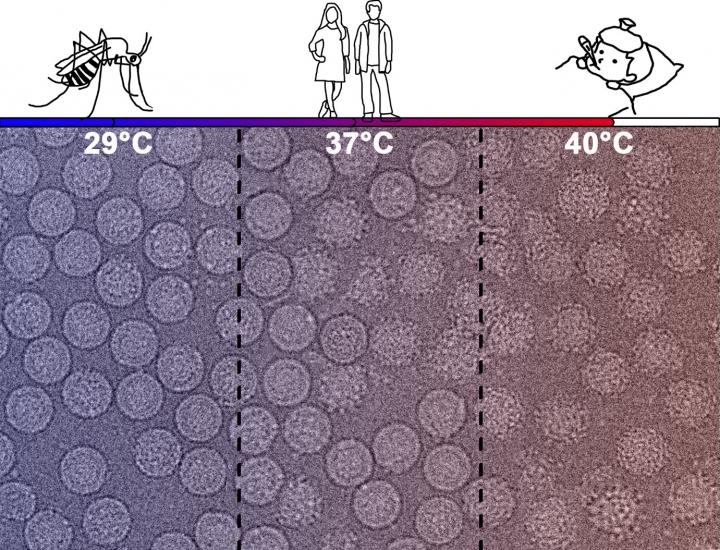
Credit: Xin-Ni Lim, Emerging Infectious Diseases Programme, Duke-NUS Medical School

Dengue virus (DENV) infects about 400 million people annually around the world, with a high prevalence in tropical and sub-tropical regions. The virus causes diseases ranging from mild dengue fever to severe dengue haemorrhagic fever and dengue shock syndrome.

DENV2 exists as smooth spherical surface particles while growing at the mosquito’s physiological temperature (29 degrees Celsius). It then changes to bumpy surfaced particles at human physiological temperature (37 degrees Celsius). This ability to morph helps the virus to evade the immune system of the human host. Hence, understanding the mechanism behind this is important for therapeutics and vaccine development.

“Together with Professor Pei-Yong Shi from UTMB, we found that in laboratory developed DENV2 strains, mutations in the virus’ E protein causes its transformation into bumpy particles. These structural changes can cause vaccines and therapeutics to be ineffective against the virus,” said Ms Xin-Ni Lim, the study’s lead author who is from Duke-NUS’ Emerging Infectious Diseases (EID) Programme.

The team also tested four DENV2 strains obtained from patients. They observed that in contrast to the laboratory adapted viruses, the majority of these clinical strains maintained smooth surface structure at 37 degrees Celsius. However, at 40 degrees Celsius, the temperature of a fever, all virus strains took on a bumpy surface.

“Our study gives a new direction to vaccine development and treatment for dengue disease. For prevention of disease through vaccines that are administered to the patient before dengue infection, we should use those that are effective against the smooth surface virus. When it comes to patients displaying fever symptoms, treatment strategies effective against the bumpy surface particles should be implemented,” said Dr Sheemei Lok, Professor, Duke-NUS’ EID and corresponding author of this study.

“This study is a first step towards gaining more insight into how DENV2 reacts and adapts to the host’s immunological defenses. We were also able to use computational modelling approaches to predict why particles from different DENV2 strains are more or less adept at morphing from the smooth to bumpy structures. By better understanding the interactions between the virus and the host, we will be able to develop better therapies and vaccines to treat or prevent infections, and contribute to public health outcomes,” said Dr Peter Bond, Principal Investigator from A*STAR’s BII.

The study’s findings also show that the lab adapted DENV2 may not be a good model for research, as its structure is different from the clinical strains isolated from patients. The team is planning to study the other DENV serotypes to find out if there are any other possible structural changes.

###

Media Contact
Lekshmy Sreekumar
[email protected]

Original Source

https://journals.plos.org/plospathogens/article?id=10.1371/journal.ppat.1007996

Related Journal Article

http://dx.doi.org/10.1371/journal.ppat.1007996

Tags: Health CareInfectious/Emerging DiseasesMedicine/HealthVirology
Share12Tweet8Share2ShareShareShare2

Related Posts

How Traits and Management Shape Equine Intelligence

January 18, 2026

Streamlined Protocols for Orbivirus Consensus Sequencing

January 18, 2026

Casein-Manganese Ferrite Nanostructures Extract Carotenoids

January 18, 2026

Chick Retina Shows Prolonged Wnt/β-Catenin Activation in Myopia

January 18, 2026
Please login to join discussion

POPULAR NEWS

  • Enhancing Spiritual Care Education in Nursing Programs

    155 shares
    Share 62 Tweet 39
  • PTSD, Depression, Anxiety in Childhood Cancer Survivors, Parents

    148 shares
    Share 59 Tweet 37
  • Robotic Ureteral Reconstruction: A Novel Approach

    78 shares
    Share 31 Tweet 20
  • Study Reveals Lipid Accumulation in ME/CFS Cells

    54 shares
    Share 22 Tweet 14

About

BIOENGINEER.ORG

We bring you the latest biotechnology news from best research centers and universities around the world. Check our website.

Follow us

Recent News

Cytokines and Estradiol: Age and Reproductive Impact

Innovative Remote Program for Opioid Use Disorder Pilot Test

How Traits and Management Shape Equine Intelligence

Subscribe to Blog via Email

Success! An email was just sent to confirm your subscription. Please find the email now and click 'Confirm' to start subscribing.

Join 71 other subscribers
  • Contact Us

Bioengineer.org © Copyright 2023 All Rights Reserved.

Welcome Back!

Login to your account below

Forgotten Password?

Retrieve your password

Please enter your username or email address to reset your password.

Log In
No Result
View All Result
  • Homepages
    • Home Page 1
    • Home Page 2
  • News
  • National
  • Business
  • Health
  • Lifestyle
  • Science

Bioengineer.org © Copyright 2023 All Rights Reserved.