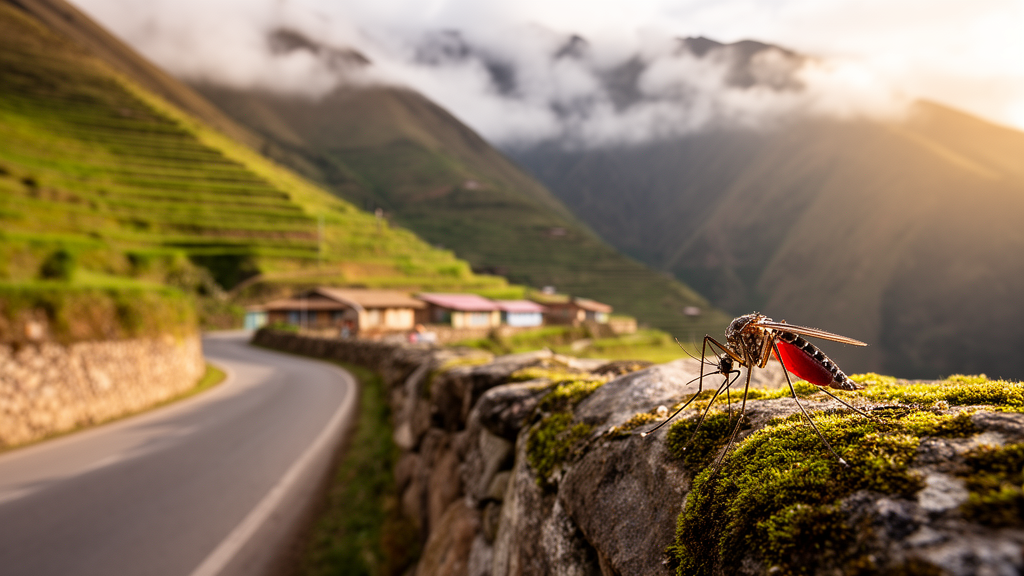
Dengue, a mosquito-borne flaviviral infection transmitted primarily by Aedes aegypti, is no longer confined to the steamy lowlands of Latin America. A systematic scoping review published in 2026 synthesizes decades of evidence showing that Aedes aegypti, the primary vector of the four antigenically distinct dengue virus serotypes, has breached the historical ecological barrier of 1,500 meters above sea level and established populations, in some cases with active viral transmission, at elevations approaching 2,500 meters in the Andes.
The scale of the underlying epidemic context is stark. World Health Organization surveillance recorded 14.6 million dengue cases and roughly 12,000 deaths in the most recent global tally, with the Region of the Americas accounting for nearly 13 million of those cases. Pan American Health Organization data show that by epidemiological week 16 of 2026, acute surges had struck Peru with a 46 percent increase, Ecuador with 25 percent, and Honduras with 55 percent relative to 2024 baselines, even as the Andean subregion fluctuated. Clinically, dengue follows an incubation period of 3 to 14 days and ranges from undifferentiated fever to severe disease marked by plasma leakage, hemorrhage, and organ impairment, which carries high mortality if unmanaged.
The review, conducted according to Joanna Briggs Institute methodology and reported under PRISMA-ScR guidelines, searched PubMed, Scopus, LILACS, and Web of Science through February 28, 2026. From 117 non-duplicate records, 28 articles published between 1981 and 2025 underwent full synthesis. The evidence concentrated on Colombia, Mexico, and Brazil, with additional documentation from Ecuador, Peru, and Bolivia, drawing on entomological field transects, ecological niche models such as MaxEnt, and climate-epidemiological time-series analyses. Substantial methodological heterogeneity across designs and outcome measures precluded quantitative meta-analysis, justifying a qualitative scoping approach.
The headline findings are striking in their specificity. In Cochabamba, Bolivia, field sampling confirmed established Aedes aegypti populations at 2,550 meters above sea level, with a household larval infestation rate of 38 percent. Colombian records documented the vector at up to 2,302 meters. In Puebla, Mexico, at approximately 2,150 meters, researchers captured both adult mosquitoes and pupae, indicating completion of the full biological cycle at that elevation. Crucially, the expansion is not merely entomological: in Colombia at 1,984 meters, natural infection of field-captured Aedes aegypti with dengue virus serotype 2 was confirmed by RT-PCR, demonstrating genuine viral circulation rather than incidental mosquito detection. Geometric morphometric evaluations of Andean populations also revealed significant variation in wing size and shape influenced by altitude, larval density, and nutritional availability, pointing to physical adaptation along elevational gradients.
The thermal biology underpinning this ascent is central to the story. Historically, the 1,500-meter boundary was treated as a static biological limit because ambient temperatures there consistently fell below the physiological minimum required for larval development, adult feeding, and extrinsic incubation of the virus within the mosquito. Classical guidance held that vector establishment required annual mean temperatures above 20 degrees Celsius, with epidemics typically occurring above 25 degrees. However, recent field and laboratory synthesis indicates that Aedes aegypti can now complete its life cycle near a lower physiological boundary of 15 to 17 degrees Celsius, exploiting thermal refuges in human-modified environments where outdoor larval development would otherwise halt. Remote sensing of land surface temperature suggests that nocturnal temperatures below 5 degrees Celsius remain the primary critical threshold limiting survival at altitude, and Colombian spatial modeling identified minimum nighttime land surface temperature and minimum altitude as the strongest predictors of risk areas.
Precipitation dynamics add a counterintuitive layer. Torrential rains often flush larvae out of breeding containers, temporarily suppressing Aedes aegypti. It is instead mild, intermittent rainfall, and especially drought-induced water scarcity, that drives expansion: when piped water supply fails, households store water in barrels and tanks, creating stable indoor aquatic microclimates that insulate larvae from the mountain cold. In Cochabamba, 85 percent of breeding sites were water-storage barrels or tanks. Work by Stewart-Ibarra and colleagues in Ecuador found that interruptions to public water supply forced 54 percent of households in peripheral areas to store water, increasing domestic container counts by 70 percent relative to areas with continuous service, and that these receptacles generated up to 69 percent of all Aedes aegypti pupae during drought periods. Meanwhile, the secondary vector Aedes albopictus surges during heavy rains and functions as a bridge vector in rural and peridomestic mountain areas up to 2,100 meters, with demonstrated capacity for viral dissemination to the salivary glands.
The coexistence of the two Aedes species at altitude challenges classical models of ecological exclusion. Traditional theory holds that invading Aedes albopictus displaces Aedes aegypti through satyrization, an asymmetric reproductive interference in which albopictus males sterilize aegypti females. The Andean gradients instead reveal effective coexistence and shared use of domestic containers: Aedes aegypti tolerates dense urban container habitat, while Aedes albopictus persists in more rural and peridomestic settings, and the abundance of artificial breeding sites appears to minimize habitat segregation between them.
Macroclimatic oscillations act as catalysts. In Peru, the El Niño-Southern Oscillation was associated with a relative risk of 1.17 for dengue outbreaks in high-altitude transition zones, a 17 percent increase attributable to sustained temperature spikes. In Brazil, prolonged thermal anomalies have converted elevated regions above roughly 1,100 meters into new high-incidence foci, a trend exacerbated by severe drought that intensifies household water storage. Satellite vegetation data reinforce the human fingerprint: pupal abundance at altitude correlates negatively with dense vegetation, indicating that the mosquito depends on artificial breeding sites and the thermal buffering of urban infrastructure rather than natural habitat. Rapid unplanned urbanization, deficient sanitary infrastructure, and high population density further compensate for suboptimal climate by increasing vector-human contact.
The projections are sobering. Historically, the 2,000-meter mark was considered an absolute continental barrier to dengue, with biological risk estimated below 1 percent. Predictive ecological niche models under shared socioeconomic pathways, including SSP2-4.5, SSP3-7.0, and SSP5-8.5, forecast a major displacement of bioclimatic suitability toward the Andean interior by 2050, potentially exposing approximately 30 million people to Aedes aegypti and 26 million to Aedes albopictus in previously non-endemic high-altitude territories. The review’s authors stress that these figures represent potential bioclimatic exposure based on suitability layers, not direct clinical incidence projections. Globally, prior modeling by Messina and colleagues suggests vector expansion into higher altitudes such as central Mexico alongside retreat from tropical lowlands where extreme heat above 35 degrees limits survival, while Ryan and colleagues estimated that under extreme RCP 8.5 scenarios nearly one billion people could face first dengue exposure in tropical highlands and temperate Europe.
To respond, the review proposes a four-pillar microclimatic surveillance framework to replace passive, elevation-based assumptions: satellite remote sensing of land surface temperature to detect nighttime thermal anomalies above vector survival thresholds, deployment of microclimate sensors in dense urban mountain zones, targeted inspection of domestic water-storage containers during dry seasons, and integration of microclimatic data into early warning systems that trigger vector control before seasonal epidemic surges.
Important limitations temper the conclusions. The evidence base is geographically concentrated in six countries, and substantial heterogeneity in study designs, elevation definitions, entomological indicators, and diagnostic methods precluded quantitative meta-analysis. Most included studies were ecological, cross-sectional, or modeling analyses, limiting causal inference and the ability to distinguish sustained establishment from temporary incursions during climatic anomalies. Human mobility between endemic lowlands and mountain cities also confounds passive surveillance, since imported cases can inflate apparent high-altitude risk. The authors emphasize that the 2,500-meter observation is a localized maximum rather than a universal limit, and they call for longitudinal, standardized, multicountry studies to confirm persistence and refine shifting altitudinal thresholds as the climate continues to warm.
Subject of Research: Altitudinal expansion of dengue and Aedes aegypti into high-altitude areas of Latin America
Article Title: Dengue and Aedes aegypti Expansion into High-Altitude Areas of Latin America: A Scoping Review
Article References: Chimbo-Paz, B. M., Acosta España, J. D., & Rodriguez-Morales, A. J. (2026). Dengue and Aedes aegypti Expansion into High-Altitude Areas of Latin America: A Scoping Review. New Microbes and New Infections, Article 101873. https://doi.org/10.1016/j.nmni.2026.101873
Image Credits: AI Generated
DOI: 10.1016/j.nmni.2026.101873
Keywords: dengue, Aedes aegypti, Aedes albopictus, altitude, Andes, climate change, vector-borne disease, scoping review, Latin America, El Nino, water storage, urbanization
News Source: Phoebe Ingram. (October 23, 2026). Dengue and Its Mosquito Vector Are Climbing Into Latin America’s High Mountains. Scienmag.