Made up of Tunisia, Libya, Morocco, Egypt and Algeria, north Africa is a melting pot of cultures with two predominant human populations with their own language and culture: the Arabs and the Imazighen. Part of their history has been buried beneath the desert, from which some research has extracted human remains up to 300,000 years old. However, their origins remained a mystery.
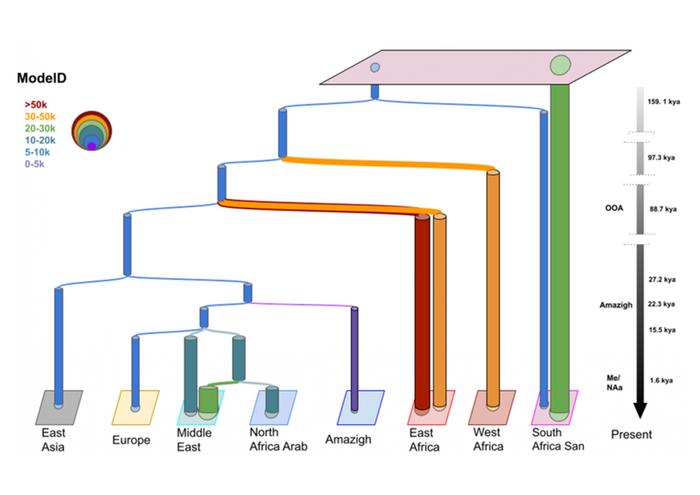
Credit: Genome Biology
Made up of Tunisia, Libya, Morocco, Egypt and Algeria, north Africa is a melting pot of cultures with two predominant human populations with their own language and culture: the Arabs and the Imazighen. Part of their history has been buried beneath the desert, from which some research has extracted human remains up to 300,000 years old. However, their origins remained a mystery.
Now, research led by David Comas, a full professor at the UPF Department of Medicine and Life Sciences (MELIS) and principal investigator at the Institute of Evolutionary Biology (IBE), a joint centre of the Spanish National Research Council (CSIC) and the Pompeu Fabra University (UPF), and Òscar Lao, also an IBE principal investigator, has discovered, using artificial intelligence tools, that the Imazighen (Amazigh in the singular) and the Arab people of north Africa have different genetic origins. For the first time, the study reveals that the two separated more than 20,000 years ago and sheds light on the region’s complex demographic history.
The ancestors of the Imazighen reach north Africa more than 20,000 years ago
Due to its geographical location, north Africa is a conclave of cultures that has received people from Europe, the Middle East and sub-Saharan Africa for thousands of years. This confluence of populations has enriched the population genome of the region, generating a complex phylogenetic puzzle.
To shed light on the origin and evolution of the Arab and Imazighen populations, the team conducted a comprehensive analysis of 364 complete genomes from different populations. To do so, it developed an innovative computational model with natural computing methods, within the field of artificial intelligence, dubbed “genetic programming for population genetics” (GP4PG). The results reveal that the differentiation between the Arab people and the Amazigh took place far earlier than expected.
“The new GP4PG model has allowed a more precise, robust and refined analysis, which for the first time clearly separates the two peoples more than 20,000 years ago, when the Imazighen returned to Africa from Eurasia in the movement known as ‘back to Africa’”, says Óscar Lao, principal investigator of the Institute of Evolutionary Biology (IBE).
“Human remains from about 22,000 years old have been found in Morocco that, according to these results, could be the ancestors of today’s Imazighen”, says David Comas, a full professor of Anthropology at the MELIS-UPF and a researcher at the IBE.
Arabs and Imazighen reached north Africa thousands of years apart
The Arab and Amazigh peoples arrived in north Africa with the migratory phenomenon known as “back to Africa”, after the departure by human populations out of Africa, a population movement whose genetic legacy endures today in its inhabitants.
“With this study we have seen that Arabs and Imazighen have not separated recently due to a question of geography, culture or language, but the genomes confirm that they became genetically differentiated about 20,000 years ago due to the different times at which the two populations colonized north Africa”, David Comas comments.
Previous studies argued that the region’s current Arab population originated in the Neolithic. However, research reveals that the majority of the Arab population colonized north Africa from the Middle East much later, during the “Arabization” of the 7th century AD.
Thus, this would be the cause of the close genetic relationship between today’s Arab populations of north Africa and those of the Middle East.
“With the GP4PG model we can observe that the arrival of the Arab people around 600 AD generated a gradual genetic gradient that declines from east to west, from the Middle East to sub-Saharan Africa”, Óscar Lao comments.
Journal
Genome Biology
DOI
10.1186/s13059-024-03341-4
Method of Research
Experimental study
Subject of Research
People
Article Title
Modelling the demographic history of human North African genomes points to a recent soft split divergence between populations
Article Publication Date
1-Aug-2024
COI Statement
none