A comprehensive scientific review published in the Journal of Occupational Medicine and Toxicology synthesizes growing evidence regarding the occupational and public health hazards associated with deer keds, blood-feeding flat flies classified within the Diptera family Hippoboscidae under the genera Lipoptena and Neolipoptena. Authored by Markus Braun, Doris Klingelhöfer, Dörthe Brüggmann, and Isabelle Marie Kramer, the investigation details how these ectoparasites, historically regarded merely as forest nuisances, represent an underestimated clinical risk. Although deer keds primarily target cervid hosts such as red deer, roe deer, white-tailed deer, moose, and reindeer, as well as domestic bovids like goats, they also seek accidental blood meals from domestic dogs, horses, and humans. Over recent years, researchers utilizing molecular detection methods have identified a broad spectrum of infectious disease agents within deer keds, spanning bacteria such as Acinetobacter, Anaplasma, Bartonella, Borrelia, Coxiella, Francisella, Mycoplasma, Rickettsia, and Chlamydia-like organisms, protozoa including Trypanosoma and Babesia, and emerging viral pathogens such as Sigmavirus lipoptenae and Severe Fever with Thrombocytopenia Syndrome Virus.
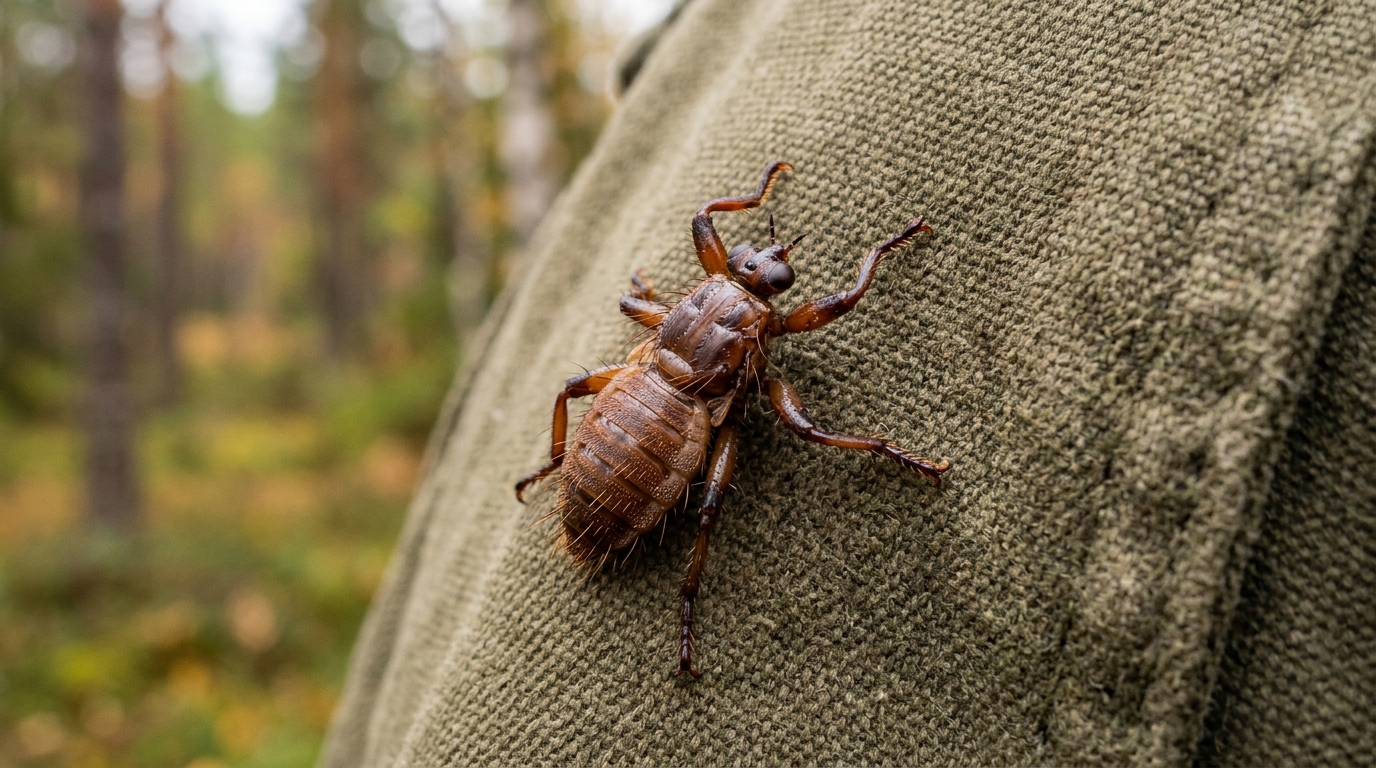
The biological architecture and parasitic behaviors of deer keds underpin both their ecological success and the distinct challenges they present to clinical diagnosis. Measuring between three and five millimeters in length, adult deer keds exhibit a dorsoventrally flattened profile and a light-to-dark brown coloration. Unlike agile biting insects capable of sustained flight over significant distances, winged adult keds cannot fly beyond approximately fifty meters in search of hosts, instead utilizing a sit-and-wait ambush strategy from vegetation. Upon successfully landing on a host animal, an adult ked sheds its wings permanently, transitioning to an obligate flightless existence within the pelage where it feeds intermittently on vertebrate blood. A single female produces and incubates a single pre-pupa internally until full maturity, subsequently depositing twenty to thirty pupae across its lifespan of roughly one year that fall to the forest floor to pupate. When keds land on accidental human hosts, they paradoxically shed their wings despite being unable to establish reproductive populations on people, remaining adhered to human hair or garments while feeding repeatedly in small blood meals, typically fifteen to twenty times per day.
Human interactions with deer keds commonly result in characteristic dermatological and immunological conditions that present distinct differential diagnostic hurdles. Because keds feed briefly and sporadically during each meal, initial bites are frequently painless and produce minimal immediate skin disruption, causing many patients to remain unaware of the exposure. Cutaneous symptoms typically manifest six to twenty-four hours post-exposure, driven by host immune sensitization to antigens present in ked salivary secretions. Patients frequently exhibit deer ked dermatitis, defined by clusters of several up to twenty to fifty scattered, irregularly shaped red or pink papules distributed predominantly across the scalp, neck, and upper back. Within days, these sites can progress into firm, itchy, erythematous welts or plaques up to twenty-five millimeters across, often featuring an intense pruritus that persists from eight to twenty days and can endure for several months or up to a full year in sensitized individuals. Such chronic lesions risk secondary bacterial infections from scratching. In contrast to tick bites, which typically present an erythematous-infiltrated lesion with poorly defined margins resolving in days, or the classic expanding erythema migrans characteristic of early Lyme borreliosis, ked dermatitis lesions remain localized, itchy, and hyperpigmented for extended intervals. Beyond cutaneous manifestations, documented medical cases also describe acute, immunoglobulin E-mediated occupational allergic rhinoconjunctivitis triggered by exposure to high concentrations of airborne deer ked antigens or hand-to-eye contact among forestry personnel.
Among the bacterial agents detected in deer keds, Bartonella species represent the most prominent candidate for active vectoring, with deer keds identified as a highly probable vector for Bartonella schoenbuchensis. Multiple field studies have documented Bartonella DNA within European deer keds, Lipoptena cervi, and the neotropical species Lipoptena mazamae, demonstrating colonization of the arthropod midgut where replication occurs, as well as vertical transmission from wingless adult females to larvae and transstadial persistence through pupation to winged adults. Clinical hypotheses directly link Bartonella schoenbuchensis to human deer ked dermatitis, accompanied by elevated total serum immunoglobulin E levels. However, medical evidence remains nuanced; a recent 2025 immunological investigation revealed no statistically significant increase in specific anti-Bartonella schoenbuchensis immunoglobulin G titers among German forestry workers compared with unexposed control populations, indicating that while vector competence is biologically plausible, active transmission efficiency and human seroprevalence require rigorous verification. DNA belonging to other Bartonella species, including sequences closely resembling Bartonella henselae, has also been detected in deer keds, although direct transmission of cat-scratch disease or trench fever through ked bites lacks definitive experimental verification.
Molecular surveillance has also frequently identified Anaplasma species within deer keds collected from wild cervids across Europe, Canada, the United States, Japan, and Thailand. Obligate intracellular bacteria such as Anaplasma phagocytophilum, the etiological agent of veterinary anaplasmosis and human granulocytic anaplasmosis, and Anaplasma ovis, an intraerythrocytic pathogen of domestic ruminants, have been detected via polymerase chain reaction in species including Lipoptena cervi, Lipoptena fortisetosa, and Lipoptena depressa. Human granulocytic anaplasmosis represents an emerging zoonosis characterized by an incubation period of five to twenty-one days followed by nonspecific febrile illness, thrombocytopenia, lymphopenia, and transaminase elevations, potentially progressing to severe complications in elderly or immunocompromised patients. While Anaplasma DNA presence in keds is well-documented, current evidence indicates that deer ked involvement in human transmission remains unproven, pointing toward potential mechanical carriage via contaminated mouthparts rather than verified biological vector competence.
The review additionally evaluates the presence of Borrelia burgdorferi sensu lato, the spirochete responsible for Lyme borreliosis, as well as Rickettsia, Coxiella, and Francisella species within deer keds. Although researchers have repeatedly amplified Borrelia DNA from host-seeking and host-collected Lipoptena cervi and Lipoptena fortisetosa in Poland, the Czech Republic, Canada, and Japan, there is currently no direct empirical proof demonstrating that keds can biologically maintain or transmit viable spirochetes to mammalian hosts. Similarly, while spotted fever group Rickettsia DNA, Coxiella burnetii DNA, and Francisella sequences have been detected in various ked populations across Europe and Asia, many of these findings may represent nonpathogenic endosymbionts, such as Francisella-like endosymbionts or rickettsial mutualists exhibiting genetic similarity to dangerous pathogens but lacking active virulence determinants. Current consensus dictates that deer keds cannot be classified as proven biological vectors for Lyme disease, Q fever, spotted fevers, or tularemia, with observed transmission risks likely constrained to incidental mechanical transfer.
Beyond bacteria, deer keds harbor unicellular protozoan parasites and emerging viruses that broaden their veterinary and public health profile. Parasitological surveys in Poland, Germany, and Venezuela have detected flagellated Trypanosoma protozoa, particularly species within the subgenus Megatrypanum that naturally infect cervids and bovids, within the midgut and hindgut of Lipoptena cervi and Lipoptena fortisetosa, though none of the identified strains appear pathogenic to humans. Intraerythrocytic Babesia protozoa have also been detected by molecular methods in Polish keds, though biological transmission to mammals has not been demonstrated. More recently, advanced metagenomic sequencing has uncovered novel viral associations, including Sigmavirus lipoptenae, an arthropod-associated rhabdovirus discovered within the microbiome of British Lipoptena cervi, and molecular detection in 2025 of the tick-borne Severe Fever with Thrombocytopenia Syndrome Virus within Lipoptena fortisetosa collected from ungulates in South Korea, demonstrating that deer keds participate in the broader ecological dynamics of high-consequence viral pathogens.
Ecological and meteorological shifts driven by ongoing climate change are actively reshaping the geographic distribution, density, and seasonal exposure windows of deer ked populations across the Northern Hemisphere. Warmer baseline temperatures and extended growing seasons have enabled both cervid hosts and their associated ectoparasites to expand their ranges into higher northern latitudes and elevated altitudes across Europe, Siberia, China, and North America. Milder conditions further prolong larval development rates and expand host-seeking flight periods, which vary markedly by species; Lipoptena cervi typically exhibits peak flight activity in late summer and autumn, while introduced Lipoptena fortisetosa emerges earlier in the year. In regions such as Finland and Poland, where widespread human recreational activities including mushroom gathering, hiking, and hunting coincide with ked flight seasons, reports of persistent ked bites and chronic dermatitis have steadily increased since the 1970s. The presence of localized, high-density environmental infestations, termed hotspots, has been observed in areas such as Pennsylvania and Ontario, illustrating significant geographic variation in exposure intensity.
To mitigate occupational and recreational exposure, the authors outline clear preventive strategies alongside current technical limitations in vector control. Permethrin-treated garments provide the most potent individual protection; experimental assays show that exposure to permethrin kills deer keds with a median survival time of thirty-five minutes, achieving total mortality within an hour. In contrast, common chemical repellents such as diethyltoluamide, ethyl butylacetylaminopropionate, picaridin, and oil of lemon eucalyptus kill keds at substantially slower rates and completely fail to provide genuine spatial repellency against aggressive landing behavior. Visual cues also influence infestation risk: Lipoptena cervi is preferentially attracted to dark and red colors while avoiding white or bright fabric, whereas Lipoptena fortisetosa shows strong behavioral attraction toward blue surfaces over red, green, black, or yellow panels. Broad environmental interventions, such as host deer culling, livestock treatment with ivermectin, or sterile insect techniques, remain economically impractical or challenging across wild populations, although managing co-feeding tick densities can reduce inter-parasite pathogen exchange.
Ultimately, the review emphasizes that deer keds should no longer be disregarded as mere outdoor nuisances, given their ability to induce chronic, debilitating dermatitis, provoke occupational respiratory allergies, and harbor diverse zoonotic agents. While their sporadic feeding biology—consuming small blood meals fifteen to twenty times daily rather than remaining attached for days like ticks—likely lowers the relative efficiency of systemic pathogen intake and delivery, their sheer local abundance poses measurable occupational hazards for foresters, naturalists, farmers, and park staff. The authors stress the necessity of educational campaigns for outdoor workers, mandatory inclusion of deer ked bites within differential clinical diagnoses in endemic regions, and targeted laboratory research to directly measure the vector competence and mechanical transmission rates of these ubiquitous ectoparasites.
Subject of Research: Health hazards and pathogen transmission potential of deer keds in occupational and public health
Article Title: The role of deer keds (Diptera: Hippoboscidae: Lipoptena and Neolipoptena) in occupational and public health
Article References: Braun, M., Klingelhöfer, D., Brüggmann, D., & Kramer, I. M. (2025). The role of deer keds (Diptera: Hippoboscidae: Lipoptena and Neolipoptena) in occupational and public health. Journal of Occupational Medicine and Toxicology, 20(1), Article 45. https://doi.org/10.1186/s12995-025-00490-5
Image Credits: AI Generated
DOI: 10.1186/s12995-025-00490-5
Keywords: deer keds, Lipoptena cervi, Lipoptena fortisetosa, Hippoboscidae, vector-borne diseases, zoonosis, occupational health, Bartonella schoenbuchensis, Anaplasma phagocytophilum, Borrelia burgdorferi, Coxiella burnetii, Francisella tularensis, parasitology, entomology, climate change, deer ked dermatitis, permethrin, SFTSV
News Source: Kristina Jarvis. (November 20, 2026). Deer Keds Pose Emerging Occupational Risks and Carry Multiple Zoonotic Pathogens. Scienmag.