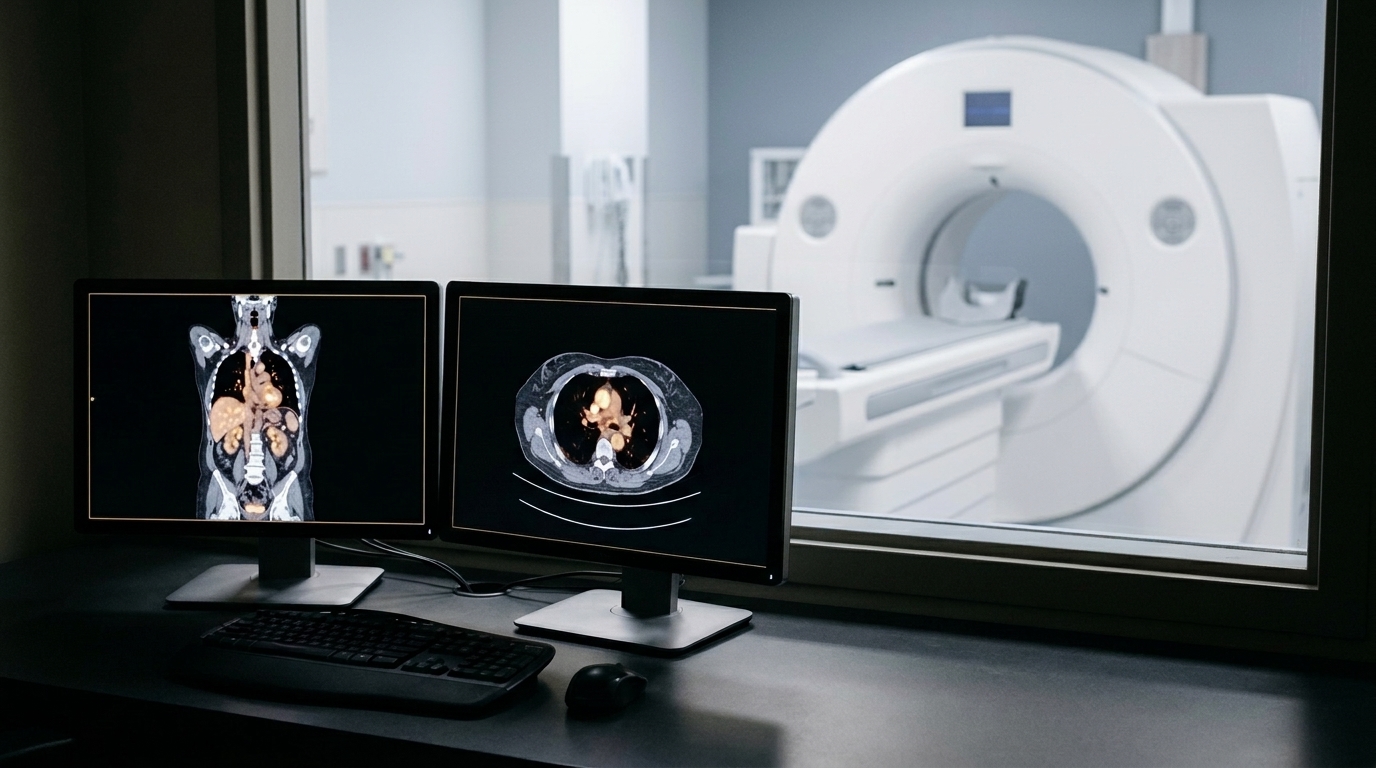
A rigorous test-retest imaging investigation evaluating automated quantitative measurements in men with metastatic prostate cancer has demonstrated that an artificial intelligence-derived continuous lesion index and mean standardized uptake value exhibit exceptional repeatability across repeated positron emission tomography scans. Published in the European Journal of Nuclear Medicine and Molecular Imaging, the study evaluated paired fluorine-18-DCFPyL prostate-specific membrane antigen positron emission tomography computed tomography examinations conducted without intervening antineoplastic therapy. The investigators established that the Prostate Cancer Molecular Imaging Standardized Evaluation framework-based lesion index achieved the lowest measurement variability across all tested parameters, closely followed by the mean standardized uptake value among conventional tracer uptake metrics. In contrast, volume-dominated parameters displayed substantially greater variability, underscoring the critical need to establish formal repeatability benchmarks before clinical teams can reliably utilize automated artificial intelligence metrics to distinguish true therapeutic response from technical imaging noise.
Prostate cancer remains one of the most frequently diagnosed malignancies among men worldwide and continues to be a substantial contributor to cancer-related mortality. The management of advanced disease hinges upon accurate detection, precise anatomical localization, and meticulous longitudinal characterization of metastatic spread to osseous, nodal, and visceral compartments. In recent years, prostate-specific membrane antigen-targeted positron emission tomography combined with computed tomography has emerged as a transformative imaging modality. The fluorine-18-labeled radiotracer 18F-DCFPyL has demonstrated clinical utility across primary staging and biochemical recurrence settings in major multicenter clinical trials. Beyond initial disease detection, PSMA PET is increasingly employed to identify candidates for PSMA-directed radioligand therapy and to monitor therapeutic efficacy over time, intensifying the clinical demand for objective, reproducible, and standardized quantitative imaging biomarkers.
To transition from subjective visual interpretation toward standardized quantitative assessment, clinical oncology and nuclear medicine frameworks rely on standardized uptake value calculations alongside anatomical volume measurements. Standard quantitative PET metrics include the maximum standardized uptake value, peak standardized uptake value, and mean standardized uptake value, alongside composite volume-dominated metrics such as total standardized uptake and overall lesion volume. Although these quantitative frameworks promise enhanced objectivity in assessing metastatic burden, their ultimate clinical utility depends fundamentally on repeatability under stable conditions. When patients undergo repeated imaging under identical biological circumstances without intervening therapy, an optimal biomarker must yield stable values within a narrow, predictable margin to prevent misclassifying measurement variability as disease progression or therapeutic efficacy.
The post hoc lesion-level test-retest investigation was conducted using a prospectively collected cohort of twenty-two men with histologically confirmed metastatic prostate cancer enrolled under an institutional review board-approved protocol. Each participant underwent two comprehensive mid-thigh-to-skull-vertex 18F-DCFPyL PSMA PET/CT scans performed on an identical Siemens Biograph mCT 128-slice scanner. The paired imaging sessions were separated by a short inter-scan interval ranging between one and seven days, with a mean separation of 3.68 ± 3.01 days. Crucially, no tumor-specific therapy was administered between the baseline scan and the follow-up retest. Patients received an intravenous injection of 18F-DCFPyL with a mean administered activity of 323 megabecquerels and were imaged approximately sixty minutes post-injection. Both imaging acquisitions for each individual patient maintained identical acquisition times and reconstruction parameters, utilizing low-dose computed tomography for precise anatomical co-registration and attenuation correction.
Automated lesion detection, segmentation, and quantification were executed using the commercially available, United States Food and Drug Administration-cleared aPROMISE platform, version 2.5.1, developed by EXINI Diagnostics. The software settings and underlying algorithmic version were locked prior to data processing to guarantee analytical consistency. The platform combines convolutional neural networks applied to the low-dose computed tomography images for full-body anatomical segmentation with a fast-marching level-set algorithm operating on the PET data to delineate candidate hotspots without imposing an arbitrary standardized uptake value threshold. Following algorithmic hotspot extraction, an experienced board-certified radiologist with more than five years of specialized PSMA PET/CT experience independently validated every identified focus, manually removing false-positive detections. Retained lesions across baseline and follow-up examinations were subsequently paired using automated deformable image registration that required identical anatomical compartments and either a spatial centroid distance within ten millimeters—or fifty millimeters for thoracic and rib lesions subject to respiratory excursion—or a volumetric overlap exceeding twenty percent.
The matching algorithm successfully paired 292 distinct lesion pairs across twenty evaluable patients, while two patients were excluded from downstream analyses due to a lack of successfully matched lesions after manual quality control. Among candidate foci, 11.5 percent of test lesions and 9.9 percent of retest lesions remained unmatched; these unmatched foci were predominantly small and exhibited modest uptake, displaying a median volume of 0.22 cubic centimeters and a median maximum standardized uptake value of 2.7. The distribution of paired lesions was heterogeneous among the participant cohort, ranging from 1 to 125 pairs per patient, with a median of four lesions per subject. The two patients presenting with the most extensive metastatic burden contributed 42.8 percent and 14.7 percent of the entire lesion dataset, respectively. Evaluated lesions were predominantly osseous metastases, accounting for 241 paired foci or 82.5 percent, alongside 43 lymph node metastases representing 14.7 percent, 5 visceral or soft-tissue lesions constituting 1.7 percent, and 3 primary prostatic lesions representing 1.0 percent.
Statistical evaluation of test-retest repeatability was conducted at the matched-lesion level, conditioning all estimates on successful lesion identification and spatial co-registration across both scans. The primary metric of repeatability was the within-subject coefficient of variation, calculated as the root mean square of individual lesion coefficients of variation, where lower values signify superior repeatability. Relative measurement reliability was concurrently quantified using the intraclass correlation coefficient under a two-way random-effects, single-measurement, absolute-agreement model, denoted as ICC(2,1). In addition, Bland-Altman analysis was conducted on the natural logarithmic scale to account for the heavy-tailed, right-skewed distribution of quantitative PET parameters. The resulting 95 percent limits of agreement were subsequently back-transformed into percentage change values to facilitate direct clinical interpretation. To account for statistical clustering arising from multiple lesions nested within individual patients, 95 percent confidence intervals were derived using a patient-level cluster bootstrap based on 5,000 resamples.
The quantitative results demonstrated a clear separation in repeatability performance across the distinct feature categories. The PROMISE-criteria-based continuous lesion index exhibited the highest repeatability of all evaluated metrics, achieving a within-subject coefficient of variation of 3.88 percent, an ICC(2,1) of 0.986, and back-transformed 95 percent limits of agreement spanning from −9.4 percent to 12.2 percent. Among the conventional uptake metrics, the mean standardized uptake value demonstrated the strongest repeatability, recording a within-subject coefficient of variation of 7.04 percent, an ICC(2,1) of 0.984, and limits of agreement ranging from −17.1 percent to 22.7 percent. Maximum standardized uptake and peak standardized uptake showed slightly wider limits of agreement. Conversely, the volume-dominated parameters displayed pronounced measurement variability: total standardized uptake yielded a within-subject coefficient of variation of 24.92 percent, while segmented lesion volume yielded 24.53 percent, with both metrics exhibiting substantially wider limits of agreement.
To explore the influence of lesion dimensions on quantitative stability, the authors conducted exploratory sensitivity analyses stratifying lesions into three distinct cohorts: the complete cohort of 292 matched pairs, 150 pairs with a mean test-retest volume exceeding 1.0 cubic centimeter, and 123 pairs with a mean volume exceeding 1.5 cubic centimeters. Imposing volume thresholds systematically narrowed the 95 percent limits of agreement and reduced percentage-based variability across all parameters, with the most dramatic improvements observed for volume-dominated features. For lesions exceeding 1.5 cubic centimeters, the within-subject coefficient of variation for mean standardized uptake value decreased further to 5.65 percent. The investigators attributed this finding to the heightened susceptibility of small PET lesions to partial-volume averaging, image noise, and boundary segmentation uncertainty when occupying only a small number of reconstructed voxels. Importantly, the relative ordering of feature repeatability was preserved across all volume thresholds, confirming the intrinsic stability of the lesion index and mean uptake.
Anatomical site comparisons between 241 bone lesions and 43 lymph node lesions revealed that nodal metastases exhibited numerically lower within-subject coefficients of variation across all six evaluated parameters. However, lymph node lesions in this cohort were systematically larger than bone lesions. When the comparative analysis was restricted to lesions with a mean test-retest volume greater than 1.0 cubic centimeter, the numerical disparity in mean standardized uptake value repeatability largely diminished between anatomical compartments.
Sensitivity analyses addressing technical parameters of the scoring scale and scan intervals provided additional insights into the robustness of the automated platform. Because the PROMISE lesion index features an upper bound capped at 3.0, the authors evaluated whether exact ceiling agreement artificially inflated its repeatability. Twenty-five lesion pairs reached the 3.0 maximum on both scans, four reached it at baseline only, and five reached it at retest only; excluding these ceiling pairs produced minimal alteration in within-subject coefficients of variation or limits of agreement. Descriptive comparisons between patients scanned one day apart and those imaged six to seven days apart demonstrated preserved feature hierarchies, although the six-to-seven-day group exhibited wider agreement limits. Because the two interval cohorts comprised different patients, distinct lesion sizes, and disparate lesion counts, these differences could not be attributed definitively to the temporal gap. Furthermore, utilizing patient-level cluster bootstrapping produced broader confidence intervals than independent lesion resampling across 81 of 90 evaluated estimates, confirming that ignoring intra-patient correlation overstates analytical precision.
The study authors highlighted several methodological limitations that frame the interpretation of their findings. The investigation was conducted at a single academic institution utilizing a single scanner model with standardized acquisition and reconstruction protocols. Consequently, the reported limits of agreement cannot be directly extrapolated to multi-center settings involving heterogeneous imaging hardware, differing reconstruction filters, or alternative radiopharmaceutical production sites without prospective validation. Although patients received no antitumor therapy during the inter-scan interval, unmeasured physiological fluctuations, including hydration state and urinary bladder clearance, could have introduced biological variability. Furthermore, repeatability was assessed exclusively on successfully detected and paired lesions, omitting small, low-uptake lesions that failed algorithmic matching. Finally, the authors stressed that while high test-retest repeatability is an indispensable prerequisite for any clinical imaging biomarker, repeatability alone does not confirm biological sensitivity to treatment response, predictive value, or clinical utility, necessitating prospective trials to establish definitive clinical thresholds.
Subject of Research: Test-retest repeatability of quantitative deep learning-derived PSMA PET parameters in metastatic prostate cancer
Article Title: Test-retest repeatability of deep learning-enabled quantitative PET parameters and PROMISE criteria-based lesion index in 18F-DCFPyL PSMA-PET/CT
Article References: Islam, M. Z., Gulpe, A., Richter, J., Werner, R. A., Bundschuh, R. A., Gorin, M. A., Pomper, M. G., Anand, A., & Rowe, S. P. (2027). Test-retest repeatability of deep learning-enabled quantitative PET parameters and PROMISE criteria-based lesion index in 18F-DCFPyL PSMA-PET/CT. European Journal of Nuclear Medicine and Molecular Imaging, 54(1), Article 49. https://doi.org/10.1007/s00259-026-08314-2
Image Credits: AI Generated
DOI: 10.1007/s00259-026-08314-2
Keywords: PSMA PET CT, 18F-DCFPyL, prostate cancer, test-retest repeatability, aPROMISE, lesion index, PROMISE criteria, SUVmean, SUVmax, SUVtotal, imaging biomarkers, nuclear medicine, deep learning, radiotracer, within-subject coefficient of variation, limits of agreement, intraclass correlation coefficient
News Source: Blake Davidson. (November 27, 2026). Deep Learning PSMA PET Analysis Demonstrates High Repeatability for Lesion Index and SUVmean. Scienmag.