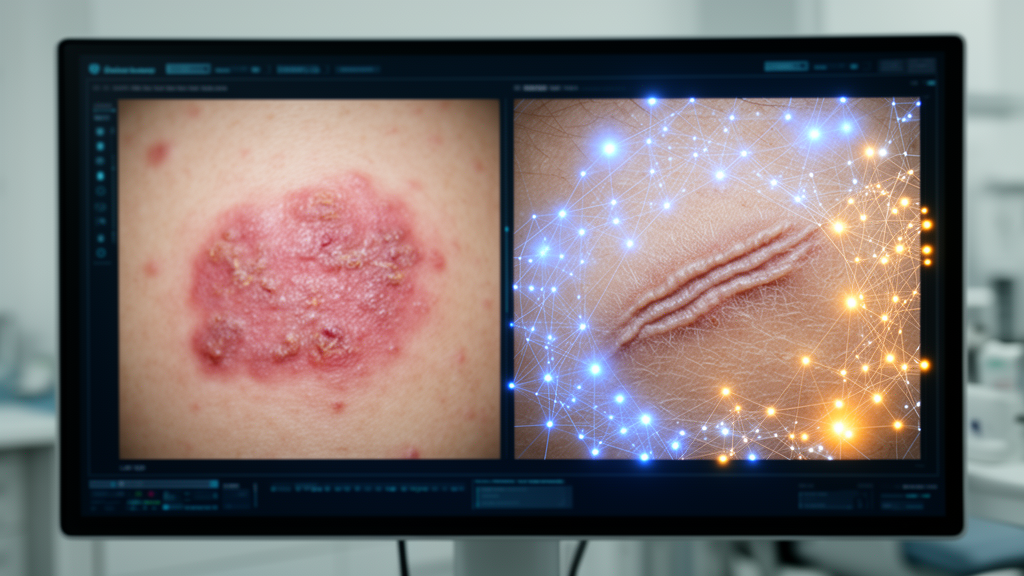
In an experimental investigation evaluating computer vision approaches for challenging dermatological differential diagnoses, researchers tested five pretrained deep learning architectures on a curated multisource dataset to distinguish between atopic dermatitis and scabies. Across a standardized experimental setup, the tested configurations achieved validation classification accuracies ranging between 92.94% and 96.65% on a holdout evaluation subset of 269 images. The convolutional neural network architecture ResNet-50 recorded the highest observed validation accuracy and weighted F1-score of 96.65% within this single-run comparison. The authors noted that these performance values were obtained on the same holdout validation set utilized for model checkpoint selection, meaning that the numerical metrics carry optimistic bias and serve as preliminary descriptive observations rather than definitive estimates of generalized clinical performance.
Eczema and scabies represent two of the most prevalent skin conditions globally, placing substantial operational demands on healthcare delivery systems due to high incidence and diagnostic overlap. Eczema, also designated as atopic dermatitis, is a chronic inflammatory disorder marked by erythema, pruritus, xerosis, and lichenification, frequently linked with immune dysregulation and environmental factors. Conversely, scabies is an intensely contagious parasitic infestation caused by Sarcoptes scabiei, presenting with severe itching, erythematous papules, burrows, and secondary bacterial infections. Because management strategies differ fundamentally—requiring anti-inflammatory or immunomodulatory therapy for eczema and targeted anti-parasitic treatment for scabies—accurate distinction is critical to prevent prolonged transmission, unnecessary drug exposure, or therapeutic failure, particularly in resource-limited clinics lacking access to specialized dermoscopy or skin-scraping procedures.
To construct a broader empirical base than single-center repositories allow, the investigative team curated a composite dataset from three geographically distinct sources: DermNet, capturing predominantly Western patient cohorts; PASSION MICCAI 2024, representing African populations; and DermaCon-IN, reflecting cases from the Indian subcontinent. Combining these repositories yielded a total collection of 2,824 dermatologist-annotated images, comprising 1,425 images of atopic dermatitis and 1,399 images of scabies. Original diagnostic labels provided by the source dataset documentation were retained without secondary rereading, adjudication of disagreements, or inter-rater reliability analysis by the authors. The researchers highlighted that while aggregating multiregional sources increases visual and geographic heterogeneity, geographic diversity alone does not ensure standardized skin-tone representation or demographic fairness across clinical subgroups.
The data partitioning framework was designed to pool images while respecting source-level boundaries where verifiable documentation existed. The complete curated corpus was divided into a training partition of 2,555 images, consisting of 1,283 eczema and 1,272 scabies cases, and a single holdout validation partition of 269 images, containing 142 eczema and 127 scabies cases, establishing an approximate 90:10 overall split. Images selected from source training folders remained in the combined training set, while source test subsets were mapped exclusively to the holdout validation partition. This preserved the documented patient-wise separation of the PASSION dataset and the subject-wise disjoint partitioning of DermaCon-IN. For DermNet, however, patient identifiers were unavailable, preventing absolute verification of patient-level separation across its predefined folders. All images were uniformly resized to 224 by 224 pixels and normalized using ImageNet channel mean and standard deviation vectors.
Data augmentation was applied exclusively during the training phase via the Albumentations library to expand visual variability and mitigate potential overfitting. The stochastic transformation pipeline incorporated horizontal flipping with a probability of 0.5, vertical flipping with a probability of 0.5, random orthogonal rotations by 90, 180, or 270 degrees with a probability of 0.5, and image sharpening with a probability of 0.5. These operations were chosen to reduce model sensitivity to varying camera angles and sharpness discrepancies arising across heterogeneous imaging devices. No augmentation was introduced into the holdout validation images, ensuring that validation evaluations remained strictly deterministic.
The experimental comparison evaluated five prominent deep learning architectures spanning classical convolutional neural networks and self-attention transformer frameworks: ResNet-50, EfficientNet-B0, ConvNeXt-Tiny, Vision Transformer (ViT-B/16), and Data-Efficient Image Transformer (DeiT-Base/16). ResNet-50 leverages residual skip connections to allow unimpeded gradient flow through deep networks. EfficientNet-B0 relies on compound scaling across depth, width, and resolution to maximize parameter efficiency. ConvNeXt-Tiny modernizes convolutional design by integrating larger kernels and streamlined normalization inspired by vision transformers. In contrast, ViT-B/16 divides input images into non-overlapping patches and processes them as sequences via self-attention to capture long-range spatial context, while DeiT-Base/16 adapts transformer training to smaller datasets using distillation techniques to achieve higher data efficiency.
All models were initialized with weights pretrained on ImageNet-1K, replacing the original 1,000-class classification head with a task-specific linear layer producing two output logits passed through softmax. The team implemented a partial fine-tuning strategy rather than training the entire network end-to-end, keeping the majority of backbone layers frozen to retain generalized low-level visual representations. Specifically, the final residual stage was unfrozen for ResNet-50, the terminal MBConv stage and convolutional layer for EfficientNet-B0, and the final stage for ConvNeXt-Tiny. For the transformer architectures, the final two transformer blocks and the concluding layer normalization were unfrozen. The CNN models were optimized using the Adam algorithm with a learning rate of 0.0001, whereas the transformer models were trained using AdamW with a lower learning rate of 0.00001 and a weight decay of 0.01 to safeguard sensitive attention parameters.
Training was conducted for a fixed budget of five epochs with a mini-batch size of 16 using cross-entropy loss, without early stopping, learning rate schedules, or automated hyperparameter searches. Computational execution took place on an NVIDIA Tesla T4 GPU utilizing Python 3.12.13, PyTorch 2.10.0, TorchVision 0.25.0, and the timm library version 1.0.26 for DeiT. Checkpoints exhibiting the highest validation accuracy on the 269-image holdout set were retained for analysis. Checkpoints were selected at epoch 5 for ConvNeXt-Tiny, EfficientNet-B0, and DeiT-Base/16, while validation accuracy peaked at epoch 4 for ResNet-50 and ViT-B/16 before declining at epoch 5, exhibiting patterns consistent with the onset of overfitting under the partial fine-tuning protocol.
In the final validation assessments at the selected checkpoints, ResNet-50 recorded an overall accuracy of 0.9665, a balanced accuracy of 0.9654, and a weighted F1-score of 0.9665. ConvNeXt-Tiny and EfficientNet-B0 both yielded validation accuracies of 0.9628 and weighted F1-scores of 0.9628, accompanied by balanced accuracies of 0.9615 and 0.9619, respectively. DeiT-Base/16 attained an accuracy of 0.9554, a balanced accuracy of 0.9528, and a weighted F1-score of 0.9552. ViT-B/16 demonstrated the lowest overall values among the cohort, achieving an accuracy of 0.9294, balanced accuracy of 0.9252, and weighted F1-score of 0.9287. Given that the absolute differences between several architectures corresponded to as few as one to three misclassified cases out of 269, the authors emphasized that these variations reflect single-run observations under a shared protocol rather than established superiority between model families.
Class-specific performance and confusion matrix breakdowns highlighted distinct error distributions across the two dermatological categories, designating scabies as the positive class. ResNet-50 misclassified a total of nine images, correctly identifying 140 of 142 eczema cases (98.59% recall, 95.24% precision) and 120 of 127 scabies cases (94.49% recall, 98.36% precision). ConvNeXt-Tiny and EfficientNet-B0 each produced 10 total misclassifications. Notably, both transformer architectures avoided any false-positive scabies predictions, correctly classifying all 142 eczema images to achieve perfect 1.0000 eczema recall and 1.0000 scabies precision. However, this conservative threshold behavior resulted in lower scabies sensitivity, with DeiT-Base/16 missing 12 scabies cases (90.55% recall) and ViT-B/16 missing 19 scabies cases (85.04% recall). Across all five models, false-negative scabies errors consistently outnumbered false-positive eczema errors.
Evaluation of threshold-independent discrimination revealed consistently strong ranking ability across all evaluated configurations. The receiver operating characteristic area under the curve (ROC-AUC) ranged from 0.9853 to 0.9936, with ConvNeXt-Tiny and EfficientNet-B0 both registering the highest ROC-AUC of 0.9936, followed by ViT-B/16 at 0.9924, DeiT-Base/16 at 0.9908, and ResNet-50 at 0.9853. Similarly, the precision-recall area under the curve (PR-AUC) ranged between 0.9862 and 0.9937, with ConvNeXt-Tiny achieving 0.9937, EfficientNet-B0 reaching 0.9931, ViT-B/16 obtaining 0.9927, DeiT-Base/16 recording 0.9924, and ResNet-50 logging 0.9862. All PR-AUC figures substantially exceeded the no-skill baseline of approximately 0.4721 defined by scabies prevalence, demonstrating that threshold-independent metrics did not mirror threshold-dependent accuracy rankings.
To explore model interpretability, researchers applied Grad-CAM++ to the highest-accuracy checkpoint of ResNet-50, generating visual saliency heatmaps for two representative examples. Qualitative visual inspection of an atopic dermatitis case demonstrated that model attention concentrated on erythematous, inflamed plaques on the legs. For an evaluated scabies example, heatmap activation localized prominently along the interdigital web spaces of the hand, an archetypal anatomical niche for scabies burrows. While these visual observations suggest that the convolutional network leveraged medically relevant visual cues rather than background artifacts in these specific instances, the authors cautioned that an unquantified inspection of only two images serves solely as illustrative, hypothesis-generating evidence rather than validated proof of systematic clinical grounding.
The authors identified several key methodological limitations that contextualize the findings. Foremost, the dataset lacked standardized skin-tone annotations, precluding subgroup fairness assessments across different demographic categories. Furthermore, due to sample constraints, no separate, untouched test set was withheld; using the 269-image validation partition for both model selection and final reporting introduces optimistic bias where a shift of one image alters accuracy by 0.37 percentage points. Additionally, because models were trained in a single run under a fixed five-epoch budget without repeated random seeds or statistical significance testing, models such as DeiT may have remained undertrained relative to their full capacity. The authors concluded that future research must incorporate prospective clinical cohorts, standardized skin-tone stratification, longer training schedules with validation-based early stopping, and quantitative interpretability metrics before automated diagnostic frameworks can be safely considered for clinical translation.
Subject of Research: Deep learning classification of eczema and scabies using multiregional dermatological image datasets
Article Title: An explainable deep learning framework for classification of eczema and scabies using a multiregional dermatological image dataset
Article References: Ahmed, M., Aabidin, Z. U., Khan, S. S., Junaid, M., Khan, R., Yousaf, M., Khan, J., Hussain, D., & Hyeon Gu, Y. (2026). An explainable deep learning framework for classification of eczema and scabies using a multiregional dermatological image dataset. Frontiers in Medicine, 13, Article 1910115. https://doi.org/10.3389/fmed.2026.1910115
Image Credits: AI Generated
DOI: 10.3389/fmed.2026.1910115
Keywords: deep learning, dermatology, eczema, scabies, artificial intelligence, convolutional neural networks, vision transformer, ResNet-50, EfficientNet-B0, ConvNeXt-Tiny, DeiT, Grad-CAM++, medical image classification, transfer learning, computer vision, explainable AI, image augmentation
News Source: Blake Davidson. (November 21, 2026). Deep Learning Models Show High Preliminary Accuracy Differentiating Eczema and Scabies. Scienmag.