• HOME
  • NEWS
  • EXPLORE
    • CAREER
      • Companies
      • Jobs
    • EVENTS
    • iGEM
      • News
      • Team
    • PHOTOS
    • VIDEO
    • WIKI
  • BLOG
  • COMMUNITY
    • FACEBOOK
    • INSTAGRAM
    • TWITTER
Wednesday, May 13, 2026
BIOENGINEER.ORG
No Result
View All Result
  • Login
  • HOME
  • NEWS
  • EXPLORE
    • CAREER
      • Companies
      • Jobs
        • Lecturer
        • PhD Studentship
        • Postdoc
        • Research Assistant
    • EVENTS
    • iGEM
      • News
      • Team
    • PHOTOS
    • VIDEO
    • WIKI
  • BLOG
  • COMMUNITY
    • FACEBOOK
    • INSTAGRAM
    • TWITTER
  • HOME
  • NEWS
  • EXPLORE
    • CAREER
      • Companies
      • Jobs
        • Lecturer
        • PhD Studentship
        • Postdoc
        • Research Assistant
    • EVENTS
    • iGEM
      • News
      • Team
    • PHOTOS
    • VIDEO
    • WIKI
  • BLOG
  • COMMUNITY
    • FACEBOOK
    • INSTAGRAM
    • TWITTER
No Result
View All Result
Bioengineer.org
No Result
View All Result
Home NEWS Science News

Deep drone acrobatics

Bioengineer by Bioengineer
June 23, 2020
in Science News
Reading Time: 2 mins read
0
IMAGE
Share on FacebookShare on TwitterShare on LinkedinShare on RedditShare on Telegram

IMAGE

Credit: Elia Kaufmann

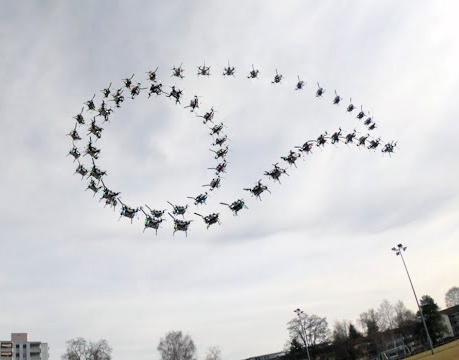
Since the dawn of flight, pilots have used acrobatic maneuvers to test the limits of their airplanes. The same goes for flying drones: Professional pilots often gage the limits of their drones and measure their level of mastery by flying such maneuvers in competitions

Greater efficiency, full speed

Working together with microprocessor company Intel, a team of researchers at the University of Zurich has now developed a quadrotor helicopter, or quadcopter, that can learn to fly acrobatic maneuvers. While a power loop or a barrel role might not be needed in conventional drone operations, a drone capable of performing such maneuvers is likely to be much more efficient. It can be pushed to its physical limits, make full use of its agility and speed, and cover more distance within its battery life.

The researchers have developed a navigation algorithm that enables drones to autonomously perform various maneuvers – using nothing more than onboard sensor measurements. To demonstrate the efficiency of their algorithm, the researchers flew maneuvers such as a power loop, a barrel roll or a matty flip, during which the drone is subject to very high thrust and extreme angular acceleration. “This navigation is another step towards integrating autonomous drones in our daily lives,” says Davide Scaramuzza, robotics professor and head of the robotics and perception group at the University of Zurich.

Trained in simulation

At the core of the novel algorithm lies an artificial neural network that combines input from the onboard camera and sensors and translates this information directly into control commands. The neural network is trained exclusively through simulated acrobatic maneuvers. This has several advantages: Maneuvers can easily be simulated through reference trajectories and do not require expensive demonstrations by a human pilot. Training can scale to a large number of diverse maneuvers and does not pose any physical risk to the quadcopter.

Only a few hours of simulation training are enough and the quadcopter is ready for use, without requiring additional fine-tuning using real data. The algorithm uses abstraction of the sensory input from the simulations and transfers it to the physical world. “Our algorithm learns how to perform acrobatic maneuvers that are challenging even for the best human pilots,” says Scaramuzza.

Fast drones for fast missions

However, the researchers acknowledge that human pilots are still better than autonomous drones. “Human pilots can quickly process unexpected situations and changes in the surroundings, and are faster to adjust,” says Scaramuzza. Nevertheless, the robotics professor is convinced that drones used for search and rescue missions or for delivery services will benefit from being able to cover long distances quickly and efficiently.

###

Media Contact
Davide Scaramuzza
[email protected]

Original Source

https://www.media.uzh.ch/en/Press-Releases/2020/Quadrokopter-Akrobatics.html

Tags: Algorithms/ModelsComputer ScienceHardwareMultimedia/Networking/Interface DesignRobotry/Artificial IntelligenceSoftware EngineeringTechnology/Engineering/Computer Science
Share12Tweet8Share2ShareShareShare2

Related Posts

Unraveling Dementia Networks in Singapore’s Elderly

May 13, 2026

Wireless Wearable Sweat Sensor Enables Continuous Biomarker Monitoring

May 13, 2026

Unlocking Pancreatic Development and Cellular Plasticity

May 13, 2026

Unraveling Raf-MEK-ERK Pathway in Prostate Cancer

May 13, 2026
Please login to join discussion

POPULAR NEWS

  • Research Indicates Potential Connection Between Prenatal Medication Exposure and Elevated Autism Risk

    842 shares
    Share 337 Tweet 211
  • New Study Reveals Plants Can Detect the Sound of Rain

    729 shares
    Share 291 Tweet 182
  • Salmonella Haem Blocks Macrophages, Boosts Infection

    62 shares
    Share 25 Tweet 16
  • Breastmilk Balances E. coli and Beneficial Bacteria in Infant Gut Microbiomes

    57 shares
    Share 23 Tweet 14

About

We bring you the latest biotechnology news from best research centers and universities around the world. Check our website.

Follow us

Recent News

Unraveling Dementia Networks in Singapore’s Elderly

Wireless Wearable Sweat Sensor Enables Continuous Biomarker Monitoring

Unlocking Pancreatic Development and Cellular Plasticity

Subscribe to Blog via Email

Enter your email address to subscribe to this blog and receive notifications of new posts by email.

Join 82 other subscribers
  • Contact Us

Bioengineer.org © Copyright 2023 All Rights Reserved.

Welcome Back!

Login to your account below

Forgotten Password?

Retrieve your password

Please enter your username or email address to reset your password.

Log In
No Result
View All Result
  • Homepages
    • Home Page 1
    • Home Page 2
  • News
  • National
  • Business
  • Health
  • Lifestyle
  • Science

Bioengineer.org © Copyright 2023 All Rights Reserved.