Credit: University of Texas at Austin Jackson School of Geosciences
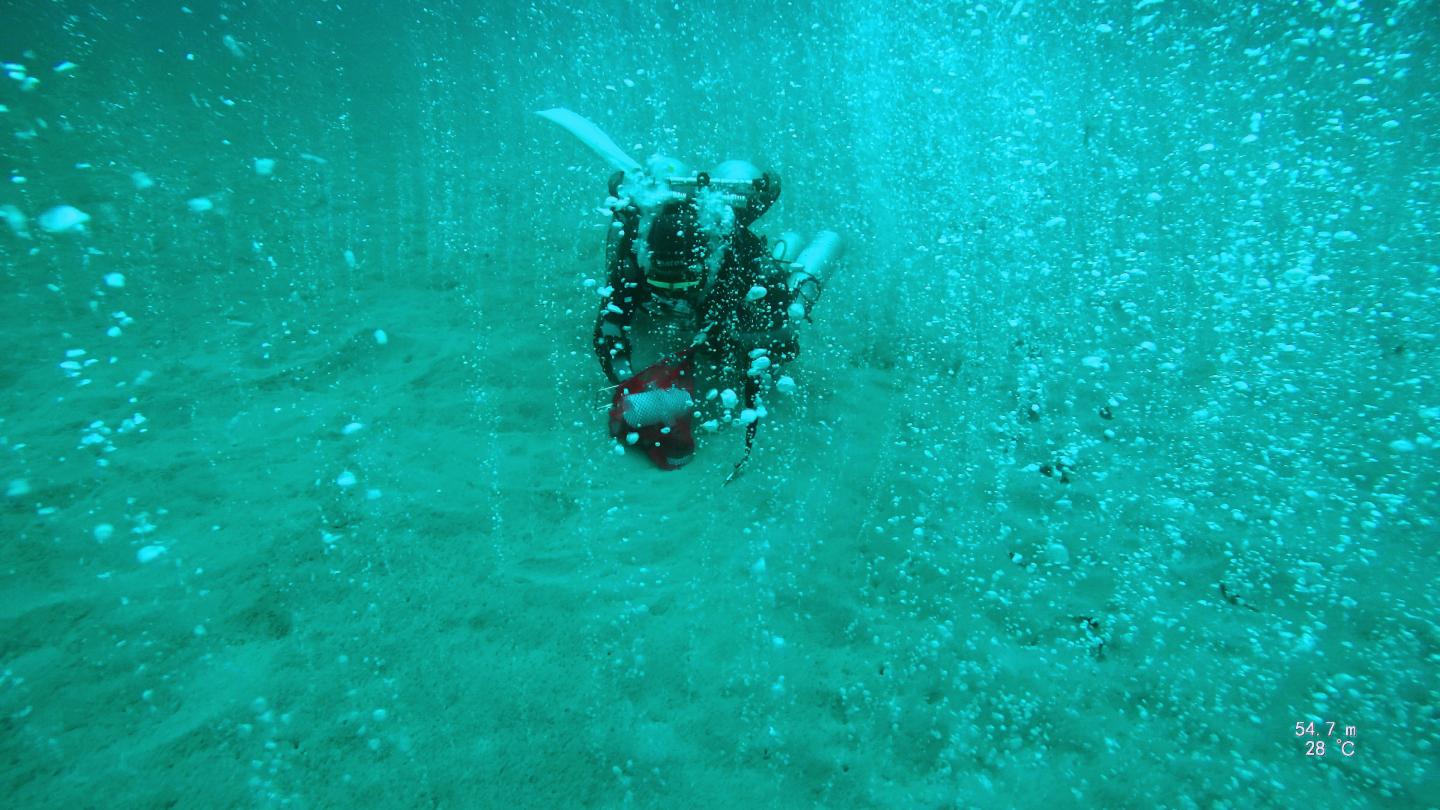
Diving 200 feet under the ocean surface to conduct scientific research can lead to some interesting places. For University of Texas at Austin Professor Bayani Cardenas, it placed him in the middle of a champagne-like environment of bubbling carbon dioxide with off-the-chart readings of the greenhouse gas.
Cardenas discovered the region – which he calls “Soda Springs” – while studying how groundwater from a nearby island could affect the ocean environment of the Verde Island Passage in the Philippines. The passage is one of the most diverse marine ecosystems in the world and is home to thriving coral reefs.
The amazing bubbling location, which Cardenas captured on video, is not a climate change nightmare. It is linked to a nearby volcano that vents out the gases through cracks in the ocean floor and has probably been doing so for decades or even millennia. However, Cardenas said that the high CO2 levels could make Soda Springs an ideal spot for studying how coral reefs may cope with climate change. The site also offers a fascinating setting to study corals and marine life that are making a home among high levels of CO2.
“These high CO2 environments that are actually close to thriving reefs, how does it work?” said Cardenas, who is a professor in the Jackson School of Geosciences at UT Austin. “Life is still thriving there, but perhaps not the kind that we are used to. They need to be studied.”
Cardenas and his coauthors from institutions in the Philippines, the Netherlands and UT described Soda Springs along with multiple scientific findings about groundwater in a paper published this month in the journal Geophysical Research Letters.
The scientists measured CO2 concentrations as high as 95,000 parts per million (ppm), more than 200 times the concentration of CO2 found in the atmosphere. The readings range from 60,000 to 95,000 and are potentially the highest ever recorded in nature. The CO2 levels fall quickly away from the seeps as the gas is diluted in the ocean, but the gas still creates an elevated CO2 environment along the rest of the coastline of the Calumpan Peninsula, with levels in the 400 to 600 ppm range.
Cardenas is a hydrologist and not an expert on reef systems. He discovered Soda Springs while researching whether groundwater from the nearby land could be discharging into the submarine ocean environment, which is a phenomenon that is generally ignored by scientists looking at the water cycle, Cardenas said.
“It’s an unseen flux of water from land to the ocean,” he said. “And it’s hard to quantify. It’s not like a river where you have a delta and you can measure it.”
The team tracked groundwater by testing for radon 222, a naturally occurring radioactive isotope that is found in local groundwater but not in open ocean water. Along with the CO2 bubbles, the team also found hotspots in the sea floor where groundwater was being discharged into the ocean. This is significant, said Cardenas, because the connection between the groundwater and ocean means that there is a pathway for pollutants from the island to make it to the reef system.
This is particularly important for a place like the Philippines, he said, where coastal development is booming largely because of ecotourism driven by the nearby reefs, but the communities almost always depend on septic tanks instead of modern sewage systems. This means the development could drive pollution to the same reefs the economy relies on.
Cardenas has been scuba diving since his college days in the Philippines. Training in deep diving has allowed him to open up a portion of the ocean that is rarely studied.
“It’s really a big part of the ocean that is left unexplored because it’s too shallow for remotely operated vehicles and is too deep for regular divers,” he said.
Conducting field work under water has also led Cardenas to develop new technical skills and techniques to collect samples under water. Elco Luijendijk, a lecturer at the University of Göttingen in Germany who reviewed the study for the journal, said that these techniques – and the findings they enabled -represent major scientific strides.
“Underwater fieldwork is 10 times harder than above water, as I have also recently found out during a diving campaign in the Caribbean,” he said. “Even simple measurements and collecting samples require a lot of care, let alone measurement of radon isotopes, which even onshore is tricky. This [study] really widens our knowledge on what happens in these environments and has shown that these vents can change seawater chemistry over large areas.”
###
Coauthors included researchers from Utrecht University in The Netherlands, the University of Texas Bureau of Economic Geology, and researchers from the following institutions in the Philippines: the Agricultural Sustainability Initiatives for Nature, Inc.; Planet Dive Resort; Scuba Academy Manila; University of the Philippines?Diliman; and, Ateneo de Manila University.
Media Contact
Anton Caputo
[email protected]
512-232-9623
Related Journal Article
http://dx.