• HOME
  • NEWS
  • EXPLORE
    • CAREER
      • Companies
      • Jobs
    • EVENTS
    • iGEM
      • News
      • Team
    • PHOTOS
    • VIDEO
    • WIKI
  • BLOG
  • COMMUNITY
    • FACEBOOK
    • INSTAGRAM
    • TWITTER
Thursday, June 25, 2026
BIOENGINEER.ORG
No Result
View All Result
  • Login
  • HOME
  • NEWS
  • EXPLORE
    • CAREER
      • Companies
      • Jobs
        • Lecturer
        • PhD Studentship
        • Postdoc
        • Research Assistant
    • EVENTS
    • iGEM
      • News
      • Team
    • PHOTOS
    • VIDEO
    • WIKI
  • BLOG
  • COMMUNITY
    • FACEBOOK
    • INSTAGRAM
    • TWITTER
  • HOME
  • NEWS
  • EXPLORE
    • CAREER
      • Companies
      • Jobs
        • Lecturer
        • PhD Studentship
        • Postdoc
        • Research Assistant
    • EVENTS
    • iGEM
      • News
      • Team
    • PHOTOS
    • VIDEO
    • WIKI
  • BLOG
  • COMMUNITY
    • FACEBOOK
    • INSTAGRAM
    • TWITTER
No Result
View All Result
Bioengineer.org
No Result
View All Result
Home NEWS Science News Health

Deep biomarkers of aging and longevity: From research to applications

Bioengineer by Bioengineer
December 4, 2019
in Health
Reading Time: 3 mins read
0
IMAGE
Share on FacebookShare on TwitterShare on LinkedinShare on RedditShare on Telegram

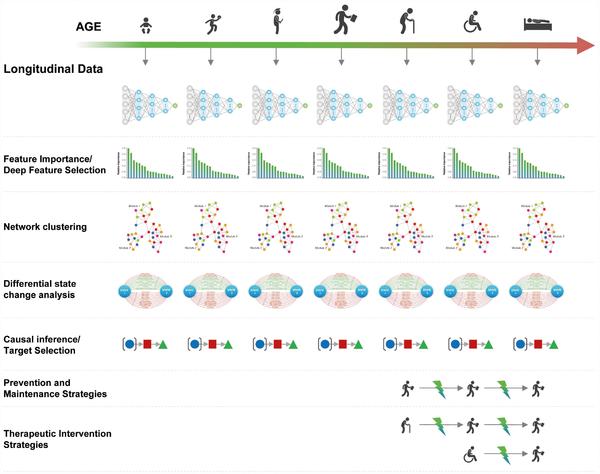
The deep age predictors can help advance aging research by establishing causal relationships in nonlinear systems.
IMAGE

Credit: Correspondence to: Alex Zhavoronkov email: [email protected]


The deep age predictors can help advance aging research by establishing causal relationships in nonlinear systems.

Deep aging clocks can be used for identification of novel therapeutic targets, evaluating the efficacy of various interventions, data quality control, data economics, prediction of health trajectories, mortality, and many other applications.

Dr. Alex Zhavoronkov from Insilico Medicine, Hong Kong Science and Technology Park, in Hong Kong, China & The Buck Institute for Research on Aging in Novato, California, USA as well as The Biogerontology Research Foundation in London, UK said “The recent hype cycle in artificial intelligence (AI) resulted in substantial investment in machine learning and increase in available talent in almost every industry and country.”

Over many generations humans have evolved to develop from a single-cell embryo within a female organism, come out, grow with the help of other humans, reach reproductive age, reproduce, take care of the young, and gradually decline.

Considering the average age of the Olympic athlete, the age of optimal performance can be safely defined as 20-30.

Lifestyle and behavioral modifications may help slow down the decline and keep the organism in the best possible state for its chronological age, a term commonly referred to as healthy aging.

To understand the differences between the healthy aging and unhealthy aging, evaluate the effects of the many lifestyle choices and a variety of emerging longevity interventions, it is essential to be able to track the rate of aging and develop a comprehensive set of aging biomarkers.

The Zhavoronkov Research Team concluded that Developing comprehensive granular multi-modal aging clocks will help get a better understanding of the aging processes, establish causal relationships, and identify preventative and therapeutic interventions.

One of the many promising applications of the deep aging clocks built into the generative adversarial networks is generation of synthetic biological data with age as a generation condition.

###

Full Text – https://doi.org/10.18632/aging.102475

Correspondence to: Alex Zhavoronkov email: [email protected]

Keywords: artificial intelligence, aging clock, deep learning, deep aging clocks aging biomarkers

About Aging-US

Launched in 2009, Aging-US publishes papers of general interest and biological significance in all fields of aging research as well as topics beyond traditional gerontology, including, but not limited to, cellular and molecular biology, human age-related diseases, pathology in model organisms, cancer, signal transduction pathways (e.g., p53, sirtuins, and PI-3K/AKT/mTOR among others), and approaches to modulating these signaling pathways.

To learn more about Aging-US, please visit http://www.Aging-US.com or connect with @AgingJrnl

Aging-US is published by Impact Journals, LLC please visit http://www.ImpactJournals.com or connect with @ImpactJrnls

Media Contact

18009220957×105

[email protected]

Media Contact
Ryan James Jessup
[email protected]
202-638-9720

Original Source

https://www.aging-us.com/news_room/deep-biomarkers-of-aging-and-longevity-from-research-to-applications

Related Journal Article

http://dx.doi.org/10.18632/aging.102475

Tags: AgingGerontologyMedicine/Health
Share12Tweet8Share2ShareShareShare2

Related Posts

Tracking Lanthanide-Labeled Microplastics in Plants

June 25, 2026

Neural Design Enables Zero-Shot Drug-Binding Proteins

June 25, 2026

Genomic Insights into Human Skin Fungi Diversity

June 25, 2026

Chiral Laser Gyroscopes Surpass Lock-In Limit

June 25, 2026
Please login to join discussion

POPULAR NEWS

  • Saying Goodbye to PGY-6: Pediatric Fellowship Realities

    103 shares
    Share 41 Tweet 26
  • Multi-Hospital Study Reveals Long Covid Burden Is Twice as High as Current Estimates

    92 shares
    Share 36 Tweet 23
  • Detection of EDCs in Breast Milk and Infant Urine Up to Six Months Highlights Early Exposure Risks

    77 shares
    Share 31 Tweet 19
  • New Drug Candidate Developed at McMaster Shows Potential for Treating Brain Cancer

    58 shares
    Share 23 Tweet 15

About

We bring you the latest biotechnology news from best research centers and universities around the world. Check our website.

Follow us

Recent News

Tracking Lanthanide-Labeled Microplastics in Plants

POSTECH Researchers Slash Cost of Reconstituted Cell-Free Systems by 95%

AI and Physics Collaborate to Design Advanced Hydrogen Storage Materials

Subscribe to Blog via Email

Success! An email was just sent to confirm your subscription. Please find the email now and click 'Confirm' to start subscribing.

Join 82 other subscribers
  • Contact Us

Bioengineer.org © Copyright 2023 All Rights Reserved.

Welcome Back!

Login to your account below

Forgotten Password?

Retrieve your password

Please enter your username or email address to reset your password.

Log In
No Result
View All Result
  • Homepages
    • Home Page 1
    • Home Page 2
  • News
  • National
  • Business
  • Health
  • Lifestyle
  • Science

Bioengineer.org © Copyright 2023 All Rights Reserved.