Protein assembly is essential for the formation of ordered biological structures, but imagine engineering one! This is exactly what researchers at Tokyo Tech have now accomplished with protein needles. By regulating the tip-to-tip interactions of these needles, they allowed for their self-assembly into lattice structures, ordered monomeric states, and fiber assemblies, paving the way for the controlled construction of more of such protein architectures.
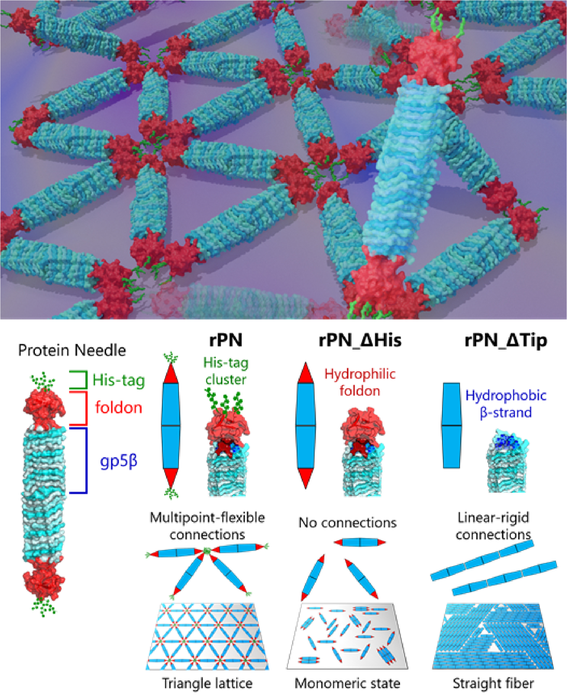
Credit: Takafumi Ueno of Tokyo Institute of Technology
Protein assembly is essential for the formation of ordered biological structures, but imagine engineering one! This is exactly what researchers at Tokyo Tech have now accomplished with protein needles. By regulating the tip-to-tip interactions of these needles, they allowed for their self-assembly into lattice structures, ordered monomeric states, and fiber assemblies, paving the way for the controlled construction of more of such protein architectures.
Proteins are the basic building blocks of our bodies. However, their molecular and macroscopic structures are complex and varied, with multiple folding patterns and substructures. Scientists have been trying to decode these structures for some time, and much progress has been made thanks to fluorescence microscopy (FM), atomic force microscopy (AFM), and high-speed AFM (HS-AFM). However, they have not been able to directly observe the dynamic motions of proteins during assembly. This is mainly due to the intricate structure of proteins, which are too small to be measured with existing techniques.
A collaborating team of researchers from Tokyo Institute of Technology (Tokyo Tech), Kyushu University, Nagoya University, and National Institutes of Natural Sciences have now developed a specialized anisotropic protein needle (PN) to help determine the assembly of similarly anisotropic proteins, giving us clues about their microstructure and assembly.
Prof. Takafumi Ueno of Tokyo Tech, who led the study, explains the premise of their work, “Our PN is a needle-shaped protein composed of the rigid body (β-helix), the terminal cap (foldon), and a binding motif (hexa-histidine tag, His-tag). By modifying these PNs by deleting the His-tag motif and foldon cap, we can produce three different types of PNs. This enabled us to regulate and observe different assembly patterns and how they change, giving us clues into the mechanics of different protein-protein interactions that we find in nature.” The results of this study were published in the journal Small.
In solution, the PNs spontaneously form a highly stable structure with a length of about 20 nm and a width of about 3.5 nm, small enough to track the rotational motion of individual molecules yet mechanically strong.
On surfaces, the team observed different kinds of ordered structures as the PNs self-assembled. These structures ranged from triangular lattices and monomeric states with nematic order (one-dimensional orientation) to fiber assemblies (Figure 1).
This, in turn, allowed the team to investigate the dynamic processes involved in protein assembly through a combination of HS-AFM and simulations (Figure 2). The results revealed that the formation of the triangular lattice structure was guided by the dynamic motions of PN, which contribute to forming ordered lattices (Figure 3).
These findings have excited the researchers, who are contemplating its potential ramifications. “These molecules play such a crucial role in biological systems that understanding their structure would further the field significantly. For instance, we could use this to lay the groundwork for constructing supramolecular structures by designing the dynamic collective motions of proteins. This concept can lead to the engineering of biocompatible sheet materials, targeted drug transports, and even protein-based nano-robots,” comments Prof. Ueno.
Indeed, such developments might just be around the corner.
Journal
Small
DOI
10.1002/smll.202106401
Method of Research
Experimental study
Subject of Research
Lab-produced tissue samples
Article Title
Protein Needles Designed to Self-assemble through Needle Tip Engineering
Article Publication Date
6-Jan-2022
COI Statement
Nothing