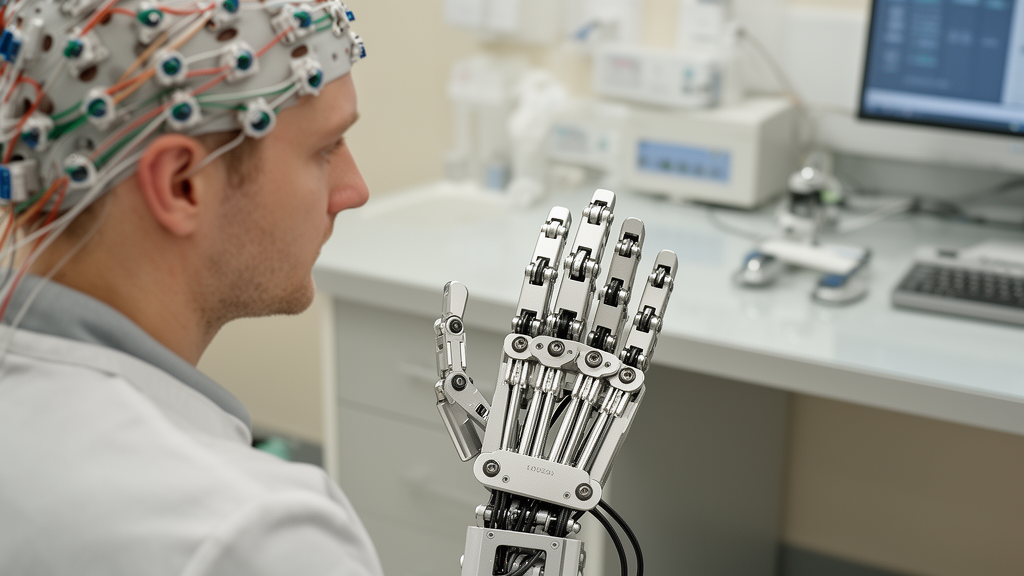
A new neuroengineering study reveals that decoding brain signals to control robotic hand exoskeletons at the individual finger level faces distinct performance differences depending on whether movements are imagined, physically guided, or combined. Published in the Journal of NeuroEngineering and Rehabilitation, the investigation evaluated electroencephalography responses during single, non-repetitive finger flexions to assess the feasibility of moving beyond basic open and close grip functions.
While brain-computer interfaces coupled with hand exoskeletons offer significant potential for restoring manual dexterity in individuals experiencing paralysis, existing devices remain largely restricted to rudimentary whole-hand opening and closing routines. Although previous research established the viability of decoding repetitive motor imagery, neural patterns produced during more natural, single-flexion movements remain insufficiently understood. In addition, effective robotic assistance requires reliable continuous intention monitoring to govern both the start and cessation of mechanical actuation.
To investigate these challenges, researchers recorded electroencephalography data from 25 healthy participants who were entirely naive to motor imagery protocols. Throughout all experimental phases, participants wore a commercial, medical-grade robotic hand exoskeleton. The experimental protocol evaluated isolated movements targeting three distinct anatomical groupings: the thumb, the index finger, and the combined middle, ring, and little fingers.
The experimental setup examined three distinct operating conditions to isolate cognitive effort and sensory feedback. In the pure motor imagery condition, participants were instructed to mentally simulate flexing the assigned fingers without executing any physical movement. In the passive movement condition, the mechanical exoskeleton directly actuated the target digits, delivering physical somatosensory feedback without voluntary user execution. In the assisted motor imagery condition, participants actively imagined the specific finger flexion while simultaneously receiving congruent mechanical assistance from the device.
The research team evaluated nine state-of-the-art neural decoding models across two core benchmarks: three-class multi-finger classification and binary intention detection. Analytical evaluations demonstrated that exoskeleton-mediated movements generated substantially stronger sensorimotor brain responses than pure motor imagery. When analyzed with a convolutional neural network, three-class multi-finger classification reached accuracies of 46.9 percent for passive movement and 47.3 percent for assisted motor imagery, compared to 34.6 percent for pure motor imagery alone.
Despite generating stronger sensorimotor signals, mechanical actuation complicated the task of verifying active cognitive participation. Intention detection algorithms faced greater difficulty identifying the presence of mental imagery during physical movement, performing worse when distinguishing assisted motor imagery from passive movement than when differentiating pure motor imagery from rest. Furthermore, direct cross-mode transfer between non-actuated and actuated states proved problematic: a convolutional-Transformer architecture that attained 79.6 percent balanced accuracy in non-actuated conditions dropped to 59.0 percent when applied to the actuated mode.
The authors concluded that while single-flexion finger targeting remains challenging in untrained individuals, advanced decoding frameworks can still enhance intention detection during physical device actuation. Future development of continuous motor engagement systems must account for somatosensory feedback and limited transferability between mechanical states.
Subject of Research: EEG-based finger classification and intention detection for robotic hand exoskeletons
Article Title: From intent to action: EEG-based multi-finger classification and intention detection across imagined and hand exoskeleton-mediated movements
Article References: Sun, Q., Merino, E. C., Van Dyck, B., & Van Hulle, M. M. (2026). From intent to action: EEG-based multi-finger classification and intention detection across imagined and hand exoskeleton-mediated movements. Journal of NeuroEngineering and Rehabilitation. https://doi.org/10.1186/s12984-026-02210-4
Image Credits: AI Generated
DOI: 10.1186/s12984-026-02210-4
Keywords: electroencephalography, hand exoskeleton, motor imagery, intention detection, multi-finger classification, passive movement, assisted motor imagery, somatosensory feedback, convolutional neural networks, transformer models, finger dexterity, sensorimotor rhythms, cross-mode transfer, neurorehabilitation, single-flexion movements, motor engagement
News Source: Cassandra Pierce. (November 17, 2026). Decoding Brain Signals for Hand Exoskeletons Faces Challenges Across Movement Modes. Scienmag.