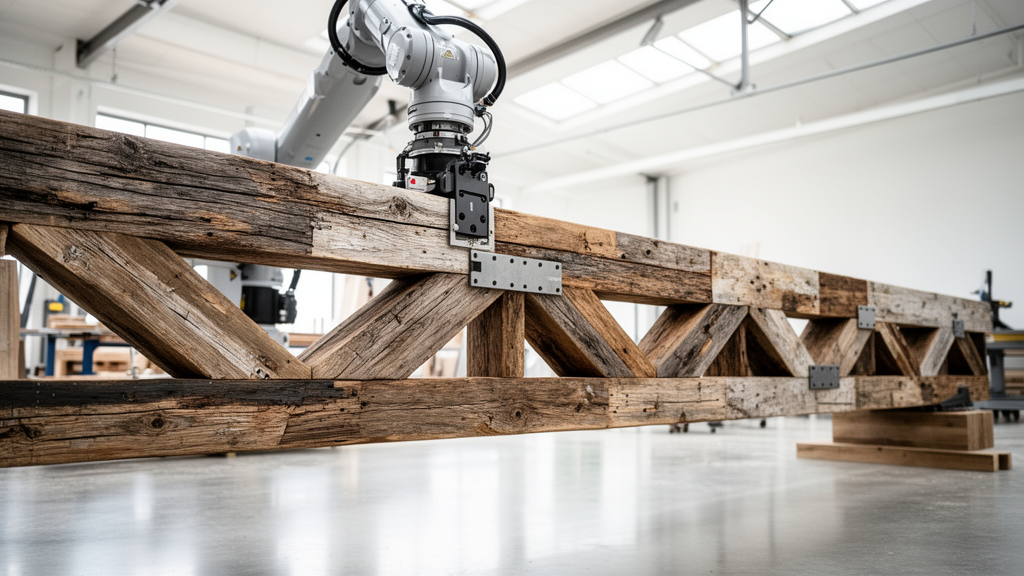
A research team led by Anja Kunic and Roberto Naboni has introduced an integrated data-driven computational design, engineering, and robotic fabrication framework that systematically converts irregular reclaimed timber waste into high-performance load-bearing structures. Discarded wood recovered from demolition sites and recycling centers has long presented formidable construction challenges due to severe material heterogeneity, undocumented structural provenance, variable geometries, and a complete absence of standardized grading systems. Rather than downcycling these biogenic resources into low-value composites or incinerating them, the newly demonstrated framework establishes a continuous cyber-physical information loop connecting material characterization, algorithmic structural generation, advanced numerical simulation, mixed reality-guided assembly, and subtractive robotic manufacturing. The efficacy of this multi-stage methodology was validated through the realization and experimental structural testing of Re:Bridge, a 3.5-meter single-span pedestrian bridge demonstrator constructed from unstandardized reclaimed sawn planks at the University of Southern Denmark.
The research addresses a pressing sustainability challenge across the built environment, where sawn timber accounts for up to fifty percent of construction and demolition waste in certain nations. While contemporary building codes are performance-based and do not strictly forbid timber reuse, they demand demonstrable compliance with serviceability and ultimate limit states. These compliance pathways presuppose predictable mechanical grades, uniform cross-sections, and known service histories, characteristics that post-consumer timber rarely satisfies. Material acquired from recycling facilities rather than controlled demolition projects exhibits unknown prior stresses, unpredictable biological wear, and pronounced geometric variability. Previous computational upcycling research largely focused on matching unaltered reclaimed members into predetermined truss layouts or processing wood into chips for composites. The authors departed from these limitations by developing an integrated structural lamination system that treats material heterogeneity not as an obstacle to be smoothed away, but as an active computational driver guiding structural form and internal material distribution.
To establish an experimental stock, the investigators sourced a container volume of A1-classified waste timber from the Blue Phoenix recycling center in Odense, Denmark. Structural repurposing commenced with eliminating members exhibiting advanced fungal decay, rot, or crushing, while planar boards were excluded due to process incompatibility with vertical stacking. Planks thinner than 50 millimeters were prioritized to accommodate 58-millimeter wooden fasteners during lamination, ensuring sufficient penetration into neighboring lamellae. The stock was conditioned to an equilibrium moisture content between 8 and 12 percent, adhering to European glulam standards, before undergoing a four-stage preparatory sequence: handheld detectors identified and extracted embedded metal contaminants; cracked ends and split grain were trimmed away; bonding faces were planed to eliminate surface imperfections and reduce cross-sectional deviations into discrete fabrication classes; and each plank received a digitally printed tracking label encoding its thickness class and serial number, yielding an active inventory of 2.2 cubic meters, or roughly 544 linear meters.
To link physical characterization with algorithmic design and manufacturing, the researchers established the Material Digital Stock, an accessible online database serving as the project’s central digital repository. Data ingestion utilized an automated robotic vision station featuring a top-down web camera mounted above a matte platform with fiducial markers and an integrated digital weighing scale. Image processing handled via OpenCV calibrated camera optics, rectified distortion, and identified plank boundary contours, while optical character recognition read identification codes from printed tags and mass values from the scale. Plank height and length were calculated directly from contour dimensions, thickness was inferred from the tag prefix, and bulk density was determined by dividing mass by volume. Statistical profiling revealed that 90.1 percent of planks were one meter or shorter, heights clustered at 10, 15, and 20 centimeters, and density stratified into classes above and below 500 kilograms per cubic meter, establishing empirical boundaries for structural synthesis.
Structural form generation was driven by a three-dimensional topology optimization routine executed with the SIMP solver using the Millipede plug-in in Grasshopper. The computational domain corresponded to a single-span pedestrian bridge spanning 3.5 meters longitudinally, widening to 1.75 meters at mid-span, with end support zones extending 1.0 meter in length and 0.3 meters in depth. Bounding heights were constrained between 100 millimeters at the supports and 200 millimeters across the central deck to reflect inventory limits. Discretized across 4,000 nodes at a 50-millimeter resolution, the model executed sixty optimization cycles under a normalized uniformly distributed vertical load. The resulting scalar density field was converted into three secondary two-dimensional fields: a continuous height field indicating depth requirements, a binary density demand field, and first principal stress trajectories tracing load paths. These trajectories guided a quad mesh whose vertices were displaced vertically according to the height field, generating an articulated SubD surface defined by variable longitudinal stiffening ribs.
To calibrate structural dimensions, the researchers generated fifteen geometric permutations by varying mid-rib height and support height while maintaining a rib base thickness of 45 millimeters. A simplified linear elastic finite element analysis evaluated elastic deflections under combined self-weight and a 5.0 kilonewton per square meter pedestrian live load. Enforcing a strict Eurocode serviceability limit of span divided by 500, or 5.70 millimeters, eliminated eight non-compliant configurations. The remaining seven viable geometries were ranked using a Performance Index that balanced normalized deflection against material volume. Although configuration it_8 exhibited the highest numerical score, it was discarded because its 160-millimeter rib height required machining 200-millimeter planks down by 40 millimeters, causing excessive material waste. The authors selected configuration it_9, featuring an 80-millimeter support height and a 180-millimeter mid-rib height, which provided strong architectural contrast, minimized unnecessary milling losses, and remapped the target height field into a feasible 40 to 180 millimeter production domain.
Material allocation within the chosen geometry was governed by a greedy heuristic algorithm operating layer by layer. For each vertical lamination pass, local height demands were sampled to filter the database for a feasible plank thickness class possessing sufficient quantity to complete the layer. A moving spatial window queried height and density fields to allocate the longest available compatible plank, simultaneously enforcing staggered butt-joint offsets with adjacent layers to prevent continuous failure planes. Planks intersecting boundary edges were computationally trimmed, and their offcut segments were automatically re-indexed into the Material Digital Stock. Prioritizing longer elements proved decisive: while an alternative variant prioritizing shorter planks achieved eight percent lower milling waste, it introduced 27.5 percent more butt joints with an average spacing of only 134 millimeters. In contrast, prioritizing longer planks yielded 261 butt joints spaced 176 millimeters apart with an average plank length of 572 millimeters, substantially improving load continuity across the laminated structure.
To simulate structural performance, the authors developed an advanced finite element model in Abaqus CAE representing 330 individual shell parts connected by 638 surface-to-surface cohesive interfaces. Individual lamellae were meshed with three-node triangular shell elements using quadratic geometric formulations to prevent shear locking. Timber orthotropy and post-elastic damage were defined using Hashin failure criteria, with the longitudinal tensile shear interaction parameter set to zero to improve solver convergence. The lamination interfaces were modeled via cohesive zone modeling utilizing bilinear traction-separation laws calibrated against experimental shear push-off and tensile tests, applying a viscous regularization parameter of 0.001. Crucially, butt joints between plank ends were assigned no mechanical interaction properties. Because end-grain adhesion is inherently weak, physical tests confirmed that butt joints provide negligible bending resistance, acting instead as local stress releases that transfer primary shear loads into adjacent continuous lamellae. Boundary conditions coupled edge shell nodes kinematically to support reference points, accurately capturing support conditions.
The finite element analysis simulated multiple Eurocode serviceability load cases, comprising full-deck live loading, asymmetric half-span loading, torsional side patches, and a 10-kilonewton concentrated pedestrian force distributed across a 0.6-by-0.6-meter area. Crucially, the simulations demonstrated the necessity of multi-level anisotropic modeling over simplified isotropic assumptions. A preliminary isotropic model yielded a maximum deflection of 4.60 millimeters, satisfying the strict span-divided-by-500 threshold of 5.70 millimeters. In contrast, incorporating timber orthotropy, cohesive interface compliance, and butt-joint releases increased maximum deflection to 12.2 millimeters, which marginally satisfied the standard Eurocode allowable serviceability limit of span divided by 250 (14.0 millimeters). The results confirmed that isotropic assumptions drastically underestimate actual deflections by neglecting interlamellar shear deformations and joint discontinuities. Furthermore, displacement fields exhibited marked structural asymmetry under symmetric loading, originating directly from the stochastic distribution of staggered butt joints, which redistributed stresses through localized shearing across adjacent bonded lamellae.
Physical production of Re:Bridge utilized a hybrid vertical glue-nail lamination process on modular welding tables, deploying LignoLoc 4.7-by-58-millimeter beechwood nails and structural adhesive with a five-minute open time. Hardwood nails functioned as internal clamps, providing distributed pressure during curing and eliminating external hydraulic presses. Guided by Microsoft HoloLens 2 mixed-reality headsets displaying real-time digital instructions, two operators assembled 64 vertical layers comprising 330 planks, 1,266 wooden nails, and 10 liters of adhesive across 40 person-hours without placement errors. Subtractive robotic sculpting with an industrial KUKA robot combined a 22-minute roughing pass with an adaptive four-step finishing protocol, completing in 4.3 machining hours compared to 9.1 hours for uniform milling. Installed across a 2.85-meter span at the University of Southern Denmark, the 198-kilogram structure underwent elastic load testing up to 800 kilograms (7.845 kilonewtons), yielding a 1.73-millimeter mid-span deflection that matched the numerical prediction of 1.56 millimeters. Sequestering 358 kilograms of biogenic carbon, the demonstrator successfully validates high-value structural timber upcycling.
Subject of Research: Data-driven design, engineering, and robotic fabrication framework for load-bearing structures made from reclaimed timber
Article Title: Stock- and stress-informed design and fabrication of load-bearing structures from reclaimed timber
Article References: Kunic, A., Angeletti, D., Nabi, J., & Naboni, R. (2026). Stock- and stress-informed design and fabrication of load-bearing structures from reclaimed timber. Low-carbon Materials and Green Construction, 4(1), Article 19. https://doi.org/10.1007/s44242-026-00115-y
Image Credits: AI Generated
DOI: 10.1007/s44242-026-00115-y
Keywords: reclaimed timber, structural upcycling, computational design, topology optimization, Material Digital Stock, mixed reality fabrication, robotic milling, glue-nail lamination, hardwood nails, finite element analysis, cohesive zone modeling, serviceability limit states, construction and demolition waste, anisotropic structural modeling, biogenic carbon storage, circular building systems, timber engineering
News Source: Denise Maddox. (November 17, 2026). Data-Driven Framework Transforms Heterogeneous Reclaimed Timber into Load-Bearing Structures. Scienmag.