• HOME
  • NEWS
  • EXPLORE
    • CAREER
      • Companies
      • Jobs
    • EVENTS
    • iGEM
      • News
      • Team
    • PHOTOS
    • VIDEO
    • WIKI
  • BLOG
  • COMMUNITY
    • FACEBOOK
    • INSTAGRAM
    • TWITTER
Saturday, May 16, 2026
BIOENGINEER.ORG
No Result
View All Result
  • Login
  • HOME
  • NEWS
  • EXPLORE
    • CAREER
      • Companies
      • Jobs
        • Lecturer
        • PhD Studentship
        • Postdoc
        • Research Assistant
    • EVENTS
    • iGEM
      • News
      • Team
    • PHOTOS
    • VIDEO
    • WIKI
  • BLOG
  • COMMUNITY
    • FACEBOOK
    • INSTAGRAM
    • TWITTER
  • HOME
  • NEWS
  • EXPLORE
    • CAREER
      • Companies
      • Jobs
        • Lecturer
        • PhD Studentship
        • Postdoc
        • Research Assistant
    • EVENTS
    • iGEM
      • News
      • Team
    • PHOTOS
    • VIDEO
    • WIKI
  • BLOG
  • COMMUNITY
    • FACEBOOK
    • INSTAGRAM
    • TWITTER
No Result
View All Result
Bioengineer.org
No Result
View All Result
Home NEWS Science News Health

Deciphering the mechanism that determines organ size and shape

Bioengineer by Bioengineer
February 21, 2020
in Health
Reading Time: 2 mins read
0
IMAGE
Share on FacebookShare on TwitterShare on LinkedinShare on RedditShare on Telegram

IMAGE

Credit: IRB Barcelona


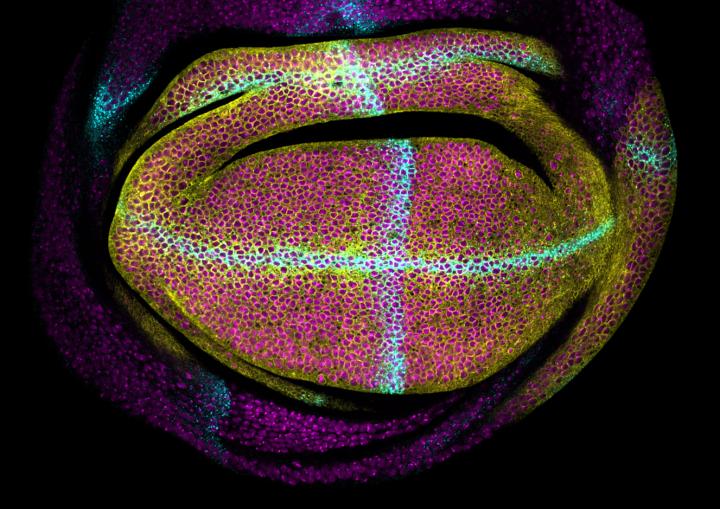
A study by IRB Barcelona´s Development and Growth Control Laboratory, headed by ICREA researcher Marco Milán, reveals how Dpp and Wg morphogens regulate organ proportions and patterning of the fly wing through independent mechanisms. Given that these morphogens are present in vertebrates, these results are highly significant for understanding the development and growth of human limbs. “The regulatory mechanism that we describe in this study may pave the way to new research lines on malformations and congenital diseases in humans,” says Marco Milán.

Size is not determined by gradients

Morphogens are distributed throughout tissues in a concentration gradient, informing cells about their “location” and providing instructions on how they should develop. Several studies have also reported that these morphogens are responsible for the growth of these tissues. While the presence of morphogens along a gradient defines the spatial distribution of the different structures, the study by the Development and Growth Control Laboratory demonstrates that the gradient itself is not indispensable to promote growth. In a previous study, published in 2017 in the journal eLife, this same group proposed that wing growth was independent of the Dpp gradient. These new findings, which have been published in Developmental Cell, “confirm that the presence of Wg is necessary throughout development, but, as occurs with Dpp, its distribution along a gradient is not an indispensable requirement,” explains Lara Barrio, first author of the study.

Morphogens stimulate directional growth

The two morphogens addressed in this study, namely Dpp and Wg, promote the growth of the fly wing, but through two independent and non-interchangeable pathways. Dpp stimulates growth along the anteroposterior axis in a unique and exclusive manner, while Wg favours proliferative activity along the proximodistal axis. The work carried out by Barrio and Milán demonstrates that the capacity of these morphogens to promote growth in two distinct directions is due to their restricted expression in two perpendicular bands and to the need for both to be present for the tissue to grow. These findings thus reveal the mechanism through which organ proportions are regulated by morphogen activity.

This study has been funded by the Ministry of Science and Innovation, the Severo Ochoa Centres of Excellence Award, the programme “A way to build Europe, supported by the European Development Fund (ERDF) and the CERCA Programme, run by the Government of Catalonia.

###

Media Contact
Communications IRB Barcelona
[email protected]

Original Source

http://www.irbbarcelona.org/en/news/deciphering-the-mechanism-that-determines-organ-size-and-shape

Related Journal Article

http://dx.doi.org/10.1016/j.devcel.2020.01.017

Tags: BiologyCell BiologyDevelopmental/Reproductive BiologyMolecular Biology
Share12Tweet8Share2ShareShareShare2

Related Posts

Pembrolizumab and Lenvatinib Trial for Mucosal Melanoma

May 16, 2026

Carboplatin ± Nivolumab in Metastatic TNBC Trial

May 16, 2026

Genetic Dosage Influences Parkinson’s Cognitive Decline

May 16, 2026

Loneliness Forecasts Parkinsonism Decline: Long-Term Study

May 16, 2026
Please login to join discussion

POPULAR NEWS

  • Research Indicates Potential Connection Between Prenatal Medication Exposure and Elevated Autism Risk

    843 shares
    Share 337 Tweet 211
  • New Study Reveals Plants Can Detect the Sound of Rain

    730 shares
    Share 291 Tweet 182
  • Salmonella Haem Blocks Macrophages, Boosts Infection

    62 shares
    Share 25 Tweet 16
  • Breastmilk Balances E. coli and Beneficial Bacteria in Infant Gut Microbiomes

    58 shares
    Share 23 Tweet 15

About

We bring you the latest biotechnology news from best research centers and universities around the world. Check our website.

Follow us

Recent News

Pembrolizumab and Lenvatinib Trial for Mucosal Melanoma

Carboplatin ± Nivolumab in Metastatic TNBC Trial

New Numeracy Screener Developed for Preschoolers

Subscribe to Blog via Email

Enter your email address to subscribe to this blog and receive notifications of new posts by email.

Join 82 other subscribers
  • Contact Us

Bioengineer.org © Copyright 2023 All Rights Reserved.

Welcome Back!

Login to your account below

Forgotten Password?

Retrieve your password

Please enter your username or email address to reset your password.

Log In
No Result
View All Result
  • Homepages
    • Home Page 1
    • Home Page 2
  • News
  • National
  • Business
  • Health
  • Lifestyle
  • Science

Bioengineer.org © Copyright 2023 All Rights Reserved.