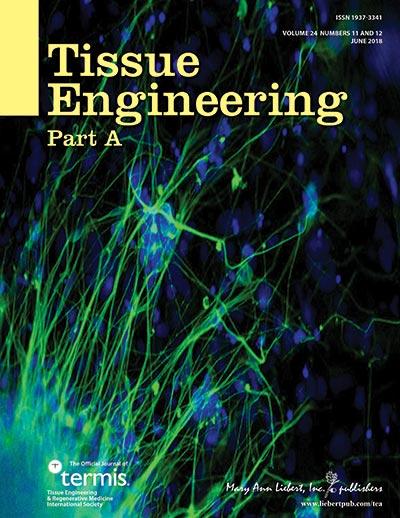
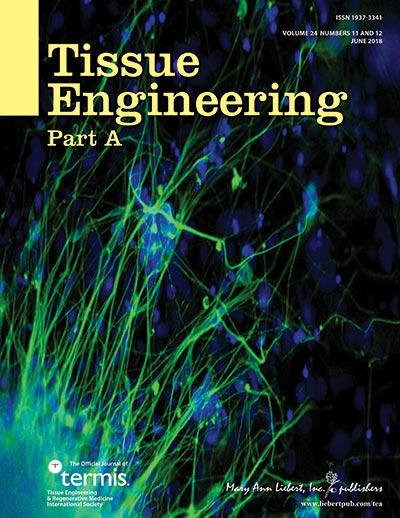
Credit: Mary Ann Liebert, Inc., publishers
New Rochelle, NY, June 22, 2018–To help prevent possible complications such as nonunion at large fracture sites, researchers have developed a cartilage matrix that mimics the early stages of repair and provides the essential structural and biological properties needed by bone-forming cells to divide and grow. A new study describing the methods used for matrix decellularization and optimization to promote bone regeneration is published in Tissue Engineering, Part A, peer-reviewed journal from Mary Ann Liebert, Inc., publishers. The article is available free on the Tissue Engineering website until July 22, 2018.
Coauthors Wollis Vas, Mittal Shah, Thomas Blacker, Michael Duchen, and Scott Roberts, University College London, U.K. and Paul Sibbons, Northwick Park Hospital, London, U.K. validate their methodology and report on regenerative results achieved in a mouse model in the article entitled "Decellularized Cartilage Directs Chondrogenic Differentiation: Creation of a Fracture Callus Mimetic." The researchers describe the effectiveness of a vacuum-assisted osmotic shock approach to remove the decellular material – including DNA and immunogenic material – from a xenogeneic hyaline cartilage matrix while retaining the extracellular matrix (ECM), which can support the growth and development of bone tissue.
"The approach by Roberts and his team, utilizing costal cartilage – accessible from the ribs and particularly well suited as the basis for an endochondral ossification bone repair mechanism – is an innovative approach that may be quickly translated into clinical use," says Tissue Engineering Co-Editor-in-Chief John P. Fisher, PhD, Fischell Family Distinguished Professor & Department Chair, and Director of the NIH Center for Engineering Complex Tissues at the University of Maryland.
###
About the Journal
Tissue Engineering is an authoritative peer-reviewed journal published monthly online and in print in three parts: Part A, the flagship journal published 24 times per year; Part B: Reviews, published bimonthly, and Part C: Methods, published 12 times per year. Led by Co-Editors-in-Chief Antonios G. Mikos, PhD, Louis Calder Professor at Rice University, Houston, TX, and John P. Fisher, PhD, Fischell Family Distinguished Professor & Department Chair, and Director of the NIH Center for Engineering Complex Tissues at the University of Maryland, the Journal brings together scientific and medical experts in the fields of biomedical engineering, material science, molecular and cellular biology, and genetic engineering. Leadership of Tissue Engineering Parts B (Reviews) and Part C (Methods) is provided by Katja Schenke-Layland, PhD, Eberhard Karls University, Tübingen and John A. Jansen, DDS, PhD, Radboud University, respectively. Tissue Engineering is the official journal of the Tissue Engineering & Regenerative Medicine International Society (TERMIS). Complete tables of content and a sample issue may be viewed on the Tissue Engineering website.
About the Publisher
Mary Ann Liebert, Inc., publishers is a privately held, fully integrated media company known for establishing authoritative peer-reviewed journals in many promising areas of science and biomedical research, including Stem Cells and Development, Human Gene Therapy, and Advances in Wound Care. Its biotechnology trade magazine, GEN (Genetic Engineering & Biotechnology News), was the first in its field and is today the industry's most widely read publication worldwide. A complete list of the firm's 80 journals, books, and newsmagazines is available on the Mary Ann Liebert, Inc., publishers website.
Media Contact
Kathryn Ryan
[email protected]
914-740-2250
@LiebertPub
http://www.liebertpub.com
Original Source
https://home.liebertpub.com/news/decellularized-cartilage-based-scaffold-promotes-bone-regeneration-at-fracture-site/2391 http://dx.doi.org/10.1089/ten.tea.2017.0450