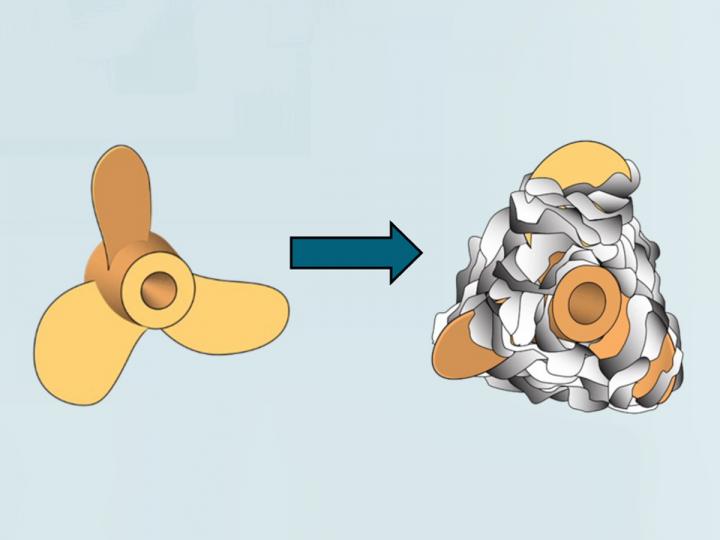
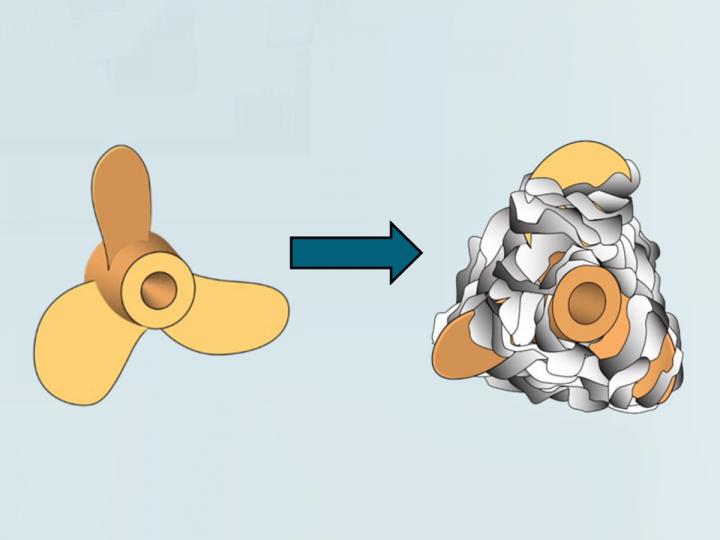
Credit: NAVSEA
LOGAN, UTAH, USA — Envisioning a device the U.S. Navy is developing with Utah State University synthetic spider silk conjures images you'd expect in a James Bond thriller. Think strong, stretchy fibers wrapping relentlessly around a boat propeller and effectively foiling nefarious efforts by smugglers, pirates or terrorists.
That's what nonlethal Maritime Vessel Stopping Occlusion Technologies or 'MVSOT,' the official name for these types of devices, are intended to do.
USU's USTAR-funded Synthetic Spider Silk Lab is the recipient of a $420,000 grant from the U.S. Navy Division of Unconventional Warfare aimed at designing and developing these devices, as well as applying USU silk manufacturing technology to enable commercial-scale production of other biomaterials.
Kevlar was the initial material used in MVSOT technologies, followed by superabsorbent polymers, leading to the current "polymer kelp" design. The Navy envisions stronger, more effective and environmentally friendly next-generation designs with spider silk and synthetic 'slime' derived from other proteins. MVSOT is currently deployed with pneumatic launchers. Future designs may use unmanned surface vessels or aerial drones.
"This project has three major aims that will benefit the Navy and advance our research," says Randy Lewis, professor in USU's Department of Biology and lab director.
First is supplying the aforementioned synthetic spider silk made from transgenic bacteria and silkworms, two of four sources the Lewis Lab uses for silk production.
A second aim of the project, Lewis says, is sharing expertise with the Navy on how to produce synthetic slime from hagfish proteins. As a defense from predators, hagfish, eel-like marine creatures, secrete a gooey, microfibrous mucin that greatly expands in seawater.
The third piece of the project is sharing USU expertise on how to scale-up production of hagfish-derived proteins to manufacture commercial-level quantities of the materials, as well as commercial-scale spinning of fibers.
"This is a great opportunity for USU, because this project will allow us to continue to develop our knowledge of synthetic silk production and applications," Lewis says. "It also provides research opportunities for three research scientists, two graduate students and a number of undergraduate researchers."
The grant is for one year, with opportunities for follow-on funding.
Lewis has received previous Navy grants, totaling more than $1 million, to develop waterproof fasteners and adhesives from synthetic spider silk.
"Certain types of spider silk have chemical and physical properties that enable them to attach to virtually any surface – even when wet," he says. "In addition, the silk is flexible, lightweight and very strong."
In addition to bacteria and silkworms, the Lewis Lab uses the milk from transgenic goats and fibers from transgenic alfalfa to produce synthetic silk.
"Spider silk has properties unmatched by any manmade material," Lewis says. "Synthetic silk holds promise for nearly endless applications in industry, medicine and consumer products."
The scientist, who joined USU in 2011, adds he's grateful to USTAR – the state-funded Utah Science and Technology and Research economic development initiative – for providing funding for his research.
"Support from the State of Utah has enabled us to advance this research, secure federal and private funding and provide world-class research opportunities for our students," Lewis says.
###
Media Contact
Randy Lewis
[email protected]
435-797-9291
http://www.usu.edu