• HOME
  • NEWS
  • EXPLORE
    • CAREER
      • Companies
      • Jobs
    • EVENTS
    • iGEM
      • News
      • Team
    • PHOTOS
    • VIDEO
    • WIKI
  • BLOG
  • COMMUNITY
    • FACEBOOK
    • INSTAGRAM
    • TWITTER
Monday, May 11, 2026
BIOENGINEER.ORG
No Result
View All Result
  • Login
  • HOME
  • NEWS
  • EXPLORE
    • CAREER
      • Companies
      • Jobs
        • Lecturer
        • PhD Studentship
        • Postdoc
        • Research Assistant
    • EVENTS
    • iGEM
      • News
      • Team
    • PHOTOS
    • VIDEO
    • WIKI
  • BLOG
  • COMMUNITY
    • FACEBOOK
    • INSTAGRAM
    • TWITTER
  • HOME
  • NEWS
  • EXPLORE
    • CAREER
      • Companies
      • Jobs
        • Lecturer
        • PhD Studentship
        • Postdoc
        • Research Assistant
    • EVENTS
    • iGEM
      • News
      • Team
    • PHOTOS
    • VIDEO
    • WIKI
  • BLOG
  • COMMUNITY
    • FACEBOOK
    • INSTAGRAM
    • TWITTER
No Result
View All Result
Bioengineer.org
No Result
View All Result
Home NEWS Science News Chemistry

Daylight damage-saving time

Bioengineer by Bioengineer
December 2, 2019
in Chemistry
Reading Time: 2 mins read
0
IMAGE
Share on FacebookShare on TwitterShare on LinkedinShare on RedditShare on Telegram

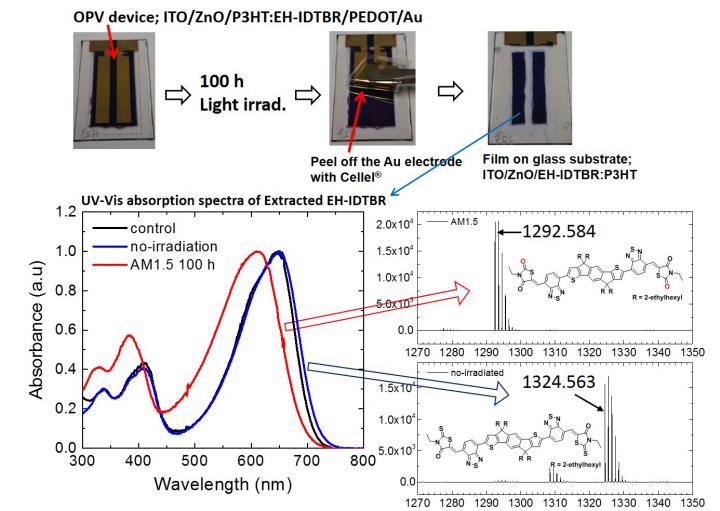
A research team led by Kanazawa University studies the process by which the performance of advanced solar cells degrades over time; this work may help promote the adoption of renewable energy produced by robust, high-efficiency organic photovoltaics
IMAGE

Credit: Kanazawa University


Kanazawa, Japan – Researchers at Kanazawa University performed a detailed investigation of the molecular mechanisms by which organic solar cells suffer damage as they are exposed to sunlight. This research has important implications for developing next-generation solar sheets that combine high efficiency, low cost, and long device lifetimes.

Solar power represents an important element of future renewable energy solutions. Historically, solar panels have tended to be inefficient or else too expensive for most homeowners to consider installing. A new class of solar cells that utilizes layers of carbon-based polymers offers efficiency of up to 10% – which is considered the minimum for practical use – at an affordable price point. The primary remaining obstacle to wide adoption of these new photovoltaics is the short lifetime of these devices because cumulative damage from the sun tends to erode their performance. Owing to the multilayer nature of the devices, it is often difficult to identify molecular mechanism by which this degradation of efficacy occurs over time.

Now, based on the results of current-voltage curves, impedance spectroscopy, and UV-VIS spectrophotometry, a research team at Kanazawa University has determined an important factor that can cause reduced performance. Similar to the way your carbon-based skin cells can get a nasty sunburn from the sun’s ultraviolet light after a day at the beach, the researchers found that the fragile organic molecules in the semiconducting layer can be damaged from exposure.

“We found that damage from UV light increased the electrical resistance of the organic semiconductor layer,” first author Makoto Karakawa says. This led to reduced current flow and thus an overall decrease in efficiency. Using a method known as matrix assisted laser desorption/ionization time-of-flight, the researchers determined the likely degradation products from solar damage. When some sulfur atoms in the materials get replaced by oxygen atoms from the atmosphere, the molecules no longer function as intended.

“While new organic semiconductor materials have allowed us to drastically increase overall efficiency, we found that they tend to be more fragile to UV damage,” senior author Kohshin Takahashi explains. Based on this understanding, it may be possible to design more robust devices that still maintain their high energy conversion rate, which is an important step to making solar an even larger portion of renewable energy generation.

###

Media Contact
Tomoya Sato
[email protected]
81-762-645-076

Related Journal Article

http://dx.doi.org/10.1016/j.orgel.2019.105448

Tags: Atomic/Molecular/Particle PhysicsChemistry/Physics/Materials SciencesEnergy/Fuel (non-petroleum)Industrial Engineering/ChemistryMaterialsMolecular PhysicsOpticsPolymer ChemistrySuperconductors/Semiconductors
Share12Tweet8Share2ShareShareShare2

Related Posts

Miniature Sensor Uses Light to Detect Touch — Chemistry

Miniature Sensor Uses Light to Detect Touch

May 8, 2026
Iron Minerals Determine Whether Dissolved Organic Matter Fuels Microbes or Becomes Long-Term Carbon Storage — Chemistry

Iron Minerals Determine Whether Dissolved Organic Matter Fuels Microbes or Becomes Long-Term Carbon Storage

May 8, 2026

Kate Evans Appointed Associate Lab Director for Biological and Environmental Systems Science at ORNL

May 8, 2026

Advancing Multiscale Modeling and Overcoming Operational Challenges in Autothermal COâ‚‚-to-Methanol Reactors

May 8, 2026
Please login to join discussion

POPULAR NEWS

  • Research Indicates Potential Connection Between Prenatal Medication Exposure and Elevated Autism Risk

    840 shares
    Share 336 Tweet 210
  • New Study Reveals Plants Can Detect the Sound of Rain

    728 shares
    Share 290 Tweet 182
  • Salmonella Haem Blocks Macrophages, Boosts Infection

    61 shares
    Share 24 Tweet 15
  • Breastmilk Balances E. coli and Beneficial Bacteria in Infant Gut Microbiomes

    57 shares
    Share 23 Tweet 14

About

We bring you the latest biotechnology news from best research centers and universities around the world. Check our website.

Follow us

Recent News

Tinengotinib Alone or with Atezolizumab in Tumors

Fear of Falling and Activity Affect Elderly Life Quality

Transforming Jellyfish Bycatch into a Valuable Collagen Source for Cosmetics and Biotechnology

Subscribe to Blog via Email

Enter your email address to subscribe to this blog and receive notifications of new posts by email.

Join 82 other subscribers
  • Contact Us

Bioengineer.org © Copyright 2023 All Rights Reserved.

Welcome Back!

Login to your account below

Forgotten Password?

Retrieve your password

Please enter your username or email address to reset your password.

Log In
No Result
View All Result
  • Homepages
    • Home Page 1
    • Home Page 2
  • News
  • National
  • Business
  • Health
  • Lifestyle
  • Science

Bioengineer.org © Copyright 2023 All Rights Reserved.