Credit: Smart Protein
A major new survey on meat consumption in Europe reports that Europeans have a growing appetite for plant-based foods and that meat consumption has dipped. While this applies to Denmark as well, Danes lag behind the other countries in the survey.
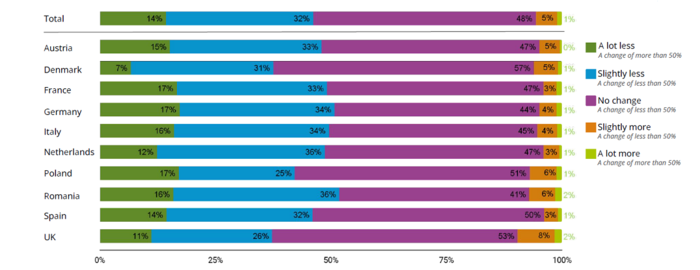
To tofu or t-bone, that is the question. Europeans – Danes among them – are opting away from meat more and more. This is demonstrated in a large new University of Copenhagen led survey on meat and plant-based food consumption in ten European countries. At the same time, Denmark is one of the countries that has been slowest to cut back on steaks, sausages and the like.
Overall, nearly 46% of Europeans eat less meat than they did a year ago, while the figure for Danes is 37%. Thus, 63% of Danish consumers have not reduced their meat consumption, which positions Denmark at an equal last among the countries in this part of the survey.
“Our meat consumption can have a major impact with regards to the climate crisis we’re up against. Therefore, it is encouraging to see that a fairly large proportion of the European population is eating less meat than in the past. At the same time, it is noteworthy that Denmark, which is usually progressist and trend setter, is at the back end of the pack. I expected a bit more from Denmark,” says Associate Professor Armando Perez-Cueto of the University of Copenhagen’s Department of Food Science.
Perez-Cueto led the survey which is the first of its kind in collaboration with ProVeg International and Ghent University as a part of the Smart Protein project.
Other data from recent years have shown that Denmark’s meat consumption is above the EU average but lower than those of its neighbouring countries (Scandinavia, Germany and the UK). As for beef, Denmark’s consumption is at the very top of the ranking and higher than in all the neighbouring countries.
Myths and cultural barriers stand in the way
Denmark doesn’t just fall in last when it comes to what we have done, but with regards to what we intend to do. Denmark is the country where the fewest number of people plan on cutting their meat consumption. While nearly 40% of Europeans combined intend on reducing their meat consumption during the months ahead, the figure for Danes is 33%. This means that 67% are either going to eat as much or more meat than before.
The survey identifies many possible reasons for Denmark’s last place finish:
“Firstly, we need to puncture widespread myths. For example, half of Danes believe that we cannot do without meat nutritionally, even if scientific evidence points to the contrary. Secondly, there is a food culture which says that plant-based foods lack sufficient taste and that a complete mealtime ought to include meat. This view is held by 45% of Danes. While only 100 years have passed since Danes lived primarily on a plant-based diet, the narrative of what’s right to eat has grown strongly,” says Armando Perez-Cueto.
Plenty of other barriers hinder an increasingly plant-rich diet as well. More than a third of Danes find that plant-based foods are too expensive, that they don’t know how to prepare them, that they lack information about them and that they just don’t find them visually appealing.
“These things can and should be addressed. It should be a task for all of society – public authorities, researchers, organisations, etc. – to nudge people towards more climate-friendly eating habits. Because, a green transition of society cannot happen without a green transition of our food consumption,” explains Armando Perez-Cueto.
Winds of promise
Armando Perez-Cueto underscores that, all in all, promising winds are blowing for a more plant-based diet among Europeans:
“Nearly 30% of the European participants report that they plan on consuming significantly more plant-based dairy and meat alternatives. And about half of all participants have yet to taste plant meat, plant milk, tofu, quinoa or similar products. So, there is enormous growth potential in the market for plant-based foods and fertile ground for developing a wider selection of and improved products.”
Among other things, the European consumers also responded to the types of plant-based products that they would like to be able to buy in stores. In particular, there is demand for plant-based poultry in the form of chicken breast and plant-based fish in the form of fish sticks, smoked salmon and fish burgers. Among Danish consumers, there is particular demand for a greater supply of plant-based minced meat and steak.
MORE FIGURES FROM THE SURVEY:
- More than 7,500 Europeans participated in the survey. They come from Denmark, Germany, the Netherlands, Austria, France, Italy, Spain, Poland, Romania and the United Kingdom.
- Vegetarians and vegans account for 7% of respondents, while 30% of the respondents consider themselves flexitarians. The Netherlands and Romania have the highest proportion of flexitarians, with 42% and 40% of their populations respectively. In Denmark, the proportion is 27%.
- Last year’s greatest reductions in meat consumption were in Romania (52% of the population) and Germany (51%). Denmark and the UK share last place (37%).
- While poultry is the most frequently consumed meat in Europe as a whole, beef is the most common choice in Denmark. 59% of Danes eat beef at least once a week.
FACTS:
- Animal products account for 82% of the greenhouse gas emissions originating from Europeans’ diets. Research shows that an increase in the consumption of plant-based alternative meats can reduce emissions by 30-90%.
- The survey was conducted by the University of Copenhagen in collaboration with the organization ProVeg International, Ghent University and Innova Market Insights as part of the Smart Protein project. The reports on the survey can be downloaded here.
- Smart Protein is an EU-funded project aimed at developing a new generation of alternative protein sources that are both sustainable and nutritious. A total of 33 industrial and research partners in 21 different countries are collaborating on the project. Armando Perez-Cueto of the Department of Food Science is leading the project’s consumer studies. The Department will also contribute to the processing of plant protein and plant-based foods.
Method of Research
Survey
Subject of Research
People