Rome (Italy), August 6, 2024 – At concerts, in stadiums, in nightclubs, or during group dances on the beach, what helps people move to the same rhythm the most is bouncing, a simple movement that acts as a facilitator of synchronization among people. This is the result that emerged from studies conducted by researchers at the Istituto Italiano di Tecnologia (IIT- Italian Institute of Technology) in Rome to understand the mechanisms that guide synchronous movements in dance. The origin of this discovery could be linked to the bouncing that humans experience as infants through the movement of maternal walking.
Credit: IIT-Istituto Italiano di Tecnologia
Rome (Italy), August 6, 2024 – At concerts, in stadiums, in nightclubs, or during group dances on the beach, what helps people move to the same rhythm the most is bouncing, a simple movement that acts as a facilitator of synchronization among people. This is the result that emerged from studies conducted by researchers at the Istituto Italiano di Tecnologia (IIT- Italian Institute of Technology) in Rome to understand the mechanisms that guide synchronous movements in dance. The origin of this discovery could be linked to the bouncing that humans experience as infants through the movement of maternal walking.
The research group coordinated by Giacomo Novembre, Principal Investigator of the Neuroscience of Perception and Action Unit at the Center for Life Nano- & Neuro-Science of IIT in Rome, studied and analyzed the behavior of 35 pairs of people who were asked to move spontaneously while listening to music in different situations: listening to the same music or different tracks with earphones, either looking at each other or not. Their research question was: what drives people to synchronize their movements in dance? Is it the music or the sight, or both? The results were published in the international journal Current Biology.
During the experiment, participants stood facing each other, each within a designated space and separated from one another by a couple of meters. The task was to dance freely to the rhythm of the music they heard through earphones, in a “silent disco” mode, while staying within their marked space.
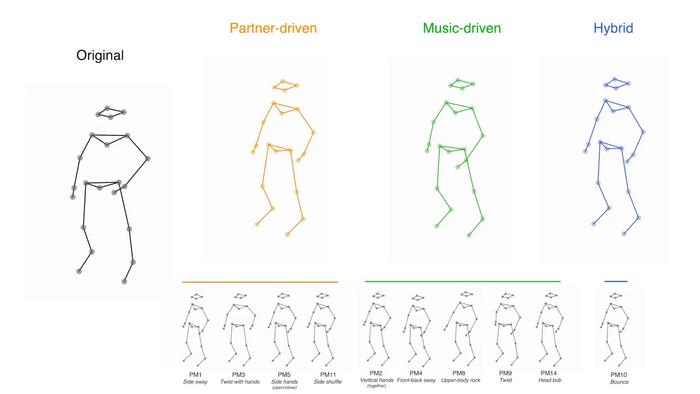
The body movements in space were recorded using wearable markers placed on the main joints and captured by an optical motion capture system with infrared cameras (Vicon). Using a fully data-driven algorithm, the researchers decomposed the complex body movements into 15 elementary “dance steps,” which alone explain over 95% of all recorded movements.
Examining these elementary movements, the researchers demonstrated that distinct dance steps synchronize either through the partner’s vision, independently of the music, even when different music is listened to, or through the music independently of the partner’s movements, even if the partner moves entirely differently. Therefore, there are two ways to synchronize: one driven by music, called “music-driven,” and one driven by movement of the partner, called “partner-driven.” These are independent of each other and can even occur simultaneously without interfering with each other.
Couple or group dancing emerges from the coexistence of these modes, which translate into specific dance movements organized in space. The “music-driven” synchrony incorporates anterior-posterior movements, while the “partner-driven” synchrony incorporates lateral movements, which are more prominent in face-to-face dances. One dance step survives this distinction and thus can synchronize through both channels (music and partner), and that is bounce, i.e. jumping repeatedly up and down to the rhythm of the music beat.
The research group observed that bounce was also the only movement that was exaggerated (i.e. amplified in magnitude) when the participants were visible to each other. “Our study suggests that the vertical bounce functions as a supramodal rhythm regulator, an entry point for coordination in dance,” explains Giacomo Novembre, Principal Investigator of the Neuroscience of Perception and Action Unit at IIT in Rome. “Essentially, vertical movements such as bounce are the most effective for achieving synchronization with other people, through both visual and auditory modes.”
“Since bounce is a fundamental component of locomotion, its unique role in rhythmic coordination might originate from what infants experience through maternal walking,” adds Felix Thomas Bigand, first author of the study and post-doc researcher at IIT in Rome. “Bounce and locomotion are among the earliest isochronous signals we experience in our lives and, so far, one of the few movements or postural (i.e. bipedal) contexts in which non-human primates synchronize movements at an interpersonal level.”
Journal
Current Biology
DOI
10.1016/j.cub.2024.05.055
Method of Research
Experimental study
Subject of Research
People
Article Title
The geometry of interpersonal synchrony in human dance
Article Publication Date
21-Jun-2024