• HOME
  • NEWS
  • EXPLORE
    • CAREER
      • Companies
      • Jobs
    • EVENTS
    • iGEM
      • News
      • Team
    • PHOTOS
    • VIDEO
    • WIKI
  • BLOG
  • COMMUNITY
    • FACEBOOK
    • INSTAGRAM
    • TWITTER
Monday, July 13, 2026
BIOENGINEER.ORG
No Result
View All Result
  • Login
  • HOME
  • NEWS
  • EXPLORE
    • CAREER
      • Companies
      • Jobs
        • Lecturer
        • PhD Studentship
        • Postdoc
        • Research Assistant
    • EVENTS
    • iGEM
      • News
      • Team
    • PHOTOS
    • VIDEO
    • WIKI
  • BLOG
  • COMMUNITY
    • FACEBOOK
    • INSTAGRAM
    • TWITTER
  • HOME
  • NEWS
  • EXPLORE
    • CAREER
      • Companies
      • Jobs
        • Lecturer
        • PhD Studentship
        • Postdoc
        • Research Assistant
    • EVENTS
    • iGEM
      • News
      • Team
    • PHOTOS
    • VIDEO
    • WIKI
  • BLOG
  • COMMUNITY
    • FACEBOOK
    • INSTAGRAM
    • TWITTER
No Result
View All Result
Bioengineer.org
No Result
View All Result
Home NEWS Science News Chemistry

Dalian coherent light source reveals oxygen production from three-body photodissociation of water

Bioengineer by Bioengineer
April 30, 2021
in Chemistry
Reading Time: 2 mins read
0
IMAGE
Share on FacebookShare on TwitterShare on LinkedinShare on RedditShare on Telegram

IMAGE

Credit: DICP

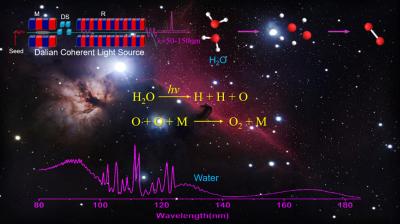
The provenance of oxygen on Earth and other solar planetary bodies is a fundamental issue. It is widely accepted that the prebiotic pathway of oxygen production in the Earth primitive atmosphere was via vacuum ultraviolet (VUV) photodissociation of CO2 and subsequent recombination of two O atoms.

In contrast, the photodissociation of H2O, one of the dominant oxygen carriers, has long been assumed to proceed mainly to produce hydroxyl (OH)- and hydrogen (H)-atom primary products, and its contribution to oxygen production is limited.

Recently, a research group led by Prof. YUAN Kaijun and YANG Xueming from the Dalian Institute of Chemical Physics (DICP) of the Chinese Academy of Sciences revealed oxygen production from the three-body photodissociation of water molecule using the Dalian Coherent Light Source.

Their findings were published in Nature Communications on April 30.

The VUV free-electron laser facility at the Dalian Coherent Light Source allows the researchers to quantitatively assess the importance of H2O photochemistry for oxygen production.

“Our experimental results indicated that H2O under VUV excitation can break into three fragments: one O atom and two H atoms, where the O atoms are in the 1D and 3P states. The three-body dissociation process is the dominant channel for H2O photochemistry in the 90-110 nm region,” said Prof. YUAN.

The quantitative determination demonstrated that approximately 20% of the H2O photoexcitation events resulted in O atoms. Considering the water abundance in widely interstellar circumstances such as in interstellar clouds, atmospheres of the solar-family comets, and even in the Earth primitive atmosphere, O production from water photolysis must be an important process. The subsequent recombination of O atoms produced O2, which represented an important prebiotic O2-production pathway.

###

This research was supported by the Strategic Priority Research Program of the Chinese Academy of Sciences, Chemical Dynamics Research Center, and the National Natural Science Foundation of China.

Media Contact
Jean Wang
[email protected]

Related Journal Article

http://dx.doi.org/10.1038/s41467-021-22824-7

Tags: AstronomyAstrophysicsChemistry/Physics/Materials SciencesSpace/Planetary Science
Share13Tweet8Share2ShareShareShare2

Related Posts

New Imaging Technology Reveals Cellular Origins of Alzheimer’s, Parkinson’s, and ALS

New Imaging Technology Reveals Cellular Origins of Alzheimer’s, Parkinson’s, and ALS

July 13, 2026
Bilayer Nonlocal Flat Optics Advances Light Manipulation Technology

Bilayer Nonlocal Flat Optics Advances Light Manipulation Technology

July 13, 2026

Melting Icebergs Threaten Stability of Distant Ocean Current System

July 13, 2026

New Method Transforms Oxetane Rings into Azetidines in Molecular Structures

July 13, 2026
Please login to join discussion

POPULAR NEWS

  • Detection of EDCs in Breast Milk and Infant Urine Up to Six Months Highlights Early Exposure Risks

    77 shares
    Share 31 Tweet 19
  • New Drug Candidate Developed at McMaster Shows Potential for Treating Brain Cancer

    58 shares
    Share 23 Tweet 15
  • KTU Researchers Explore Ultrasound’s Role in Enhancing Blood Flow Beyond Diagnostics

    53 shares
    Share 21 Tweet 13
  • Experimental Therapy Simultaneously Destroys Prostate Tumor Cells and Reactivates Antitumor Immunity

    46 shares
    Share 18 Tweet 12

About

BIOENGINEER.ORG

We bring you the latest biotechnology news from best research centers and universities around the world. Check our website.

Follow us

Recent News

WVU engineers create AI to accelerate wildfire satellite tracking

Unusual Epigenetic Modifier Drives Some Cancers While Inhibiting Others

New Imaging Technology Reveals Cellular Origins of Alzheimer’s, Parkinson’s, and ALS

Subscribe to Blog via Email

Enter your email address to subscribe to this blog and receive notifications of new posts by email.

Join 85 other subscribers
  • Contact Us

Bioengineer.org © Copyright 2023 All Rights Reserved.

Welcome Back!

Login to your account below

Forgotten Password?

Retrieve your password

Please enter your username or email address to reset your password.

Log In
No Result
View All Result
  • Homepages
    • Home Page 1
    • Home Page 2
  • News
  • National
  • Business
  • Health
  • Lifestyle
  • Science

Bioengineer.org © Copyright 2023 All Rights Reserved.