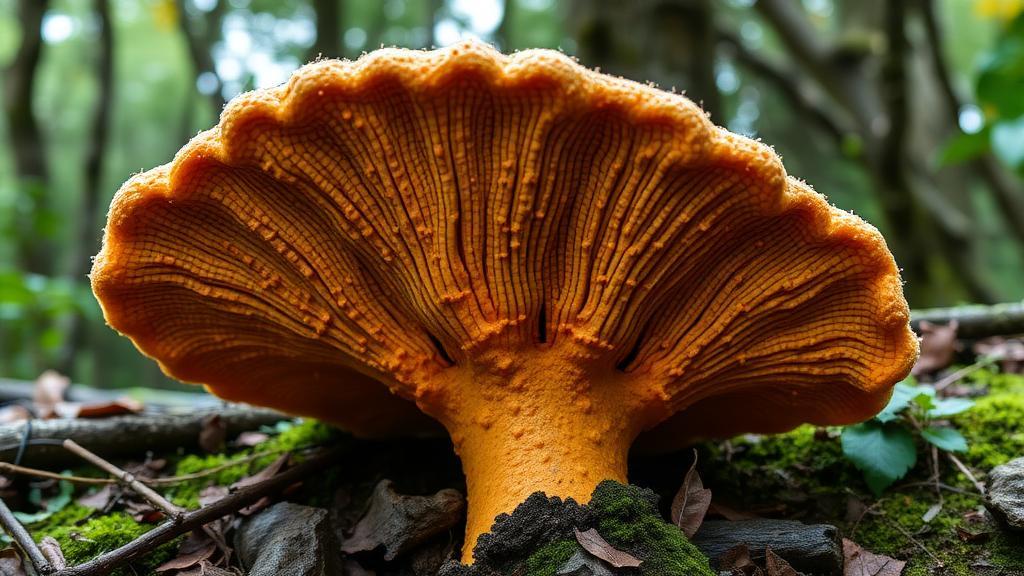
Deep in the forests of Yunnan Province in southwestern China, an international team of scientists has unearthed a fungal giant that is forcing researchers to rethink the limits of body size in one of the largest groups of life on Earth. The newly described species, Dianjunus rex, produces upright fruiting bodies that reach up to 50 centimeters in height and weigh as much as 2.2 kilograms, making it the largest known fruiting structure within the phylum Ascomycota, a lineage that contains more than 64,000 described species. The discovery, published in the journal Frontiers in Fungal Biology, is remarkable not only for the sheer dimensions of the organism but also for its evolutionary pedigree: genomic analysis indicates that the fungus belongs to a family that split from all other known lineages roughly 65 million years ago, in the immediate aftermath of the mass extinction that wiped out the dinosaurs.
The fieldwork that led to the discovery was carried out by researchers from institutions in China, Thailand, and Mexico, with the corresponding author, Dr Indunil C. Senanayake, an associate professor at the Germplasm Bank of Wild Species of the Kunming Institute of Botany in China, coordinating the study. The team encountered the strange fungus during surveys in temperate coniferous forests near the localities of Damaidi and Yipinglang, and again in tropical rainforest near Nanbang. In both settings, the organism appeared as large whitish structures rising from the soil around woody roots of Chinese cork oak, emerging from the rhizosphere, the biologically rich zone of soil and root interactions. To trained mycologists, the specimens were immediately recognizable as the fruiting bodies, or stromata, of an ascomycete fungus, yet nothing about them matched any known species.
Understanding why this find is so unusual requires a brief look at fungal anatomy. Most people picture fungi as mushrooms, but true mushrooms with cap and stem are produced by basidiomycetes, only one of the two great divisions of the fungal kingdom. Ascomycetes, by contrast, do not form mushrooms at all. Instead, they release their spores from tiny, sac-like cells called asci, which sit inside or on the surface of fruiting bodies that are often small, crust-like, cup-shaped, or flask-shaped structures. Among this enormous and mostly inconspicuous group, fruiting bodies that stand 20 to 30 centimeters tall were previously considered the upper limit of what was possible. Dianjunus rex, with its half-meter-tall, multi-kilogram stromata, nearly doubles that record, which is why the researchers have affectionately nicknamed it D-rex, a nod to its regal dimensions.
To determine exactly what they had found, the scientists collected fruiting bodies and deposited voucher specimens in the fungarium of the Kunming Institute of Botany, ensuring that the physical reference material is permanently available for future study. Back in the laboratory, they germinated spores on culture media and examined the resulting colonies under the microscope, documenting the detailed morphological features, spore shape, tissue structure, and surface characteristics, that mycologists use to distinguish species. In parallel, they sequenced the fungus’s genome, including its full complement of protein-coding genes, providing a molecular dataset that could be compared against the growing library of fungal genomes.
The combined evidence from morphology and genetics was unambiguous. Dianjunus rex was not merely a new species; it was so distinct that it warranted the description of a new genus and, remarkably, an entirely new family, Dianjunaceae, within the order Xylariales. In taxonomy, the family rank sits well above the species level, and the creation of a new family from a single organism signals just how deep the evolutionary separation is between this fungus and its nearest neighbors. The closest known relative is Graphostroma platystoma, a fungus that grows on dead hardwood across the northern hemisphere and which, like D-rex, is so isolated that it constitutes its own family, Graphostromataceae. The researchers chose the name Dianjunus rex in honor of both the organism’s king-sized fruiting bodies and the ancient Dian kingdom, a historic polity of the Yunnan region.
The order Xylariales, to which the new family belongs, is famous among mycologists for its chemical and enzymatic repertoire. Many of its members produce an array of secondary metabolites, biologically active compounds that have long attracted attention from pharmacologists and chemists, as well as enzymes capable of degrading complex plant polymers such as lignin and cellulose. The authors suggest that D-rex likely shares this enzymatic toolkit, which would allow it to digest dead wood and explain its habit of growing on the woody roots of its host trees. If confirmed, this would place the giant fungus among the wood-decomposing recyclers that play a crucial role in forest carbon cycles, breaking down fallen timber and returning its constituents to the soil.
Perhaps the most striking result of the study came from the molecular clock analysis. By comparing the new species’ DNA with the genomes of hundreds of fungi whose evolutionary ages are already calibrated, the researchers estimated that the Dianjunaceae lineage arose approximately 65 million years ago. That date places the origin of the family just one million years after the Cretaceous-Paleogene mass extinction, the cataclysm triggered by an asteroid impact that eliminated the non-avian dinosaurs and countless other animals and plants. The timing, Senanayake noted, raises an intriguing possibility: after the mass extinction, forests underwent dramatic changes, including the sudden availability of large amounts of dead plant material, and for wood-associated decomposing fungi, such environmental disruption may have created new ecological opportunities. In other words, the ancestor of D-rex may have flourished in the ecological vacuum left behind by a world in collapse.
Why would a fungus evolve fruiting bodies of such extraordinary size? The authors offer a hypothesis grounded in fungal ecology. Spore dispersal is the central challenge in the reproductive life of a fungus, and in dense forests, where ground-level air movement is weak and vegetation and debris obstruct airflow, spores released close to the soil may travel only short distances. A fruiting body that towers above the surrounding vegetation and litter could catch stronger air currents and achieve better wind dispersal of its spores. But such a large structure demands a substantial energy investment, drawing on the fungus’s finite resources, and Senanayake hypothesized that this strategy likely evolved only in places where the ecological benefits outweighed the costs. D-rex’s gigantism, on this view, is not a curiosity but a finely tuned adaptation to the specific conditions of the Yunnan forests where it grows.
The discovery also carries a broader message about how much of fungal diversity remains undocumented. Senanayake and colleagues predict that more discoveries of fungi from subtropical China lie in store, because the region combines exceptional habitat heterogeneity, climatic stability, and complex biotic interactions that promote fungal diversification. Historically, however, fungal diversity in these ecosystems has been underestimated, owing to logistical difficulties in field sampling, the seasonal and cryptic nature of fungal fruiting, and a long-standing research emphasis on economically important fungi. A single collection trip that yields a new family, a new genus, and a record-breaking species is a vivid illustration of that gap. As genomic methods become cheaper and field surveys reach more remote habitats, mycologists expect many more evolutionary surprises, and Dianjunus rex stands as a reminder that some of the planet’s most extraordinary organisms may be waiting, quite literally, at the roots of the trees.
Subject of Research: Discovery and evolutionary analysis of Dianjunus rex, a giant ascomycete fungus from Yunnan, China, representing a new fungal family that originated around 65 million years ago.
Article Title: Scientists discover ‘D-rex’, a giant fungus from Chinese forests whose unique lineage dates back 65 million years
Article References: Scientists discover ‘D-rex’, a giant fungus from Chinese forests whose unique lineage dates back 65 million years. (n.d.). Original publication
Image Credits: AI Generated
DOI: Not provided
Keywords: Dianjunus rex, mycology, Ascomycota, Xylariales, Yunnan, fungal taxonomy, molecular clock, Cretaceous-Paleogene extinction, spore dispersal, wood-decomposing fungi, new family Dianjunaceae, Kunming Institute of Botany
News Source: Roger Howard. (October 14, 2026). D-rex: Giant 65-Million-Year-Old Fungus From Chinese Forests Rewrites Fungal Family Tree. Scienmag.