The multi-institution team will explore novel methods of chemical synthesis through mechanochemistry
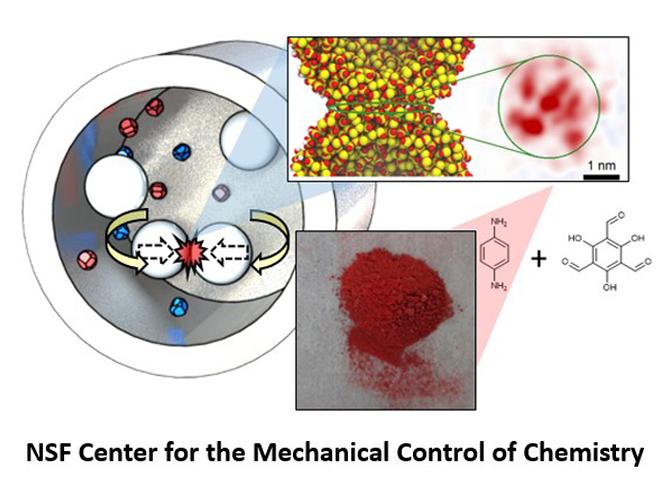
Credit: NSF
NEW YORK, August 4, 2020 — Researchers from the Advanced Science Research Center at The Graduate Center, CUNY (CUNY ASRC) are part of a multi-institution team of scientists that has been awarded one of three newly announced $1.8 million, phase 1 grants from the Centers for Chemical Innovation (CCI) — part of the National Science Foundation Division of Chemistry. The grant will fund the team’s work to help establish the NSF Center for the Mechanical Control of Chemistry (CMCC).
“Mechanical force is the next frontier in organic chemistry,” said professor Adam Braunschweig, whose lab at the CUNY ASRC Nanoscience Initiative is part of the multi-institution team. “Using force, instead of heat, to accelerate reactions, could lead to more efficient ways to make drugs or reduce the use of dangerous industrial solvents in the chemical industry. Our group will lead the reaction design team in an effort to develop new, predictive rules that anticipate how reactive chemicals will respond to mechanical stress.”
The overall project will be led by Texas A&M University chemist James D. Batteas, who will serve as the principal investigator. The team will include co-investigators Jonathan Felts from the Texas A&M Department of Mechanical Engineering; Adam Braunschweig from the CUNY ASRC,; Robert Carpick and Andrew Rappe from the University of Pennsylvania; Danna Freedman from Northwestern University; and Ashlie Martini from the University of California, Merced. Together, the team will bring critical expertise in chemistry, physics, materials science, and engineering mechanics to the project.
CCI initiatives support projects that are too complex and multi-faceted for individuals or small groups of researchers to tackle on their own. CCI was designed to bring together researchers with diverse expertise to support high risk, transformative science; energize the chemistry research community; and enable researchers to take on grand challenges while creatively engaging the public in the scientific enterprise.
As the first CCI to be funded in Texas and one of 30 created since the program began in 2012, the CMCC seeks to better understand how the application of precise mechanical forces can be used to alter chemical reaction rates and pathways at surfaces and interfaces. One of the CMCC’s primary goals is to develop quantitative models for mechanochemical synthesis that will have significant impact on the synthesis of materials, ranging from everyday commodity chemicals, to novel materials for advanced electronics, to pharmaceuticals.
The use of mechanical force to drive chemistry dates to antiquity, but developing it into a reliable method for chemical synthesis largely has been ignored because the tools to investigate how the application of force affects reactions were until recently highly underdeveloped. CMCC aims to create a new toolbox that will allow researchers to define and control the forces applied to molecules in very precise ways. In partnership with Eastman and Dow Chemical Companies, the center will seek to apply the transformative knowledge of the mechanochemistry it develops to industrial-scale processes to enable new approaches for more energy efficient, more selective, and safer chemical syntheses.
“The broader impact of this work will be a new perspective on chemical reactivity that will guide the development of new technologies for chemical synthesis,” Batteas said. “Imagine being able to do on-demand synthesis without the need for complex reactors. Such approaches may enable, for example, more rapid prototyping of customized drugs or the ability to carry out complex chemical syntheses on Mars using only locally sourced materials.”
The CCI Program is structured in two phases — an initial solicitation that results in awards supporting a center’s scientific, management, and infrastructure development en route to an opportunity for $20 million in subsequent funding, based on a demonstrated capacity for sustainable large-scale science and transformative impact in chemistry.
At the heart of the CMCC is the training of a diverse cadre of graduate and undergraduate students in chemistry, physics, mechanics, and materials science who will play key roles in center research and outreach activities. Current plans include a mechanochemistry-themed STEM summer camp for high school students, science history exhibits, entrepreneurship opportunities, and training in both technology transfer strategies and public policy.
###
About the Advanced Science Research Center
The ASRC at The Graduate Center elevates scientific research and education at CUNY and beyond through initiatives in five distinctive, but increasingly interconnected disciplines: environmental sciences, nanoscience, neuroscience, photonics, and structural biology. The ASRC promotes a collaborative, interdisciplinary research culture with renowned researchers from each of the initiatives working side-by-side in the ASRC’s core facilities, sharing equipment that is among the most advanced available.
About The Graduate Center of The City University of New York
The Graduate Center of The City University of New York (CUNY) is a leader in public graduate education devoted to enhancing the public good through pioneering research, serious learning, and reasoned debate. The Graduate Center offers ambitious students more than 40 doctoral and master’s programs of the highest caliber, taught by top faculty from throughout CUNY — the nation’s largest public urban university. Through its nearly 40 centers, institutes, and initiatives, including its Advanced Science Research Center (ASRC), The Graduate Center influences public policy and discourse and shapes innovation. The Graduate Center’s extensive public programs make it a home for culture and conversation.
Media Contact
Shawn Rhea
[email protected]