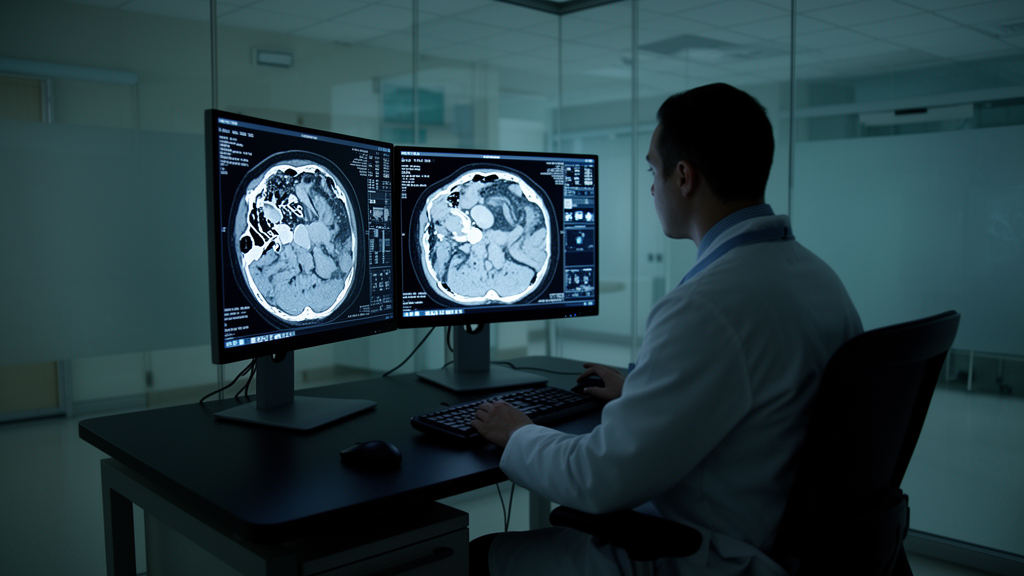
In a multicenter retrospective study, researchers developed and evaluated an artificial intelligence model integrating handcrafted radiomics and deep transfer learning features from contrast-enhanced computed tomography, demonstrating promising discrimination for characterizing the risk of surgical intervention in patients presenting with small bowel obstruction. The combined clinical and deep-learning radiomics model achieved an area under the receiver-operating-characteristic curve of 0.82 during external validation across independent hospital centers.
The investigative team designed the multicenter retrospective study to address the clinical challenge of estimating the likelihood that an individual with small bowel obstruction will require surgical intervention. Across three participating medical centers, the study gathered and analyzed clinical and imaging records from a total of 314 patients diagnosed with small bowel obstruction. Patients treated at one center constituted the primary training cohort of 219 individuals, while patients admitted to the remaining two centers made up an external validation cohort of 95 individuals.
Within the study’s analytical framework, high-risk small bowel obstruction was defined specifically as a condition necessitating surgical management. To capture diverse imaging characteristics, the investigators extracted handcrafted radiomic features from three-dimensional regions of interest on contrast-enhanced computed tomography scans. These handcrafted features were subsequently combined with two-dimensional ResNet-50 deep transfer learning features to construct a baseline deep-learning radiomic model, designated as the DLR model.
To enhance diagnostic stratification further, the researchers constructed a nomogram-based model known as the DLRN model by integrating two specific clinical features into the deep-learning radiomic score. These two clinical variables comprised rebound tenderness detected on physical examination and reduced bowel-wall enhancement visualized on contrast-enhanced computed tomography. Across the complete cohort of 314 patients, treatment outcomes were closely split, with 158 patients undergoing surgical intervention and 156 patients receiving conservative non-surgical management.
Model performance across cohorts was systematically evaluated using multiple statistical assessment tools. The investigators measured discrimination using the area under the receiver-operating-characteristic curve, quantified risk reclassification through net reclassification improvement and integrated discrimination improvement, and utilized decision-curve analysis to determine clinical net benefit. In addition to computational model metrics, the researchers conducted a reader study to assess changes in radiologists’ diagnostic performance when assisted by the artificial intelligence model.
In performance testing, the integrated DLRN model achieved an area under the receiver-operating-characteristic curve of 0.94 within the training cohort and 0.82 within the external validation cohort. When tested on the external validation cohort, the DLRN model’s area under the curve was numerically higher than the area under the curve achieved by the standalone clinical model at 0.72, the standalone radiomics model at 0.81, and the deep-learning radiomic model at 0.80. However, pairwise DeLong statistical comparisons indicated that none of these external validation differences were statistically significant, with p-values exceeding 0.05.
The study observed that incremental discrimination and clinical net benefit were substantially more evident in the internal training cohort than in the external test group. In the external validation cohort, neither the integrated discrimination improvement comparisons nor the receiver-operating-characteristic curve comparisons established statistically significant superiority for the combined model over other configurations. Furthermore, while the mean accuracy of radiologists improved numerically with artificial intelligence assistance, the reader study did not establish a direct treatment effect or demonstrable improvement in clinical patient outcomes.
Subject of Research: CT radiomics and deep transfer learning for predicting surgical intervention in small bowel obstruction
Article Title: CT radiomics with transfer learning features for characterizing the risk of surgical intervention in small bowel obstruction: a multicenter retrospective study
Article References: Zhang, G., Ning, Y., Sun, Y., Liao, J., Liu, X., Huang, W., Zhou, G., Wei, Y., Han, X., & Wang, D. (2026). CT radiomics with transfer learning features for characterizing the risk of surgical intervention in small bowel obstruction: a multicenter retrospective study. European Journal of Medical Research. https://doi.org/10.1186/s40001-026-05422-5
Image Credits: AI Generated
DOI: 10.1186/s40001-026-05422-5
Keywords: small bowel obstruction, computed tomography, contrast-enhanced CT, radiomics, deep transfer learning, ResNet-50, surgical intervention, DLRN model, rebound tenderness, bowel-wall enhancement, external validation, receiver operating characteristic, decision curve analysis, net reclassification improvement, integrated discrimination improvement, multicenter retrospective study, radiologist AI assistance
News Source: Scienmag.