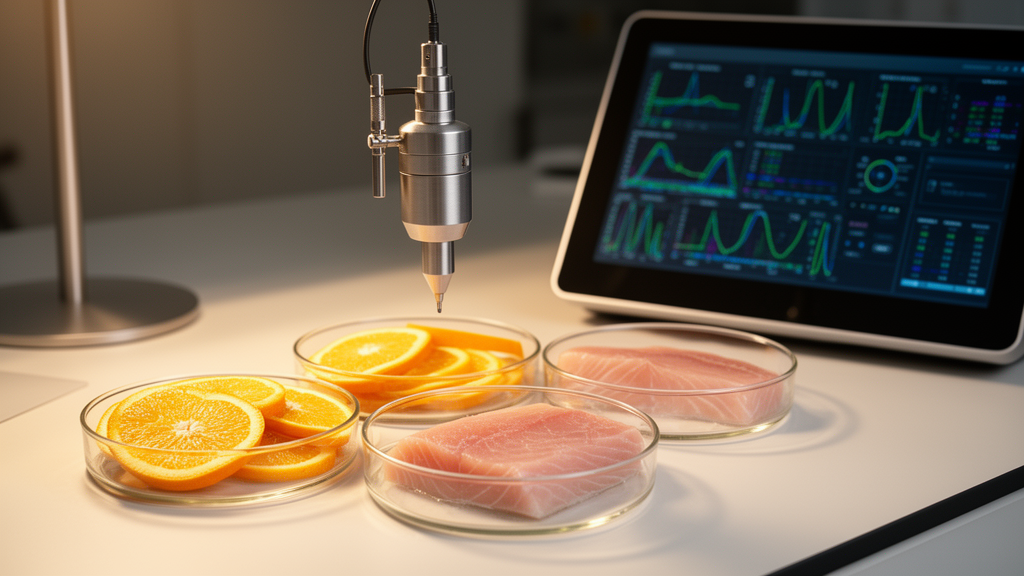
Ensuring the authenticity, safety, and sensory quality of food products represents a major ongoing priority across the global food sector, where traditional analytical techniques like gas chromatography–mass spectrometry and high-performance liquid chromatography deliver precise chemical characterization but remain labor-intensive, slow, and expensive. Electronic noses offer an objective and non-destructive alternative by mimicking the biological mechanisms of mammalian olfaction through cross-reactive chemical sensor arrays that detect complex mixtures of volatile organic compounds. Rather than isolating individual chemical constituents, these instrument arrays capture collective multivariate response patterns that form characteristic aroma fingerprints for diverse food samples. A comprehensive narrative review by researchers Grace Maria Paulson, Ameen Pareesa Zidhiq, Kaushalya Wijayasekara, and Sandeep Singh Rana summarizes findings from 106 studies published between 2010 and 2026 to evaluate how artificial intelligence, classical machine learning, and advanced deep learning algorithms transform raw gas sensor data into reliable evaluations of food quality, freshness, and authenticity.
The foundational architecture of an electronic nose relies on a combinatorial coding strategy directly analogous to biological olfactory perception. In mammalian biology, odorant molecules activate overlapping subsets of broadly tuned receptors, producing combinatorial activation patterns that neural circuits decode to identify specific odors. Replicating this principle at the instrumental level, an electronic nose pairs semi-selective sensing materials with pattern-recognition algorithms that decode high-dimensional sensor response vectors into defined food quality or freshness categories. The reviewed literature encompasses a diverse spectrum of sensing transducers, most prominently metal oxide semiconductor sensors, which operate via chemiresistive transduction when volatile organic compounds adsorb onto heated metal oxide surfaces like tin dioxide, zinc oxide, or tungsten trioxide. Other established transducer classes include conducting polymers that operate at ambient room temperatures, mass-sensitive quartz crystal microbalances, surface acoustic wave devices, and emerging hybrid nanocomposite platforms fabricated from carbon nanotubes, graphene oxide, and conducting polymer blends.
The reviewed body of literature was gathered through structured searches across Google Scholar and PubMed databases between March and April 2026, screening records that combined gas-sensing hardware with machine learning across dairy, meat, seafood, beverages, fruits, and processed food matrices. Of the 106 eligible studies analyzed in the review, 58 publications contributed foundational data on sensor types, operating principles, headspace sampling configurations, and traditional chemometric limitations, while 48 applied artificial intelligence, machine learning, or deep learning methodologies to perform comparative analytical tasks. The investigators evaluated how algorithms address critical food industry tasks, including spoilage monitoring, shelf-life estimation, authenticity verification, and aroma profiling, while tracking how computational workflows manage the high-dimensional, collinear, and non-linear data structures generated across multi-sensor arrays.
Prior to the widespread integration of modern machine learning, food quality assessment using electronic noses depended on traditional chemometric techniques, primarily principal component analysis for unsupervised dimensionality reduction alongside linear discriminant analysis and partial least squares regression for supervised classification. While these classical techniques offered straightforward mathematical interpretability, the review notes they struggled substantially with the non-linear response profiles and complex intermolecular interactions characteristic of multi-component volatile organic mixtures. Conventional linear decision boundaries frequently produced misclassifications when confronted with subtle aroma shifts or diverse food matrices. Furthermore, early chemometric setups exhibited rigid calibration profiles that failed when transferred across different sensor configurations, proved vulnerable to baseline drift from sensor aging, and operated largely as offline diagnostic routines requiring extensive manual intervention.
The introduction of classical supervised machine learning algorithms significantly expanded the analytical capacity of electronic noses when processing complex food matrices. Support vector machines have been widely adopted due to their robust capability to define non-linear classification margins even within relatively small experimental training datasets. In surveyed applications, support vector machine models paired with discrete wavelet transforms and principal component analysis achieved classification accuracies exceeding 98 percent when discriminating between unadulterated beef and beef adulterated with pork across 420 experimental measurements. Similarly, random forest models demonstrated high stability and predictive performance in classifying raw milk sources and estimating fat and protein concentrations across 1,000 data points from ten farms, achieving determination coefficients above 0.93. Artificial neural networks, k-nearest neighbors, and decision tree variants also consistently outperformed traditional linear chemometrics in distinguishing fresh from deteriorated samples across meat, tea, and dairy matrices.
To overcome the reliance of classical machine learning on handcrafted feature extraction and extensive manual preprocessing, researchers have increasingly deployed deep learning architectures that automatically extract hierarchical representations from raw or transformed sensor signals. Convolutional neural networks, particularly one-dimensional convolutional networks, have proven effective at processing continuous volatile organic compound trajectories, allowing systems to capture dynamic transient behaviors rather than relying strictly on steady-state measurements. Hybrid architectures have emerged as an especially effective computational strategy: combining convolutional layers for automated feature extraction with support vector machines for final decision boundaries provides strong generalization performance on small sample sizes. Additionally, hybrid models integrating convolutional neural networks with long short-term memory recurrent networks capture both localized sensor feature representations and long-term temporal dependencies that unfold during food storage and microbial spoilage.
Beyond single-device aroma identification, emerging computational frameworks are tackling the real-world operational challenges of cross-platform deployment and sensor instability. Transfer learning and domain adaptation methodologies enable models pretrained on baseline food datasets to be calibrated for new food products, different sensor devices, or shifting operating conditions with minimal retraining. In parallel, multimodal sensory integration is gaining traction by coupling electronic-nose volatile detection with computer vision, hyperspectral imaging, or electronic tongues to jointly analyze chemical, optical, and morphological food properties for comprehensive quality grading. To address the black-box nature of advanced neural networks, recent studies are incorporating explainable artificial intelligence frameworks such as Shapley Additive Explanations and Local Interpretable Model-Agnostic Explanations, which identify the specific sensor signals driving predictions to bolster regulatory compliance and industrial transparency.
The review also documents ongoing developments in microelectromechanical systems and nanoelectromechanical systems designed to miniaturize electronic-nose platforms into compact lab-on-chip devices. Micro-hotplate structures fabricated through silicon micromachining drastically reduce the thermal mass of metal oxide sensing layers, enabling precise temperature modulation that extracts rich response patterns from fewer individual sensing elements. Integrating these miniaturized sensors with microfluidic sample handling, wireless connectivity, and onboard machine learning establishes practical pathways toward portable and potentially in-line inspection tools. Commercial electronic-nose instruments, including the Airsense Analytics PEN3 portable metal oxide system, Alpha MOS FOX platforms, and Sensigent Cyranose 320 nanocomposite devices, already demonstrate practical utility in laboratory aroma profiling and rapid authenticity screening, although proprietary hardware and closed signal-processing pipelines continue to complicate direct cross-platform analytical comparisons.
Despite impressive reported performance figures across published literature, the review emphasizes that severe technical and methodological barriers still hinder widespread industrial adoption. Sensor drift remains a pervasive physical challenge, caused by sensor aging, surface contamination, and ambient humidity or temperature fluctuations that distort baseline responses and degrade calibration stability over time. While baseline correction, periodic recalibration using reference samples, adaptive retraining algorithms, and ensemble methods help mitigate drift, each introduces logistical complexity. Methodologically, the authors warn that reported classification accuracies cannot be viewed as universal benchmarks due to wide variations in sample sizes, sensor arrays, class distributions, and preprocessing steps. Critical validation vulnerabilities were highlighted in surveyed studies, including instances where synthetic oversampling or feature selection protocols were applied prior to train-test splits, introducing risks of data or target leakage that inflate apparent predictive accuracy.
Ultimately, transitioning artificial intelligence-driven electronic noses from academic laboratories into automated, real-time industrial food processing systems requires rigorous standardization and validation across independent sample batches, diverse operating environments, and multi-instrument deployments. The authors emphasize that future research must prioritize establishing public benchmark datasets, harmonized testing protocols, and robust external validation to verify model generalizability beyond controlled bench conditions. As advanced sensor microfabrication converges with transfer learning, edge computing, and distributed Internet of Things ecosystems, intelligent electronic noses possess substantial potential to evolve into automated, connected sensing networks capable of autonomous freshness tracking, rapid adulteration screening, and continuous safety assurance throughout food supply chains.
Subject of Research: Artificial intelligence and machine learning applications in electronic nose systems for food quality and sensory evaluation
Article Title: AI-powered electronic noses: advances in machine learning for food quality and sensory assessment
Article References: Paulson, G. M., Zidhiq, A. P., Wijayasekara, K., & Rana, S. S. (2026). AI-powered electronic noses: advances in machine learning for food quality and sensory assessment. Frontiers in Artificial Intelligence, 9, Article 1904306. https://doi.org/10.3389/frai.2026.1904306
Image Credits: AI Generated
DOI: 10.3389/frai.2026.1904306
Keywords: Electronic Noses, Artificial Intelligence, Machine Learning, Deep Learning, Food Quality Assessment, Food Authenticity, Volatile Organic Compounds, Gas Sensor Arrays, Sensor Drift, Support Vector Machines, Convolutional Neural Networks, Metal Oxide Sensors, Headspace Analysis, Transfer Learning, Food Safety Monitoring, Commercial E-Noses
News Source: Blake Davidson. (November 25, 2026). Machine Learning Powers Electronic Noses for Food Freshness and Authenticity Assessment. Scienmag.