• HOME
  • NEWS
  • EXPLORE
    • CAREER
      • Companies
      • Jobs
    • EVENTS
    • iGEM
      • News
      • Team
    • PHOTOS
    • VIDEO
    • WIKI
  • BLOG
  • COMMUNITY
    • FACEBOOK
    • INSTAGRAM
    • TWITTER
Monday, May 11, 2026
BIOENGINEER.ORG
No Result
View All Result
  • Login
  • HOME
  • NEWS
  • EXPLORE
    • CAREER
      • Companies
      • Jobs
        • Lecturer
        • PhD Studentship
        • Postdoc
        • Research Assistant
    • EVENTS
    • iGEM
      • News
      • Team
    • PHOTOS
    • VIDEO
    • WIKI
  • BLOG
  • COMMUNITY
    • FACEBOOK
    • INSTAGRAM
    • TWITTER
  • HOME
  • NEWS
  • EXPLORE
    • CAREER
      • Companies
      • Jobs
        • Lecturer
        • PhD Studentship
        • Postdoc
        • Research Assistant
    • EVENTS
    • iGEM
      • News
      • Team
    • PHOTOS
    • VIDEO
    • WIKI
  • BLOG
  • COMMUNITY
    • FACEBOOK
    • INSTAGRAM
    • TWITTER
No Result
View All Result
Bioengineer.org
No Result
View All Result
Home NEWS Science News Chemistry

Crystalline ‘artificial muscle’ makes paper doll do sit-ups

Bioengineer by Bioengineer
July 17, 2019
in Chemistry
Reading Time: 2 mins read
0
IMAGE
Share on FacebookShare on TwitterShare on LinkedinShare on RedditShare on Telegram

IMAGE

Credit: American Chemical Society

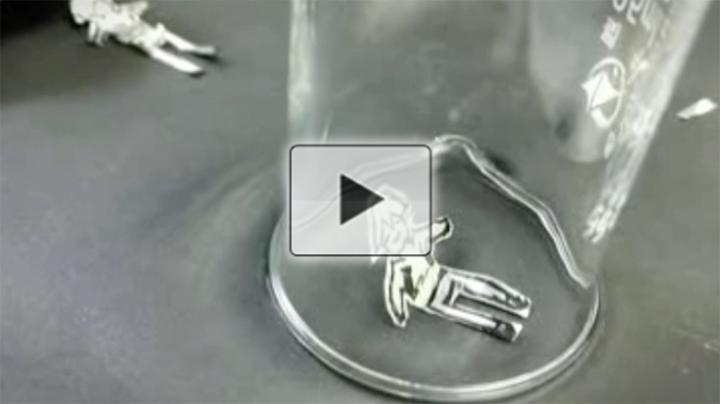
Scary movies about dolls that can move, like Anabelle and Chucky, are popular at theaters this summer. Meanwhile, a much less menacing animated doll has chemists talking. Researchers have given a foil “paper doll” the ability to move and do sit-ups with a new material called polymer covalent organic frameworks (polyCOFs). They report their results in ACS Central Science. Watch a video of the material in action here.

Scientists make conventional COFs by linking simple organic building blocks, such as carbon-containing molecules with boric acid or aldehyde groups, with covalent bonds. The ordered, porous structures show great potential for various applications, including catalysis, gas storage and drug delivery. However, COFs typically exist as nano- or micro-sized crystalline powders that are brittle and can’t be made into larger sheets or membranes that would be useful for many practical applications. Yao Chen, Shengqian Ma, Zhenjie Zhang and colleagues wondered if they could improve COFs’ mechanical properties by using linear polymers as building blocks.

The researchers based their polyCOF on an existing COF structure, but during the compound’s synthesis, they added polyethylene glycol (PEG) to the reactants. The PEG chains bridged the pore space of the COF, making a more compact, cohesive and stable structure. In contrast to the original COF, the polyCOF could be incorporated into flexible membranes that were repeatedly bent, twisted or stretched without damage. To demonstrate how polyCOFs could be used as an artificial muscle, the team made a doll containing the membrane as the waist and aluminum foil as its other parts. Upon exposure to ethanol vapors, the doll sat up; when the vapors were withdrawn, it laid down. The researchers repeated these actions several times, making the doll do “sit-ups.” The expansion of polyCOF pores upon binding the gas likely explains the doll’s calisthenics, the researchers say.

###

The authors acknowledge funding from the National Natural Science Foundation of China, Tianjin Natural Science Foundation of China and the National Science Foundation.

The study is freely available as an ACS AuthorChoice article here.

For more research news, journalists and public information officers are encouraged to apply for complimentary press registration for the ACS fall 2019 national meeting in San Diego.

The American Chemical Society, the world’s largest scientific society, is a not-for-profit organization chartered by the U.S. Congress. ACS is a global leader in providing access to chemistry-related information and research through its multiple databases, peer-reviewed journals and scientific conferences. ACS does not conduct research, but publishes and publicizes peer-reviewed scientific studies. Its main offices are in Washington, D.C., and Columbus, Ohio.

To automatically receive news releases from the American Chemical Society, contact [email protected].

Follow us on Twitter | Facebook

Media Contact
Katie Cottingham
[email protected]

Related Journal Article

http://dx.doi.org/10.1021/acscentsci.9b00212

Tags: BiotechnologyChemistry/Physics/Materials SciencesPolymer Chemistry
Share12Tweet8Share2ShareShareShare2

Related Posts

Miniature Sensor Uses Light to Detect Touch — Chemistry

Miniature Sensor Uses Light to Detect Touch

May 8, 2026
Iron Minerals Determine Whether Dissolved Organic Matter Fuels Microbes or Becomes Long-Term Carbon Storage — Chemistry

Iron Minerals Determine Whether Dissolved Organic Matter Fuels Microbes or Becomes Long-Term Carbon Storage

May 8, 2026

Kate Evans Appointed Associate Lab Director for Biological and Environmental Systems Science at ORNL

May 8, 2026

Advancing Multiscale Modeling and Overcoming Operational Challenges in Autothermal COâ‚‚-to-Methanol Reactors

May 8, 2026
Please login to join discussion

POPULAR NEWS

  • Research Indicates Potential Connection Between Prenatal Medication Exposure and Elevated Autism Risk

    840 shares
    Share 336 Tweet 210
  • New Study Reveals Plants Can Detect the Sound of Rain

    727 shares
    Share 290 Tweet 181
  • Salmonella Haem Blocks Macrophages, Boosts Infection

    61 shares
    Share 24 Tweet 15
  • Breastmilk Balances E. coli and Beneficial Bacteria in Infant Gut Microbiomes

    57 shares
    Share 23 Tweet 14

About

We bring you the latest biotechnology news from best research centers and universities around the world. Check our website.

Follow us

Recent News

New Post-Hoc Analysis Explores Daily Oral Orforglipron Use in Adults Over 65 with Obesity, Regardless of Diabetes Status

Evaluating Digoxin Use in Patients with Symptomatic Rheumatic Heart Disease

Evaluating the Effectiveness and Safety of Digitalis Glycosides in Treating Heart Failure

Subscribe to Blog via Email

Enter your email address to subscribe to this blog and receive notifications of new posts by email.

Join 82 other subscribers
  • Contact Us

Bioengineer.org © Copyright 2023 All Rights Reserved.

Welcome Back!

Login to your account below

Forgotten Password?

Retrieve your password

Please enter your username or email address to reset your password.

Log In
No Result
View All Result
  • Homepages
    • Home Page 1
    • Home Page 2
  • News
  • National
  • Business
  • Health
  • Lifestyle
  • Science

Bioengineer.org © Copyright 2023 All Rights Reserved.