• HOME
  • NEWS
  • EXPLORE
    • CAREER
      • Companies
      • Jobs
    • EVENTS
    • iGEM
      • News
      • Team
    • PHOTOS
    • VIDEO
    • WIKI
  • BLOG
  • COMMUNITY
    • FACEBOOK
    • INSTAGRAM
    • TWITTER
Thursday, July 2, 2026
BIOENGINEER.ORG
No Result
View All Result
  • Login
  • HOME
  • NEWS
  • EXPLORE
    • CAREER
      • Companies
      • Jobs
        • Lecturer
        • PhD Studentship
        • Postdoc
        • Research Assistant
    • EVENTS
    • iGEM
      • News
      • Team
    • PHOTOS
    • VIDEO
    • WIKI
  • BLOG
  • COMMUNITY
    • FACEBOOK
    • INSTAGRAM
    • TWITTER
  • HOME
  • NEWS
  • EXPLORE
    • CAREER
      • Companies
      • Jobs
        • Lecturer
        • PhD Studentship
        • Postdoc
        • Research Assistant
    • EVENTS
    • iGEM
      • News
      • Team
    • PHOTOS
    • VIDEO
    • WIKI
  • BLOG
  • COMMUNITY
    • FACEBOOK
    • INSTAGRAM
    • TWITTER
No Result
View All Result
Bioengineer.org
No Result
View All Result
Home NEWS Science News Biology

Cryo-EM reveals unexpected diversity of photosystems

Bioengineer by Bioengineer
March 9, 2020
in Biology
Reading Time: 2 mins read
0
IMAGE
Share on FacebookShare on TwitterShare on LinkedinShare on RedditShare on Telegram

IMAGE

Credit: Ella Marushchenko

Oxygenic photosynthesis is the conversion of sunlight into chemical energy that underpins the survival of virtually all complex life forms. The energy conversion is driven by a photosynthetic apparatus that captures light photons in the bioenergetic membranes of cyanobacteria, algae and plants. Photosystem I is a central component of this process.

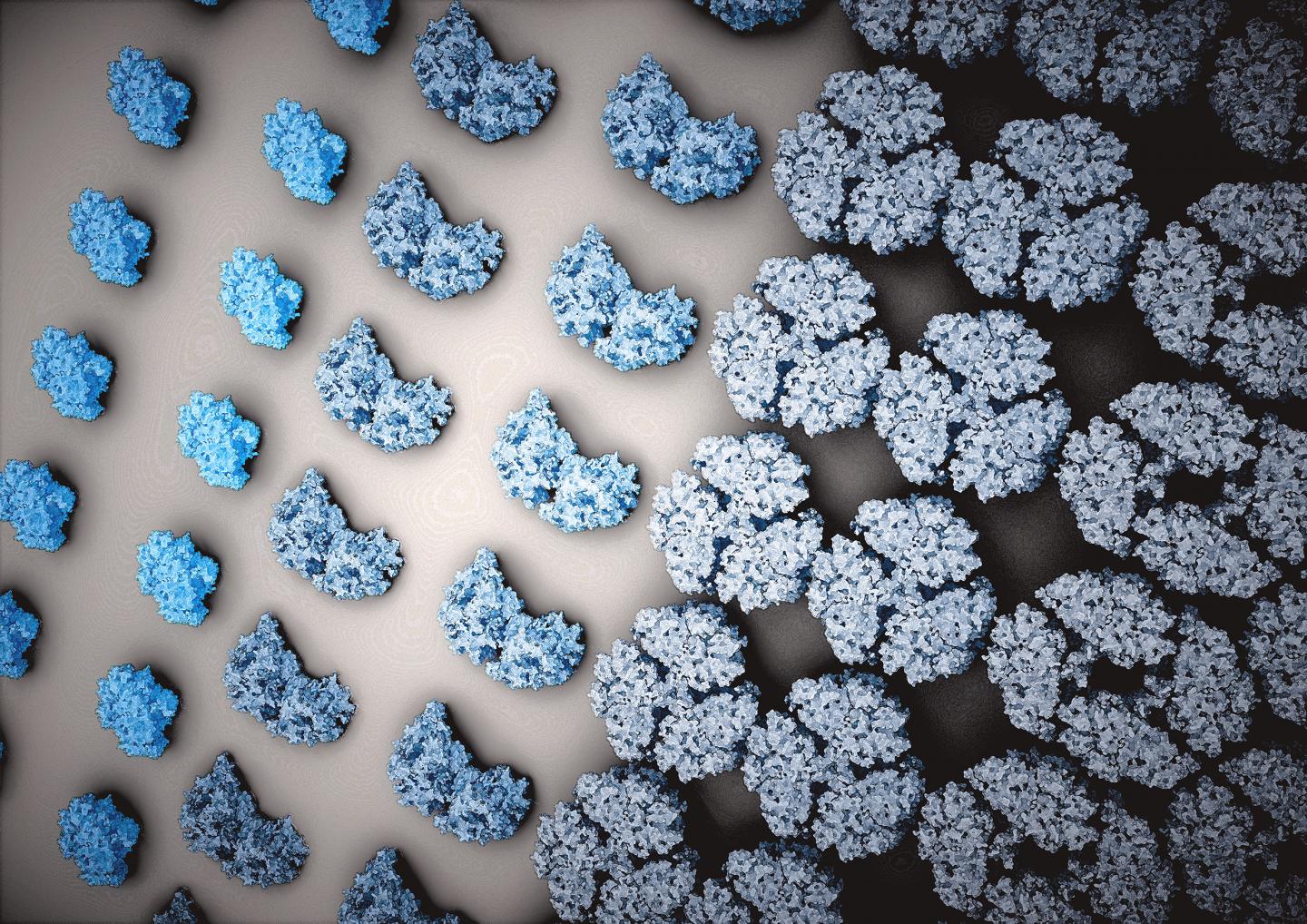
The current textbook paradigm of Photosystem I is a trimer architecture for cyanobacteria, and a monomer for algae. Two new discoveries from a collaboration of researchers from SciLifeLab with Tsinghua University and Tel Aviv University, reported in Nature Plants, find that freshwater-living plankton Anabaena has adapted a specialized Photosystem I dimer of dimers with 476 pigments; while green alga Dunaliella, has optimized a minimal form of Photosystem I (mini-PSI) to live in hypersaline environment and under light stress. Annemarie Perez Boerema from Alexey Amunts lab (Stockholm University, SciLifeLab) used cryo-EM to visualize the unusual forms of Photosystem I.

The first study on Photosystem I tetramer from Anabaena revealed an increased surface area allowing enrichment of Photosystems in the bioenergetic membrane. This provides an advantage during maturation stages requiring nitrogenase activity. The second study revealed mini-PSI from Dunaliella that features the smallest complex of its kind identified up to date. The scientists also report new energy pathways, pigment binding sites and phospholipids. Unlike all the other known counterparts, the mini-PSI lacks the core protein components that would be involved in interactions with additional light-harvesting partners. This observation suggests previously unknown regulatory mechanism reducing the association of peripheral antennae for environmental acclimatisation.

Together, the two studies show that Photosystems can photosynthesise beyond the textbook description. The discovered configurations in diverged species can be considered as an evolutionary prank that nature makes on occasion, which is promising news for researchers exploring fundamental questions in bioenergetics.

###

Paper on Photosystem I from Anabaena

Paper on Photosystem I from Dunaliella

Amunts’ lab webpage

Media Contact
Vasileios Kyriakidis
[email protected]

Related Journal Article

http://dx.doi.org/10.1038/s41477-020-0610-x

Tags: BiochemistryBiodiversityBiologyEvolution
Share12Tweet8Share2ShareShareShare2

Related Posts

New Study Reveals How to Reduce Risk of Dangerous Wildlife Encounters This Summer — Biology

New Study Reveals How to Reduce Risk of Dangerous Wildlife Encounters This Summer

July 2, 2026
Hepatic IFRD1 Alleviates Metabolic Dysfunction-Linked Steatohepatitis Through the GLUD1/α-KG Pathway — Biology

Hepatic IFRD1 Alleviates Metabolic Dysfunction-Linked Steatohepatitis Through the GLUD1/α-KG Pathway

July 2, 2026

Intricate Food Webs Support Ecosystem Health and Stability

July 2, 2026

Fatty Liver Accelerates Aggressive Cancer Metastasis

July 2, 2026
Please login to join discussion

POPULAR NEWS

  • Detection of EDCs in Breast Milk and Infant Urine Up to Six Months Highlights Early Exposure Risks

    77 shares
    Share 31 Tweet 19
  • Saying Goodbye to PGY-6: Pediatric Fellowship Realities

    103 shares
    Share 41 Tweet 26
  • New Drug Candidate Developed at McMaster Shows Potential for Treating Brain Cancer

    58 shares
    Share 23 Tweet 15
  • KTU Researchers Explore Ultrasound’s Role in Enhancing Blood Flow Beyond Diagnostics

    53 shares
    Share 21 Tweet 13

About

We bring you the latest biotechnology news from best research centers and universities around the world. Check our website.

Follow us

Recent News

Chromatin Loops Shield Forks from Replication Stress

Linking Single-Cell Transcriptomes to Mouse Visual Circuits

Graz University of Technology Deciphers the Structural Secrets of MOF Thin Films

Subscribe to Blog via Email

Enter your email address to subscribe to this blog and receive notifications of new posts by email.

Join 82 other subscribers
  • Contact Us

Bioengineer.org © Copyright 2023 All Rights Reserved.

Welcome Back!

Login to your account below

Forgotten Password?

Retrieve your password

Please enter your username or email address to reset your password.

Log In
No Result
View All Result
  • Homepages
    • Home Page 1
    • Home Page 2
  • News
  • National
  • Business
  • Health
  • Lifestyle
  • Science

Bioengineer.org © Copyright 2023 All Rights Reserved.