• HOME
  • NEWS
  • EXPLORE
    • CAREER
      • Companies
      • Jobs
    • EVENTS
    • iGEM
      • News
      • Team
    • PHOTOS
    • VIDEO
    • WIKI
  • BLOG
  • COMMUNITY
    • FACEBOOK
    • INSTAGRAM
    • TWITTER
Wednesday, February 4, 2026
BIOENGINEER.ORG
No Result
View All Result
  • Login
  • HOME
  • NEWS
  • EXPLORE
    • CAREER
      • Companies
      • Jobs
        • Lecturer
        • PhD Studentship
        • Postdoc
        • Research Assistant
    • EVENTS
    • iGEM
      • News
      • Team
    • PHOTOS
    • VIDEO
    • WIKI
  • BLOG
  • COMMUNITY
    • FACEBOOK
    • INSTAGRAM
    • TWITTER
  • HOME
  • NEWS
  • EXPLORE
    • CAREER
      • Companies
      • Jobs
        • Lecturer
        • PhD Studentship
        • Postdoc
        • Research Assistant
    • EVENTS
    • iGEM
      • News
      • Team
    • PHOTOS
    • VIDEO
    • WIKI
  • BLOG
  • COMMUNITY
    • FACEBOOK
    • INSTAGRAM
    • TWITTER
No Result
View All Result
Bioengineer.org
No Result
View All Result
Home NEWS Science News Biology

Crunching the data: New liver cancer subtypes revealed immunologically

Bioengineer by Bioengineer
February 1, 2019
in Biology
Reading Time: 2 mins read
0
IMAGE
Share on FacebookShare on TwitterShare on LinkedinShare on RedditShare on Telegram

IMAGE

Credit: Department of Molecular Oncology,TMDU


A research team based at Tokyo Medical and Dental University (TMDU) has used an integrated data analysis to classify hepatocellular carcinoma, the most common type of liver cancer, into three distinct subgroups, which should aid targeted treatment

Tokyo, Japan – Liver cancer remains a major problem in healthcare globally, being the second most common cause of cancer-related death globally. Previous studies showed that this disease, especially its predominant form hepatocellular carcinoma (HCC), exhibits substantial heterogeneity. However, efforts to categorize HCC more precisely have been limited by an inability to integrate data from various sources into a single classification system.

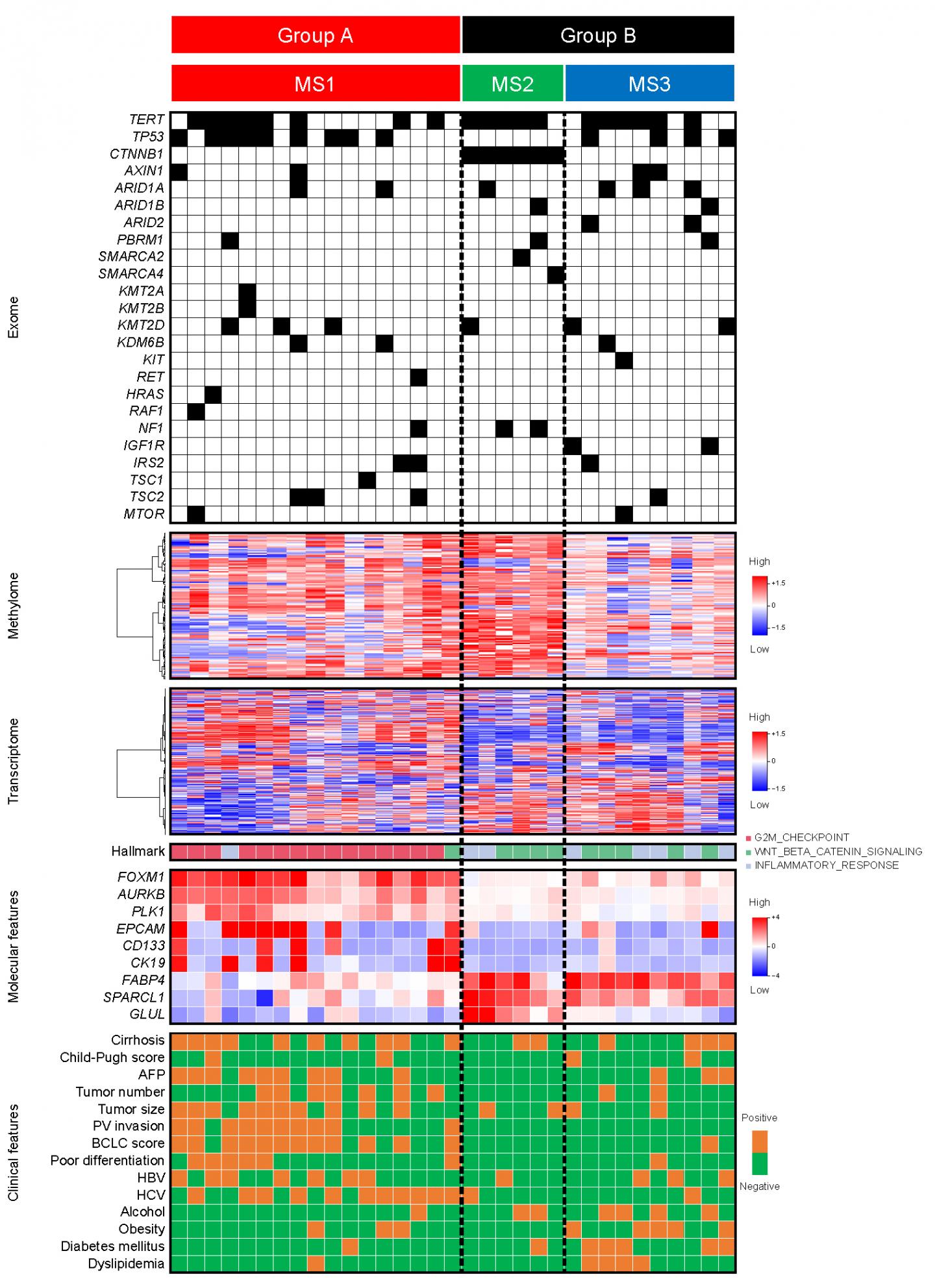
A Tokyo Medical and Dental University (TMDU)-centered research group has made a major advance in this field by combining data on mutations, gene expression patterns, and immunological status to shed light on the variation among cases of HCC. The study, recently reported in the journal EBioMedicine, reveals that there are actually three distinct types of this disease, which should help in predicting the prognosis of individual patients and treating them more effectively (Fig 1).

The team first extracted a range of data on 183 removed HCC tumor specimens and then used statistical analysis to see if they clustered together into specific groups with distinct features. They then tested whether their findings were supported by an additional analysis of data from 373 HCC patients, and also incorporated data on each patient’s characteristics such as their clinical course and overall outcome.

“We knew that we’d have to take a large number of different variables into account in order to establish clinically useful stratification of HCC,” corresponding author Shinji Tanaka says. He adds, “our combination of genomic, epigenomic, and transcriptomic data and immune system characterization provided new insights into this disease.”

Among the three types of HCC revealed by the observations, one included tumors with mutation in the CTNNB1 gene along with a suppressed immune system (Fig 2). Another featured tumors in those with metabolic disease, associated with conditions such as obesity, diabetes, and dyslipidemia, rather than having an association with hepatitis virus infection as typically found in other cases. Finally, in the third group, the tumors showed mitogenic features and chromosomal instability, and a worse patient prognosis (Fig 3).

“If we can use this new classification to group HCC patients according to their subtype, it should help us provide the specific treatment that’s best for them,” lead author Shu Shimada of TMDU says. “Our finding of a metabolic disease-related subtype is also particularly important given the rate at which diseases such as obesity and diabetes are becoming more and more prevalent.”

The article “Comprehensive molecular and immunological characterization of hepatocellular carcinoma” is published in EBioMedicine at doi: 10.1016/j.ebiom.2018.12.058.

###

Media Contact
Shinji TANAKA
[email protected]

Original Source

http://www.tmd.ac.jp/english/press-release/20190131_1/index.html

Related Journal Article

http://dx.doi.org/10.1016/j.ebiom.2018.12.058

Tags: BioinformaticsBiologyGeneticsImmunology/Allergies/AsthmaInternal MedicineLiverMolecular Biology
Share12Tweet8Share2ShareShareShare2

Related Posts

Sugar Molecules Offer Promising New Approach to Combat Drug-Resistant Bacteria

Sugar Molecules Offer Promising New Approach to Combat Drug-Resistant Bacteria

February 4, 2026
Unlocking History: Genetic Study of Deep Maniot Greeks Unveils a Unique Balkan Time Capsule

Unlocking History: Genetic Study of Deep Maniot Greeks Unveils a Unique Balkan Time Capsule

February 4, 2026

Enhancing ssDNA Templates for CRISPR Gene Editing

February 4, 2026

Adaptive Decision-Making in Naïve Animals: A Novel Unsupervised Model Inspired by Baby Chicks, Turtles, and Insects

February 4, 2026
Please login to join discussion

POPULAR NEWS

  • Enhancing Spiritual Care Education in Nursing Programs

    158 shares
    Share 63 Tweet 40
  • Robotic Ureteral Reconstruction: A Novel Approach

    81 shares
    Share 32 Tweet 20
  • Digital Privacy: Health Data Control in Incarceration

    63 shares
    Share 25 Tweet 16
  • Study Reveals Lipid Accumulation in ME/CFS Cells

    57 shares
    Share 23 Tweet 14

About

BIOENGINEER.ORG

We bring you the latest biotechnology news from best research centers and universities around the world. Check our website.

Follow us

Recent News

Racial-Ethnic Gaps in Preterm Infant Growth

Revealing Bacterial Pseudaminylation with Universal Antibody Tools

NCCN Marks World Cancer Day by Pledging Enhanced Updates to Patient Resources

Subscribe to Blog via Email

Enter your email address to subscribe to this blog and receive notifications of new posts by email.

Join 73 other subscribers
  • Contact Us

Bioengineer.org © Copyright 2023 All Rights Reserved.

Welcome Back!

Login to your account below

Forgotten Password?

Retrieve your password

Please enter your username or email address to reset your password.

Log In
No Result
View All Result
  • Homepages
    • Home Page 1
    • Home Page 2
  • News
  • National
  • Business
  • Health
  • Lifestyle
  • Science

Bioengineer.org © Copyright 2023 All Rights Reserved.