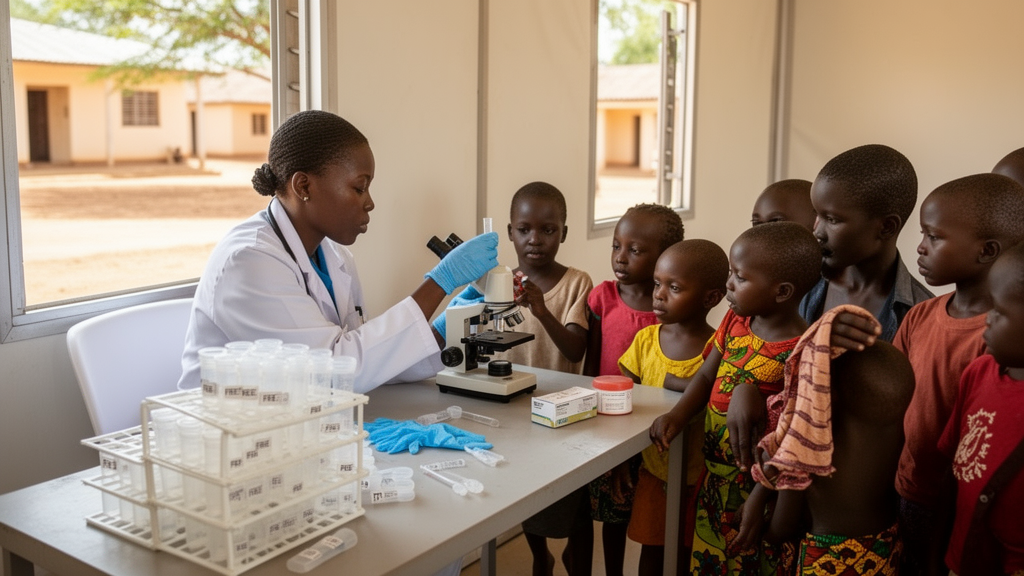
A cross-sectional study of 208 school-age children in the peri-urban districts of Chongwe and Kafue, Lusaka Province, Zambia, found that urogenital schistosomiasis was more prevalent in Chongwe than in Kafue. Investigators assessed infection using urine filtration microscopy, enzyme-linked immunosorbent assay (ELISA) and quantitative polymerase chain reaction (qPCR), identifying a geographic difference in prevalence between the two districts.
Microscopy detected 48 infected children: 34, or 70.8% of the positive cases, were from Chongwe, while 14, or 29.2%, were from Kafue. The distribution of microscopy-positive cases differed significantly between districts (χ² = 4.84; P < 0.05). Quantitative PCR showed the same pattern, with reported prevalence of 73.9% in Chongwe and 28.9% in Kafue. The qPCR difference was also significant (χ² = 13.52; P < 0.01). Together, the two laboratory approaches identified a greater burden of detected urogenital schistosomiasis in Chongwe among the children studied.
No significant association was observed between sex and infection status. Infection was, however, significantly associated with age across the study population. The investigators did not report an association between sex, whereas the association with age indicates that infection status was not evenly distributed across the children’s age groups in this sample.
The findings document ongoing transmission of urogenital schistosomiasis in the surveyed peri-urban districts, but the study’s design and geographic scope limit what can be inferred. A cross-sectional assessment provides a snapshot at one point rather than measuring how prevalence changed over time. It also does not establish why Chongwe had higher detected prevalence than Kafue, and the results cannot be assumed to represent all school-age children in Lusaka or Zambia. The researchers said the updated epidemiological information could help identify where surveillance and control efforts need strengthening and support planning and implementation within the World Health Organization’s neglected tropical disease agenda.
Subject of Research: Prevalence of urogenital schistosomiasis among school-age children in two peri-urban districts of Lusaka, Zambia
Article Title: Schistosoma haematobium infection among school age children in two peri-urban areas of Lusaka, Zambia: A cross-sectional study
Article References: Mutengo, M. M., Mwansa, J., Chisanga, K., Zulu, E., Mulunda, N. R., Muchinga, J., Rodríguez, E., Sánchez, S., Castro, L., Perteguer, M. J., Carmena, D., & Sotillo, J. (2026). Schistosoma haematobium infection among school age children in two peri-urban areas of Lusaka, Zambia: A cross-sectional study. PLOS Neglected Tropical Diseases, 20(10), e0014013. https://doi.org/10.1371/journal.pntd.0014013
Image Credits: AI Generated
DOI: 10.1371/journal.pntd.0014013
Keywords: schistosomiasis, Schistosoma haematobium, school-age children, Zambia, Lusaka, Chongwe, Kafue, cross-sectional study, qPCR, urine microscopy, parasite surveillance, Schistosoma
News Source: Ophelia Keating. (October 21, 2026). Cross-sectional survey of 208 children finds higher schistosomiasis prevalence in Chongwe. Scienmag.