• HOME
  • NEWS
  • EXPLORE
    • CAREER
      • Companies
      • Jobs
    • EVENTS
    • iGEM
      • News
      • Team
    • PHOTOS
    • VIDEO
    • WIKI
  • BLOG
  • COMMUNITY
    • FACEBOOK
    • INSTAGRAM
    • TWITTER
Thursday, May 21, 2026
BIOENGINEER.ORG
No Result
View All Result
  • Login
  • HOME
  • NEWS
  • EXPLORE
    • CAREER
      • Companies
      • Jobs
        • Lecturer
        • PhD Studentship
        • Postdoc
        • Research Assistant
    • EVENTS
    • iGEM
      • News
      • Team
    • PHOTOS
    • VIDEO
    • WIKI
  • BLOG
  • COMMUNITY
    • FACEBOOK
    • INSTAGRAM
    • TWITTER
  • HOME
  • NEWS
  • EXPLORE
    • CAREER
      • Companies
      • Jobs
        • Lecturer
        • PhD Studentship
        • Postdoc
        • Research Assistant
    • EVENTS
    • iGEM
      • News
      • Team
    • PHOTOS
    • VIDEO
    • WIKI
  • BLOG
  • COMMUNITY
    • FACEBOOK
    • INSTAGRAM
    • TWITTER
No Result
View All Result
Bioengineer.org
No Result
View All Result
Home NEWS Science News Chemistry

Creating patterns spontaneously in synthetic materials

Bioengineer by Bioengineer
March 24, 2021
in Chemistry
Reading Time: 3 mins read
0
IMAGE
Share on FacebookShare on TwitterShare on LinkedinShare on RedditShare on Telegram

IMAGE

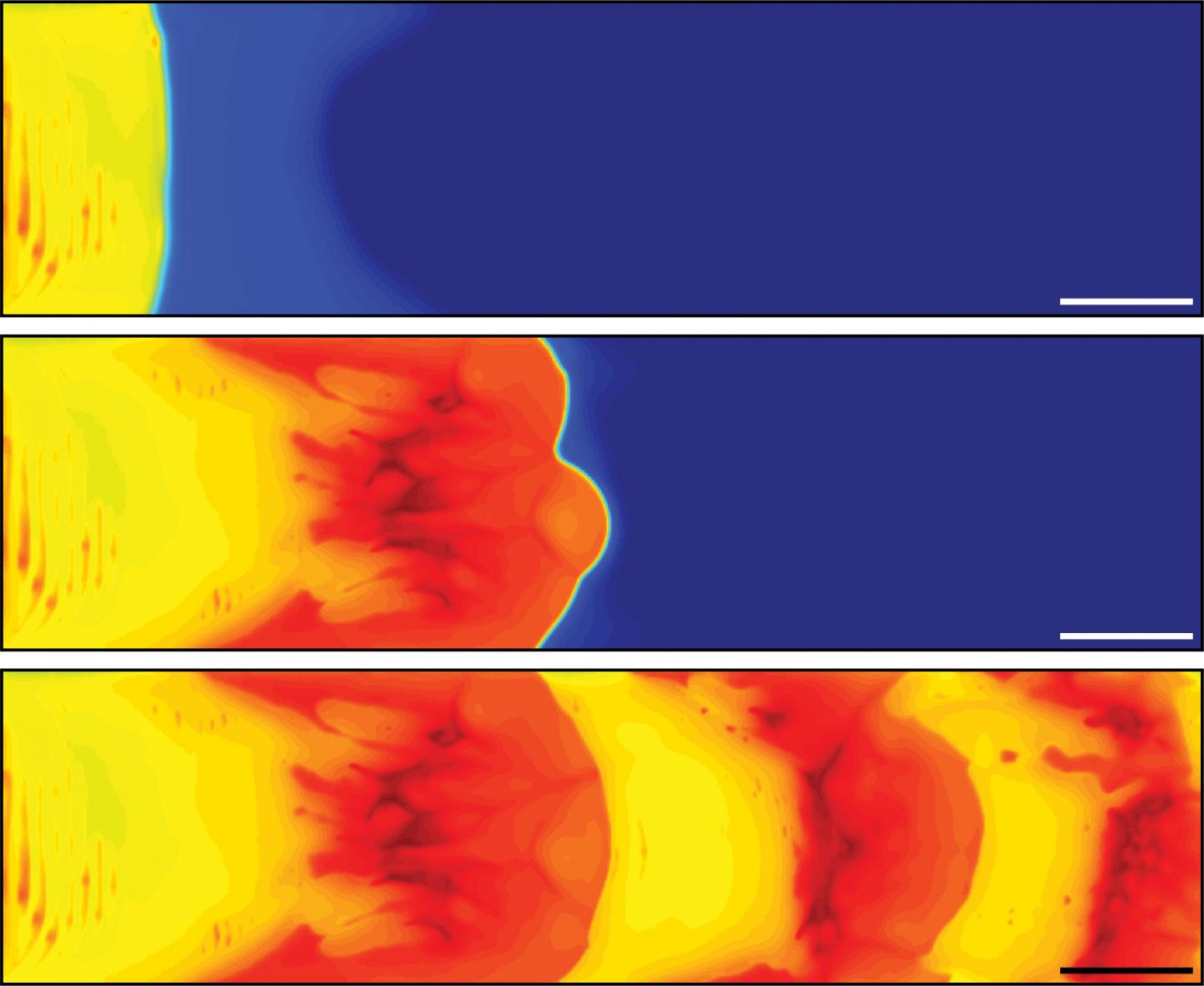
Credit: Adapted from ACS Central Science 2021, DOI: 10.1021/acscentsci.1c00110

Nature produces a startling array of patterned materials, from the sensitive ridges on a person’s fingertip to a cheetah’s camouflaging spots. Although nature’s patterns arise spontaneously during development, creating patterns on synthetic materials is more laborious. Now, researchers reporting in ACS Central Science have found an easy way to make patterned materials having complex microstructures with variations in mechanical, thermal and optical properties — without the need for masks, molds or printers.

In animals, patterns form before birth in response to genetically controlled signals that often vary in concentration along a gradient. In contrast, traditional manufacturing approaches for creating patterns and structures involve multiple steps, such as layer-by-layer assembly, lithography, molding or casting. Jeffrey Moore, Nancy Sottos, Philippe Geubelle and colleagues wanted to develop a spontaneous patterning method more akin to the biological process.

The team placed a solution of dicyclopentadiene monomer in a channel and then heated one end of the channel. The heat activated a ruthenium catalyst, which caused the monomer to polymerize, generating more heat that traveled down the channel. This continued to happen until all available monomer in the region was consumed. Eventually, heat traveled farther down the channel to a location where fresh monomer was present, and the process began again. With this technique, the team produced resins with regular ridges, and they controlled the height and spacing of the ridges by adjusting the initial temperature of the solution. By using a different monomer or adding other compounds to the solution, the researchers created materials with patterns of color and stiffness. The new method could someday be used to create a variety of new “smart” materials, from tire or shoe treads to electronics and biomaterials, the researchers say.

###

The authors acknowledge funding from the Air Force Office of Scientific Research, the Arnold & Mabel Beckman Foundation, the National Science Foundation and the Illinois Space Grant Consortium.

The paper’s abstract will be available on March 24 at 8 a.m. Eastern time here: http://pubs.acs.org/doi/abs/10.1021/acscentsci.1c00110

For more of the latest research news, register for our upcoming meeting, ACS Spring 2021. Journalists and public information officers are encouraged to apply for complimentary press registration by emailing us at [email protected].

The American Chemical Society (ACS) is a nonprofit organization chartered by the U.S. Congress. ACS’ mission is to advance the broader chemistry enterprise and its practitioners for the benefit of Earth and all its people. The Society is a global leader in promoting excellence in science education and providing access to chemistry-related information and research through its multiple research solutions, peer-reviewed journals, scientific conferences, eBooks and weekly news periodical Chemical & Engineering News. ACS journals are among the most cited, most trusted and most read within the scientific literature; however, ACS itself does not conduct chemical research. As a specialist in scientific information solutions (including SciFinder® and STN®), its CAS division powers global research, discovery and innovation. ACS’ main offices are in Washington, D.C., and Columbus, Ohio.

To automatically receive news releases from the American Chemical Society, contact [email protected].

Follow us: Twitter | Facebook

Media Contact
Katie Cottingham
[email protected]
Tags: BiotechnologyChemistry/Physics/Materials SciencesMaterialsTechnology/Engineering/Computer Science
Share12Tweet8Share2ShareShareShare2

Related Posts

Scientists Achieve Breakthrough in Molecular ‘Sandwich’ Assembly — Chemistry

Scientists Achieve Breakthrough in Molecular ‘Sandwich’ Assembly

May 21, 2026
Advancing In Vivo and In Situ Monitoring: Science Bulletin Highlights Host-Based Antifouling Gold Nanotube Sensor for Selective Detection of Mechanically Sensitive Serotonin Release in Intestinal Mucosa — Chemistry

Advancing In Vivo and In Situ Monitoring: Science Bulletin Highlights Host-Based Antifouling Gold Nanotube Sensor for Selective Detection of Mechanically Sensitive Serotonin Release in Intestinal Mucosa

May 20, 2026

How Magnetic Orientation Could Influence the Building Blocks of Life

May 20, 2026

Breaking a 200-Year-Old Belief: Novel Surface Design Achieves Two Distinct Wetting States on One Substrate

May 20, 2026
Please login to join discussion

POPULAR NEWS

  • blank

    New Study Reveals Plants Can Detect the Sound of Rain

    733 shares
    Share 292 Tweet 183
  • ESMO 2025: mRNA COVID Vaccines Enhance Efficacy of Cancer Immunotherapy

    303 shares
    Share 121 Tweet 76
  • Research Indicates Potential Connection Between Prenatal Medication Exposure and Elevated Autism Risk

    846 shares
    Share 338 Tweet 212
  • Breastmilk Balances E. coli and Beneficial Bacteria in Infant Gut Microbiomes

    58 shares
    Share 23 Tweet 15

About

We bring you the latest biotechnology news from best research centers and universities around the world. Check our website.

Follow us

Recent News

De Novo Design of Quasisymmetric Protein Cages

Rural Siblings of Individuals with Neurodevelopmental Conditions Face Unique Challenges Without Adequate Support

Stretch-Resistant Spoof Plasmonic Fabric via Fiber Buckling

Subscribe to Blog via Email

Enter your email address to subscribe to this blog and receive notifications of new posts by email.

Join 82 other subscribers
  • Contact Us

Bioengineer.org © Copyright 2023 All Rights Reserved.

Welcome Back!

Login to your account below

Forgotten Password?

Retrieve your password

Please enter your username or email address to reset your password.

Log In
No Result
View All Result
  • Homepages
    • Home Page 1
    • Home Page 2
  • News
  • National
  • Business
  • Health
  • Lifestyle
  • Science

Bioengineer.org © Copyright 2023 All Rights Reserved.