A curated research collection in the Journal of Materials Science: Materials in Medicine demonstrates how interdisciplinary advances in material composition, post-fabrication processing, and precision manufacturing are reshaping craniofacial reconstruction. The published contributions evaluate experimental strategies ranging from implant decontamination and porous structural meshes to injectable bioactive matrices, pro-angiogenic ceramics, and elevated-temperature metal forming.
Material processing and sterilization protocols were evaluated by Kunrath and colleagues, who conducted in vitro investigations into how standard clinical preparation methods modify dental implant surfaces. Although physical surface morphology and micro-roughness parameters remained stable across all tested sterilization techniques, chemical profiling revealed pronounced alterations following autoclaving and exposure to ultraviolet-C radiation.
The same investigation showed that autoclaving degraded the functional performance of hydrophilic implant surfaces, reducing their biological utility. Furthermore, exposure to ambient air following package opening diminished surface properties regardless of the initial sterilization method used, underscoring the sensitivity of surface conditioning during the transition from manufacture to surgical placement.
Addressing structural requirements in guided bone regeneration, Yanagisawa and co-workers developed bioresorbable dome constructs combining carbonate apatite granules with woven or knitted Vicryl mesh. Evaluated in a rabbit calvarial defect model, the architectural arrangement of the synthetic mesh directly governed tissue response and regenerative efficacy.
Constructs featuring a knitted mesh on the outer soft-tissue interface significantly enhanced appositional bone formation by establishing a barrier against unwanted fibrous tissue infiltration. In contrast, woven mesh configurations degraded earlier and permitted rapid fibrous connective tissue ingrowth into the graft zone, substantially restricting new bone formation and graft volume stability.
In the domain of rigid load-bearing reconstructions for the cranial vault, Daoush and collaborators synthesized ceramic-metal composite materials using spark plasma sintering. The researchers reinforced a Ti-12Mo-6Zr titanium alloy matrix with variable proportions of alumina ceramic to assess microstructural and mechanical adjustments.
Nanoindentation testing of these sintered composites demonstrated that incremental additions of alumina systematically elevated nanomechanical properties, yielding higher surface hardness and an increased Young’s modulus. These findings confirm the potential of spark-plasma-sintered ceramic-metal hybrids to withstand physiological stress in cranial reconstruction scenarios.
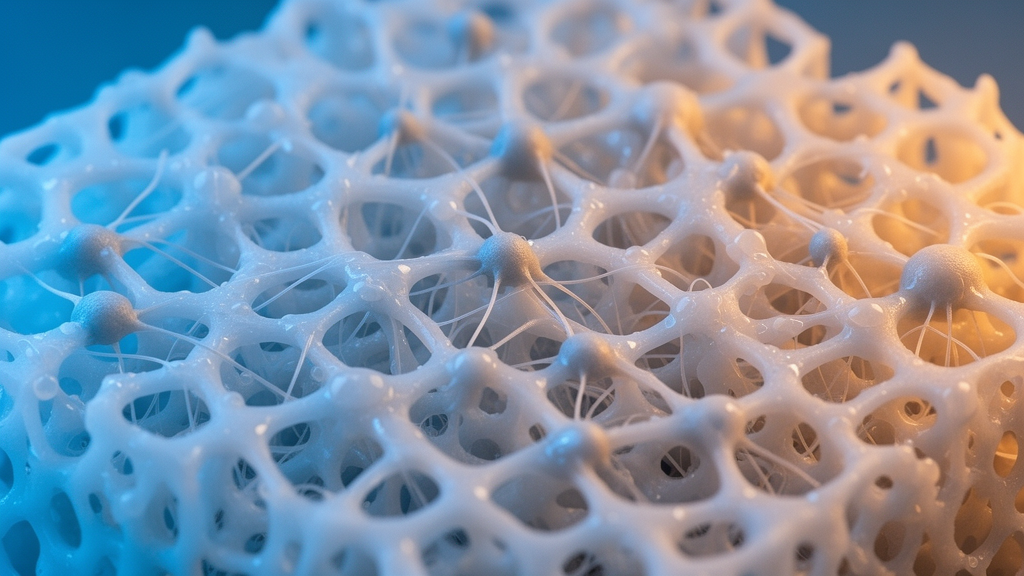
Targeting soft-tissue deficits where surgical invasiveness is a primary concern, Yu and colleagues engineered an injectable, self-assembling biomaterial combining activated plasma albumin gel with concentrated growth factors. The resulting crosslinked hydrogel exhibited a hierarchical nanofibrous architecture with uniform porosity and sustained biomolecule retention.
In laboratory assays, the injectable matrix delivered continuous growth factor release that supported the viability, proliferation, and migration of human periodontal ligament stem cells over an observation period of at least 14 days. When administered clinically for gingival black triangle reconstruction, the material facilitated successful interdental papilla restoration that remained functionally and aesthetically stable through six months of follow-up.
Investigating the physiological coordination between blood vessel development and mineralized tissue formation, Wang and colleagues examined nano-dicalcium silicate in vitro using human umbilical vein endothelial cell co-cultures and in vivo using animal bone defect models. The bioceramic stimulated endothelial cell proliferation, migration, and capillary-like tube formation.
Transcriptomic profiling via RNA sequencing confirmed that nano-dicalcium silicate upregulated gene expression across the MAPK and PI3K/Akt intracellular signaling cascades, which drive angiogenic activity. Subsequent in vivo implantation confirmed robust neovascularization within targeted bone defect sites, providing empirical support for material-driven angiogenesis-osteogenesis coupling.
Addressing patient-specific cranial implant fabrication, Choudhary and co-workers explored heat-assisted single point incremental forming applied to perforated AZ31B magnesium alloy sheets. By elevating process temperatures to 400 degrees Celsius, the team overcame room-temperature ductility constraints, optimizing tool geometry and parameters to achieve deeper forming profiles and reduced surface roughness for complex anatomical geometries.
Beyond empirical metal forming, computational simulations provided crucial insights into the mechanical behavior of the perforated AZ31B magnesium alloy during warm single point incremental forming. By applying finite element modelling to the 400-degree-Celsius forming process, investigators examined the distribution of stress, strain, and deformation throughout the sheet metal. These numerical evaluations helped clarify how optimized tool geometry and elevated processing temperatures mitigate the severe room-temperature ductility limitations characteristic of magnesium alloys. The resulting reduction in surface roughness and attainment of greater forming depths directly support the precision manufacturing of patient-specific cranial implants. Such digital simulations demonstrate how predictive modeling can guide the fabrication of geometrically complex metallic implants tailored to individualized anatomical reconstructions.
An overarching conceptual theme unifying this body of research is the decisive technological shift from passive structural biomaterials toward biointeractive, functionally engineered systems. Historically, biomaterials intended for craniofacial reconstruction were designed predominantly to offer inert physical containment or structural contouring. In contrast, modern craniofacial strategies increasingly demand materials that actively orchestrate biological events, including localized cell recruitment, guided migration, tissue-specific regeneration, and the induction of functional blood vessels. This biological modulation reflects a broader paradigm where physical matrices are deliberately engineered to communicate with host cellular systems. By providing biological cues alongside structural support, these advanced systems seek to restore complex craniofacial defects with superior biological integration and predictable therapeutic performance.
This biological responsiveness remains intrinsically vulnerable to downstream handling, highlighting the critical role of post-fabrication processing and sterilization protocols. Although material developers often focus extensively on bulk chemistry and initial surface micro-topography, the physical preservation of topography alone does not guarantee chemical preservation. Sterilization methods such as autoclaving and ultraviolet-C irradiation induced marked alterations in surface chemistry without disrupting baseline morphology or roughness parameters. Autoclaving proved particularly detrimental to hydrophilic dental implant surfaces, diminishing their biological functionality. Moreover, the subsequent observation that atmospheric air exposure after package opening impaired functional surface properties regardless of sterilization type emphasizes that translational success depends heavily on rigorous environmental control throughout storage, transport, and operating theater preparation.
In guided bone regeneration, the micro-architecture of synthetic resorbable meshes governs biological outcomes by regulating space maintenance and tissue compartmentalization. When evaluating dome constructs in rabbit calvarial models, spatial stabilization of particulate carbonate apatite was achieved only when the outer boundary successfully resisted soft-tissue pressure. Knitted Vicryl mesh placed on the outer aspect effectively excluded encroaching fibrous tissue while maintaining graft geometry, thereby fostering robust appositional bone deposition. In contrast, the more rapid degradation kinetics and looser structural weave of woven configurations permitted early fibrous invasion directly into the augmentation space. This premature cellular infiltration displaced graft granules, compromised space-making capacity, and severely restricted osteogenesis, establishing that textile geometry is as critical as material composition in guided regeneration.
For large-scale defects within the cranial skeleton, structural stability requires rigid biomaterials capable of bearing physiological mechanical forces. The synthesis of Ti-12Mo-6Zr titanium alloy composites reinforced with ceramic alumina particles through spark plasma sintering illustrates how hybrid metal-ceramic systems resolve mechanical demands. Nanoindentation measurements confirmed that increasing alumina ceramic fractions directly elevated both Young’s modulus and nanohardness across the composite matrix. These mechanical enhancements indicate that spark plasma sintering produces a dense, well-consolidated composite capable of resisting localized deformation. By combining the fracture resilience of titanium alloys with the wear resistance and stiffness of ceramic phases, these reinforced formulations provide a viable structural foundation for reconstructive procedures involving load-bearing segments of the cranial vault.
Parallel to load-bearing skeletal reconstruction, aesthetic and functional restoration of delicate oral soft tissues necessitates minimally invasive, injectable biomaterial formats. The engineered matrix based on activated plasma albumin gel self-assembled and crosslinked with concentrated growth factors illustrates this therapeutic direction. Exhibiting a hierarchical porous microstructure characterized by uniform nanofibrous architecture, the hydrogel created a protective biomimetic microenvironment. In vitro testing demonstrated that the matrix maintained sustained, localized growth factor release that elevated human periodontal ligament stem cell proliferation, migration, and viability over a minimum of 14 days. Clinically, direct injection of this bioactive autologous matrix into deficient interdental spaces achieved predictable gingival papilla regeneration, with functional volume and contour maintained stably throughout a 6-month clinical evaluation period.
The success of mineralized tissue regeneration relies fundamentally on the biological interdependence between microvascular network formation and mineralized matrix deposition. Investigations into nano-dicalcium silicate ceramics highlight how engineered biomaterials can deliberately stimulate angiogenesis-osteogenesis coupling. In endothelial co-culture models, the bioceramic provoked pronounced increases in endothelial cell migration, proliferation, and tubular organization. Mechanistic RNA sequencing demonstrated that this angiogenic cascade is driven by the transcriptomic upregulation of MAPK and PI3K/Akt signaling pathways, which serve as central regulators of vascular sprouting and cell motility. In vivo bone defect implantation confirmed that nano-dicalcium silicate constructs induce vigorous neovascularization within the defect bed, verifying that establishing robust blood vessel networks is an indispensable biological prerequisite for sustained, high-quality bone formation.
Ultimately, the synthesis of findings across these six investigations underscores that craniofacial reconstruction has transitioned into a highly convergent, multidisciplinary field. Realizing predictable clinical efficacy requires the systematic integration of fundamental materials science, molecular cell biology, and advanced digital manufacturing techniques. While laboratory characterization and preclinical defect models have demonstrated substantial improvements in material stability, bioactivity, and anatomical formability, bridging the gap between benchtop optimization and consistent clinical translation remains the central challenge facing regenerative medicine. Future progress will depend on harmonizing bioactive signaling mechanisms, precise post-processing sterilization standards, and patient-specific digital fabrication methods to reliably restore both functional integrity and aesthetic form in patients suffering from complex craniofacial defects.
Subject of Research: Advances in biomaterials and manufacturing technologies for craniofacial regeneration
Article Title: Advances in biomaterials and technologies applied in craniofacial regeneration
Article References: Asa’ad, F. (2026). Advances in biomaterials and technologies applied in craniofacial regeneration. Journal of Materials Science: Materials in Medicine, 37(1), Article 84. https://doi.org/10.1007/s10856-026-07105-3
Image Credits: AI Generated
DOI: 10.1007/s10856-026-07105-3
Keywords: craniofacial regeneration, biomaterials, tissue engineering, dental implant surfaces, sterilization protocols, bioresorbable mesh, alveolar ridge augmentation, carbonate apatite, spark plasma sintering, titanium alloy composite, activated plasma albumin gel, periodontal ligament stem cells, gingival black triangle, nano-dicalcium silicate, angiogenesis-osteogenesis coupling, single point incremental forming, magnesium alloy AZ31B, cranial reconstruction
News Source: Ophelia Keating. (November 19, 2026). Craniofacial Regeneration Studies Highlight Bioactive Systems, Scaffold Architecture, and Precision Forming. Scienmag.