• HOME
  • NEWS
  • EXPLORE
    • CAREER
      • Companies
      • Jobs
    • EVENTS
    • iGEM
      • News
      • Team
    • PHOTOS
    • VIDEO
    • WIKI
  • BLOG
  • COMMUNITY
    • FACEBOOK
    • INSTAGRAM
    • TWITTER
Monday, May 18, 2026
BIOENGINEER.ORG
No Result
View All Result
  • Login
  • HOME
  • NEWS
  • EXPLORE
    • CAREER
      • Companies
      • Jobs
        • Lecturer
        • PhD Studentship
        • Postdoc
        • Research Assistant
    • EVENTS
    • iGEM
      • News
      • Team
    • PHOTOS
    • VIDEO
    • WIKI
  • BLOG
  • COMMUNITY
    • FACEBOOK
    • INSTAGRAM
    • TWITTER
  • HOME
  • NEWS
  • EXPLORE
    • CAREER
      • Companies
      • Jobs
        • Lecturer
        • PhD Studentship
        • Postdoc
        • Research Assistant
    • EVENTS
    • iGEM
      • News
      • Team
    • PHOTOS
    • VIDEO
    • WIKI
  • BLOG
  • COMMUNITY
    • FACEBOOK
    • INSTAGRAM
    • TWITTER
No Result
View All Result
Bioengineer.org
No Result
View All Result
Home NEWS Science News Chemistry

Could vacuum physics be revealed by laser-driven microbubble?

Bioengineer by Bioengineer
July 9, 2019
in Chemistry
Reading Time: 2 mins read
0
IMAGE
Share on FacebookShare on TwitterShare on LinkedinShare on RedditShare on Telegram

IMAGE

Credit: M. Murakami

Osaka, Japan — A “vacuum” is generally thought to be nothing but empty space. But in fact, a vacuum is filled with “virtual particle-antiparticle pairs” of electrons and positrons that are continuously created and annihilated in unimaginably short time-scales.

The quest for a better understanding of vacuum physics will lead to the elucidation of fundamental questions in modern physics, which is integral in unravelling the mysteries of space exploration such as the Big Bang. However, to forcibly separate the virtual pairs using a laser’s electric field and cause them to appear not as virtual particles but real particles, the laser intensity required would be ten million times higher than what today’s laser technology is capable of. This field intensity is the so-called “Schwinger limit”, named a half century ago after the American Nobel laureate, Julian Schwinger.

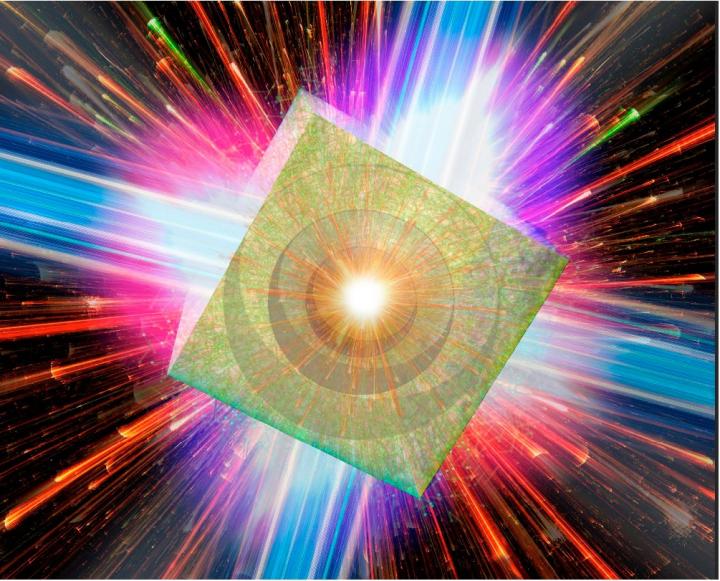
Scientists at Osaka University discovered a novel mechanism which they refer to as microbubble implosion (MBI) in 2018. In MBI, super-high energy hydrogen ions (relativistic protons) are emitted at the moment when bubbles shrink to atomic size through the irradiation of hydrides with micron-sized spherical bubbles by ultraintense, ultrashort laser pulses.

In this study, the group led by Masakatsu Murakami confirmed that during MBI, an ultrahigh electrostatic field close to the Schwinger field could be achieved because micron-sized bubbles embedded in a solid hydride target implode to have nanometer-sized diameters upon ionization.

From the 3D simulations carried out at the Osaka University Institute of Laser Engineering, they also found that the density during the maximum compression of the bubble reaches several hundred thousand to one million times solid density. At this density, something no larger than a lump sugar would weigh a few hundred kilograms. The energy density at the bubble center was found to be about one million times higher than that at the sun. These astonishing numbers have been thought to be impossible to achieve on Earth. Their research results were published in Physics of Plasmas.

###

About Osaka University

Osaka University was founded in 1931 as one of the seven imperial universities of Japan and now has expanded to one of Japan’s leading comprehensive universities. The University has now embarked on open research revolution from a position as Japan’s most innovative university and among the most innovative institutions in the world according to Reuters 2015 Top 100 Innovative Universities and the Nature Index Innovation 2017. The university’s ability to innovate from the stage of fundamental research through the creation of useful technology with economic impact stems from its broad disciplinary spectrum. Website: https://resou.osaka-u.ac.jp/en/top

Media Contact
Saori Obayashi
[email protected]

Related Journal Article

http://dx.doi.org/10.1063/1.5093043

Tags: Chemistry/Physics/Materials SciencesComputer ScienceNanotechnology/MicromachinesSpace/Planetary Science
Share12Tweet8Share2ShareShareShare2

Related Posts

Sharpening Our View of Bacteria — Chemistry

Sharpening Our View of Bacteria

May 18, 2026
New Drexel Study Reveals Key to Keeping Students on Track in Physics Learning — Chemistry

New Drexel Study Reveals Key to Keeping Students on Track in Physics Learning

May 15, 2026

Reversible Glue Technology Powers Up with Electric Activation

May 15, 2026

Sweet as Honey: Unveiling a New Heat Transport Regime in Ultrathin Semiconductors

May 15, 2026
Please login to join discussion

POPULAR NEWS

  • Research Indicates Potential Connection Between Prenatal Medication Exposure and Elevated Autism Risk

    844 shares
    Share 338 Tweet 211
  • New Study Reveals Plants Can Detect the Sound of Rain

    731 shares
    Share 292 Tweet 182
  • Salmonella Haem Blocks Macrophages, Boosts Infection

    62 shares
    Share 25 Tweet 16
  • Breastmilk Balances E. coli and Beneficial Bacteria in Infant Gut Microbiomes

    58 shares
    Share 23 Tweet 15

About

We bring you the latest biotechnology news from best research centers and universities around the world. Check our website.

Follow us

Recent News

Maternal Age and Pregnancy Heart Risks Explored

Hypoxic Burden Links to Bronchopulmonary Dysplasia Risk

Fossil Fuel Phase-Out: Challenges and Opportunities Under 1.5°C

Subscribe to Blog via Email

Enter your email address to subscribe to this blog and receive notifications of new posts by email.

Join 82 other subscribers
  • Contact Us

Bioengineer.org © Copyright 2023 All Rights Reserved.

Welcome Back!

Login to your account below

Forgotten Password?

Retrieve your password

Please enter your username or email address to reset your password.

Log In
No Result
View All Result
  • Homepages
    • Home Page 1
    • Home Page 2
  • News
  • National
  • Business
  • Health
  • Lifestyle
  • Science

Bioengineer.org © Copyright 2023 All Rights Reserved.